• Skip to primary navigation
  • Skip to main content
  • Skip to primary sidebar

Moreau Center Social Justice Programs

  • Home
  • Immersions
    • Affordable Housing
    • Border Immersion
    • Civil Rights
    • Community Organizing and Resistance (CORE) Immersion
    • Environmental Justice
    • L’Arche Bologna
    • Nicaragua
    • North Portland Civil Rights
    • Rural
    • Tanzania
    • Urban
  • Service Plunge
    • Blog Updates
  • Interns for Justice
  • Donate
  • Archived

National

Hope and Change Through Action

March 24, 2023 By Tyler

3/9/23

We started our last full day in Tucson by heading to Southside Presbyterian Church to listen to a presentation about sanctuary movements in the United States. We were given some history of the sanctuary movement in the 1980s, which was started after many people from El Salvador and Guatemala fled their country due to their repressive government. Many churches like ones in Nogales, Mexico & Arizona, and others near the southwest border provided support for those at risk for deportation just like Southside Presbyterian Church. These churches networked and united by lending hands to those in need by providing shelter, food, legal assistance, and other support they needed. We learned about how the U.S. enacted a law that allowed people fleeing to qualify for asylum status, but they failed to comply to their own law and deported many back to their country. Many churches that offered sanctuary were threatened, which pushed some churches to go public by inviting the media, so the victims at risk of deportation could tell their story. These sanctuary churches were safe havens for many needing assistance, in which the US failed to do. Today, there are over 100 places of worship in the U.S. declared as public or private sanctuaries dedicated to help those at risk of deportation. Not to mention, there was universities, states, and cities dedicated as sanctuaries too. This presentation showed us how people can come together in the face of adversity. 

The outside of Southside Presbyterian Church

We headed back to BorderLinks after the Sanctuary Coalition. The next two things in the itinerary were the Solidarity Workshop and Action Planning. We discussed with Josue how to stand in solidarity with people who have different struggles than we do. We also talked how this immersion can be more than just the week we spent in Arizona. This past week, we have been overwhelmed by a wide array of emotions, and it may be easy to feel hopeless against a system that deprives the lives of people that it so depends on. It is through consistent action and having conversations that challenge the status quo that we can hope to change how things are. We spent the last week immersing ourselves in the Tucson community by listening and having conversations with people whose life experiences were different than ours. I am grateful to have been part of this immersion, it has allowed me to experience the Tucson community with the people who call it home. Being the last full day, Josue had one more thing to show us.  

Near the end of the day on Thursday, we all got in the van and our delegation leader, Josue, drove us to one of his favorite spots in Tucson called Gates Pass. We drove up a winding road that brought us into the hills above the city. The hills were covered in Saguaro Cacti. We got out in a small parking lot that looked out over the desert in front of us . Josue told us that his favorite viewpoint was on a hilltop to the left of the parking lot. We followed him up a steep trail until we reached to the top. The view from there was incredible. You could see in all 360 degrees across the desert and back to Tucson below us. We spent quite a while at the top, taking pictures and joking around. Eventually, the sun started to set and the hills turned orange around us. It was a perfect way to wrap up the immersion together and enjoy the natural beauty of Arizona. 

-Yongxin Lin, Eduardo Gonon, and Benjamin Spillman 

Filed Under: Border, Border Immersion 2023

Have Compassion

March 24, 2023 By Tyler

3/8/23

As part of our activities today we had a DACAmented voices in health care presentation, where we discussed the additional barriers presented to non-U.S. citizens in the U.S. There were several things that stuck out to me. One of them was the pressure many feel to push aside any health concerns, often for the sake of work and or to make sure there is enough money for their children instead. To me, this spoke to the great lengths many will go to ensure a quality of life for their children whenever possible.  

Under our current healthcare system, it feels as though you are not deserving of care until you have the money for it. The basis for care is this not the inherit dignity and humanity of another person, but rather how many funds you have to offer.  

I find this reflective of the current immigration system and narratives of immigration. If we were to shift our focus and realize the humanity of those who are seeking aid, then suddenly you aren’t dealing with a scary and mysterious figure, you are approaching a person worthy of empathy and care.  

I have found it frustrating to think of all the different narratives and legislations that function because others have diminished the humanity and the struggles of migrants. On a more hopeful note, it was also inspiring to see art created by DACA recipients to add to and change the current narrative. Taking the time to reflect on various poems and artwork, we get a glimpse into someone else’s lives experience. While we may not share these experiences and thus not fully understand them, there is something powerful in connecting with someone through their vulnerability as they share their story.  

The last thing this brings me to is compassion. To paraphrase, Alok Vaid-Menon, a non-binary activist, has stated that people should focus more on compassion than comprehension. While this was said in a conversation about supporting trans and non-binary people, we reflected on the words as it could relate to the topic of immigration. Though my parents are immigrants, and thus I am a little familiar with the immigration process, this does not mean I have a full comprehension of what it is like to cross the border or live in the U.S. without documentation. However, I don’t need that comprehension to have compassion.  

This sense of compassion is what I leave with after today. If there is one thing I could offer to anyone who wishes to increase their knowledge and understanding of issues affecting migrants, I would say to focus on that compassion. I truly believe by doing so we can think of and act for solutions to build a brighter and united future rather than building literal and metaphorical walls between one another.  

Cindy Garibay

Filed Under: Border, Border Immersion 2023

Desert Walk and Casa Mariposa

March 24, 2023 By Tyler

3/07/2023

Our day began with a walk in the desert. When I first pictured it in my head, I thought we would be walking around an area with nothing else other than sand and occasional cacti. I could not have been more wrong with this assumption. 

We took the walk through the desert area surrounding Arivaca Lake. With the terrain, this walk turned more into a hike. There was dry grass everywhere, hills, dry plants that would scratch you as you walk by, and different types of cacti. We started earlier in the day but as we went on our trek grew hotter and hotter. I grew more thirsty as we went on, even though I had a full water bottle with me. By the time we were done with the hike, I had already run out of water. 

At the end of our journey, we came across a drop-off point with many jugs full of water, as well as a bucket filled with easy-to-open canned foods. Seeing this in person was such a surreal moment that could not be explained with words. We were told by our BorderLinks leader that this site was one of the most (if not the most) used in the area, hence the amount of food and water present.

This experience made me realize the importance of humanitarian aid. Later on in the day (which will be discussed in detail later in this post), we watched videos showing how border patrol directly fuels the missing person crisis regarding immigrants. We were shown footage of these people dumping out water from jugs left for immigrants by samaritans and/or organizations like No More Deaths. I had no words after seeing this. How can someone do something so cruel, so inhumane? How can they throw away the food left for migrants to eat? 

—

After coming back from Arivaca Lake and the desert walk, we visited Casa Mariposa where we were greeted by Kat and Rocío. We introduced ourselves to them and they began to tell the story of Rocío. As we were listening to her story, we gained a better understanding of what life was like for someone in a detention center. More often than not, people who are sent to detention centers are usually held there a lot longer than they are told, and they are held on high bonds that are usually impossible for the people being held there to pay. In addition to not knowing how long they will stay there, the living conditions are often such that we would consider them unbearable. These detention centers are often referred to as “hieleras” which translates to coolers because of how cold these places can be. 

Thanks to the help of Casa Mariposa, however, they have given people the opportunity to create relationships with people outside the detention center and in some cases even receive donations to help pay bonds. It is hard to imagine just how much of an impact organizations like Casa Mariposa can have on people who feel like their situation is completely hopeless. We learned that even the smallest actions can make all the difference in the world to someone trapped inside one of these detention centers. 

At the end of the presentation by Casa Mariposa, they offered us the opportunity to write letters to people who are currently in detention centers so that we could participate in the effort to give support to those people. We were also offered the option to leave our home address on the letter so that if they want to they can send a letter back to us and keep in touch. 

After having dinner, we had our workshop where we watched videos discussing border patrol and how they are fueling the missing persons crisis. From purposely sabotaging humanitarian aid for people crossing the desert to chasing migrants into the desert with harsh conditions such as dangerous terrain during nightfall. Helicopters have even been used before to try to chase migrants in remote or dangerous areas of the desert. Overall, these migrant-border patrol encounters often end in some sort of conflict that becomes detrimental to migrants. 

After having our reflection that night, we concluded that although immigration issues seem hopeless to fix, we can see that small actions can have a huge impact. For example, we have seen that humanitarian aid is widely used across the desert and small efforts through organizations like Casa Mariposa can completely change someone’s life. This gave us some hope for a future where change is possible and justice exists.

-Kaylee Gunderson

Filed Under: Border, Border Immersion 2023

The Border

March 22, 2023 By Tyler

During our Monday morning, we visited the Nogales, Arizona border, and we had a first hand experience to be able to stand next to the wall.  

A view of the US-Mexico Border

Andrea Gonon: “We got to meet Don Manuel, and he gave me us a better inside on how families are separate on the border. What really touched me was how families would celebrate birthdays from both sides of the wall. It’s clear to me that the wall doesn’t take away the love that families have for each other.” 

Jorge:  “Media make this huge deal about the border being this huge infrastructure that needs to be protected all the time. That border towns are places where constant fighting needs to be done to protect the “American dream and values” One needs to experience the border first-hand to understand the toxic myths media has inculcated to our perception of it. Being able to have the privilege to see and feel the wall up close made me realize that this wall is not here to secure our country, it is here to create a physical and metaphorical barrier blocking the migration of people, animals, and nature overall that have existed before the birth of the U.S. The U.S. antagonizes migration and calls it a “crisis” which is ironic because our current “migration crisis” has been caused by the negative interference of the U.S. government in many Latin American countries when it comes to their socio-political climates. If you have the resources to do so, visit border towns. Learn about their history and impact of the physical border, learn about the original people of the land. Do not fall into this ciclical mentality of the “migration crisis” created as a scare tactic from the government. Make your own opinions about the border.  

Migration is part of our daily lives. Migration is natural. Migration is beautiful.” 

-Andrea Gonon, Jorge Salazar

Filed Under: Border, Border Immersion 2023

Tucson Art and Culture

March 22, 2023 By Tyler

Sunday, March 5th, 2023

Throughout day one, we really enjoyed our exploration of the connection between the
history and art of the area. We started the day with orientation, had lunch as a group, and then
went to the Tucson Art Museum. There was an artisan market outside with lots of vendors that
showcased different types of art in Arizona. Along with the variety of cultures that surround the
area and art from those cultures, something that stood out to us was that everything was written
in both English and Spanish, whether that be informational descriptions of the art or signs
around the city as well. It was really nice to see that inclusiveness in language to accommodate
everyone since they are both prominent languages in Tucson.


Inside the museum there was an exhibition of ancient Latin American art next to an
exhibition of colonial art. It was interesting to see how the art highlighted different aspects of
early Latin American culture, and how colonialism made an impact on them. This serves as a
reminder that art has always served as a form of expression which in hindsight can show us the
values of a culture or group during a specific time. Even though the post-colonial art was
reflective of European styles, it also maintained certain aspects of early Latin American culture.
The artists made their own art, and this reminded us of how different cultures can influence each
other to create something new that celebrates both.

Coyota Koshares art piece from the Tucson Art Museum


My favorite piece of art at the Tucson Art Museum was in their permanent indigenous art
exhibition. A mixed media lithograph titled “Coyote Koshares (four figures with watermelon)” by
Harry Fonseca, a Hawaiian, Portuguese, and Nisenan artist stood out to me. This particular
piece is a serigraph layered with glitter and bursting with bright, joyous colors. The work utilized
vibrant colors and featured four cartoonish, whimsical coyotes in jeans and high top sneakers
each eating their own rind of watermelon. Their backdrop was equally as beautiful, featuring
flowers and a pastel rainbow. Apart from its visual appeal, the piece is a representation of
indigenous storytelling through the eyes of the artist. The coyote was featured, as is in many of
his works, as a homage to this animal which has a tremendous cultural significance within the
Nisenan tribe. They most often portray trickery and have a great importance in the culture,
particularly throughout traditions and stories. To portray them in this playful manner was
Fonseca’s way of highlighting the magic, drama, and beauty of Nisenan story telling.
Another interpretation of the image came by making a connection between the coyotes
in the painting and the traffickers that bring immigrants illegally into the United States. People
also refer to them as coyotes since these animals operate in groups, using the cover of the
night. An immigrant may trust a coyote for help in navigating the desert, but there is a risk. Many
immigrants have been abandoned in the desert by their coyotes, or fallen victim to human
trafficking or different types of abuse from them. Coyotes have been known to charge
immigrants high tariffs from $4,500 – $10,000 dollars, which many migrants pay in the hopes of
a new life. The painting shows these coyotes enjoying a slice of watermelon within a jovial
background, but they are still coyotes and their expressions may or may not come across as
devious.

Some of the Border Immersion participants in front of a mural in Tucson


Afterwards, we came back to Borderlinks to do a history activity on immigration and the
conversation that followed was really nice, as our group has people full of different backgrounds
related to the subject. We are really excited for the coming days and the value in experiences
that this immersion has to offer!

-Kylie Riggles, Andrés Dankel, Yeidi M. Ramos

Filed Under: Border, Border Immersion 2023

Serving and Talking with Birmingham’s Changemakers

June 1, 2022 By liwanag

On our first full day in Birmingham, we had the opportunity to meet with groups who are intimately aware of the issues their communities face and working to address them. We started our day at Build UP, a nonprofit designed to to address the failings of Memphis schools by providing low-income youth in the Ensley and Titusville communities career ready skills and education. The area BuildUP established was the first place in Alabama where African Americans could own land, but at Build UP’s founding, only 82% of residents were renters. Home ownership is one of the best ways to build equity and wealth, but intergenerational poverty, a history of racist policies, and income inequality has prevented many African Americans from entering the housing market. Build UP empowers youth by teaching them financial literacy and hands-on skills, while providing a robust education and paycheck. They learn practical skills by working on abandoned homes that Build UP acquires and turns into like-new duplexes that students take ownership of when they graduate with a zero percent interest loan. 

When we arrived, we were greeted by Build UP’s founder Mark Martin and toured the space. The school was just moved into this new location where they have a full workshop, many classrooms, and a shared space with another nonprofit, providing an athletic program. The building was still being finished, so we had the chance to help with projects needing to be done. The group split up to work on different projects around the building and we helped paint, garden, and hang ceiling tiles. I relished the chance to do some hands-on work and was glad to contribute, albeit only a little. After a few hours of work, we had lunch with the students and teachers who were working on a new community garden. 

After lunch, we went to City Hall and met with the Division of Social Justice and Racial Equity. This small but mighty team was established by Birmingham’s Mayor Randall Woodfin to ensure that the city’s operations, policies, and decision-making are equitable and just. This conversation was by far my favorite experience so far because we got to hear about the current efforts being made at the governmental level to address the lasting legacy of racism in Alabama. One of the most impressive pregrams they’ve established is called ACE, the Academy of Civic Engagement. The central goal of the initiative is getting residents directly involved and engaged with their local municipal government. They aim to bring everyday citizens together for a deeper understanding of how the City is working for them and prepare residents to go out into their communities to act, serve, and lead. Getting people aware and involved in local government is so important. Learning about the role that they have played in getting the people of Birmingham engaged has given me ideas for how we can implement similar efforts in Portland and other cities.

-Nicole Rooney

Filed Under: Civil Rights Immersion 2022

Reverence & Rejoicing

May 25, 2022 By liwanag

On our first full day in Memphis, TN (May 16th), we arrived at the Memphis Branch of the National Association for the Advancement of Colored People (NAACP) to meet with Ian Randolph, Chair of the Political Action Committee. Ian is committed to getting people to vote, and he highlighted his emphasis and focus on issues (e.g., voting rights) rather than candidates or parties. He also reminded us that voter disenfranchisement efforts persist to this day. Ian explained that Tennessee residents recently voted to require firemen, police officers, and emergency personnel to live within the county they serve, but the Tennessee state legislature overrode the decision in direct opposition to what the voting community wanted – a clear violation of democracy. This modern-day example illustrated how policy and ideology continue to work hand in hand; its connection to historic battles over ideology pertaining to the control of Black bodies was abundantly clear. After concluding our meeting with Ian at the NAACP, we spent much of the afternoon exploring the National Civil Rights Museum, built around the former Lorraine Motel, the site of the assassination of Martin Luther King Jr. on April 4, 1968.  

The next day (May 17th), our group drove to rural Mississippi to complete the Emmett Till Pilgrimage. We had the opportunity to speak with Benjamin Saulsberry, the Public Engagement and Museum Education Director at the Emmett Till Interpretive Center in Sumner, MS, and Mayor Johnny B. Thomas of the Emmett Till Historic Intrepid Center (E.T.H.I.C.) in Glendora, MS.  We strongly encourage readers to educate themselves about the brutal murder of 14-year-old Emmett Till, but in brief, our pilgrimage took us to the locations where two white men tossed Emmett Till’s body over the Black Bayou Bridge (Glendora, MS) and where the men were tried, but ultimately acquitted by an all-white, male jury (Sumner, MS).  

One recurring theme our group discussed was the importance of being present, intentional, and reverent when visiting and learning about key historical sites in the civil rights movement. Many of us expressed disappointment and frustration after observing other visitors who appeared to rush through the historical exhibits without any obvious attention to the featured content, or who thought it was appropriate to take “selfies” at significant assassination and murder sites.

Both of these two days presented heavy information, leading us to reflect on the injustices of the past and present. The end of each day however presented more joyful moments. After the National Civil Rights Museum, we took the time to explore Beale Street, a historic area known for a lively culture filled with energetic music, delicious food, and unique shops. The street was alive with energy as people walked all around, enjoying the warm sunny weather. Some sat down to enjoy the beats of live music or filled various buildings identified by their eye-catching neon light signs. We couldn’t help but be captured by the captivating energy that surrounded us. 

Similarly, following our pilgrimage to rural Mississippi to visit the Emmett Till Interpretive Center and Emmett Till Historic Intrepid Center, our group dined in Central BBQ, a top-rated spot for BBQ in Memphis. Surrounded by the rich smells of slow smoked Memphis-style BBQ, the talkative restaurant environment, and the company of one another, once again, we could not help but smile and enjoy the warm atmosphere while digging into a delicious plate of food. 

One might not think that the more joyful end to our days would have an immediate connection to the history we have learned about, and yet in some ways it is not so far removed from it. While visiting the Emmett Till Historic Intrepid Center, we learned about King’s Place Juke Joint. This space boasted a lively weekend life where Black people could escape racial discrimination and direct their energy to socialization, music, and joy. This is merely one example of a location that hosted many moments of celebration and community within an identity that was all too often devalued. In the context of living in a society that tells you your identity, culture, and personhood are not of value, moments of joy and celebration become personal acts of resistance. So, we take a moment to recognize that the same melting pot of Memphis music (delta-blues, jazz, rock ‘n’ roll, R&B and gospel) that spreads entertainment and jubilance to eager crowds walking down the street today has historical roots in expressions of melancholy, anguish, and defiance. These elements do not work against each other, but rather are linked to one another. 

While it is important to make time for deep reflection and painful history, we should remember that there is a time and place to find joy and celebration, sometimes even at the same time. Though there are still many battles being fought, stopping to rest and look back reveals hard earned progress. In describing his work with the NAACP, Ian had told us “keep your mind on the future…don’t expect the good things tomorrow” and so we add: take the time to enjoy the good things today.

~Cindy Garibay & Dr. Lauren Berger

Filed Under: Civil Rights Immersion 2022

Segregation cannot hold them down

May 16, 2022 By liwanag

Saturday, May 14, 2022

During our packed day of exploring and learning about the Civil Rights Movement, a common theme at the Birmingham Civil Rights Institute was the impacts and processes of dismantling segregation. The above quote, delivered to us via an intro video presented before entering the exhibits, explained the strength and power that black communities had during times of segregation. Black communities established community spaces, schools, and churches that were integral not only for building community with one another, but for planning civil rights protests and boycotts. As the video finished and the screen lifted, the beginning of the exhibit was revealed, starting with two water fountains labeled “colored” and “white”, giving us a very clear visual of what segregation was like for people living during this time. As each of us walked through the museum deeply reflecting on the images, words and exhibits that were presented to us, we discovered the intense level of planning, courage, and persistence each individual had in this process. 

For some of us, learning the role that kids had in the movement was deeply striking, considering that this tactic was deemed effective; the images of children being arrested and put into jail by police officers impacted the community on a different level. Another moving piece of history was learning about the children in Kelly Ingram Park who were peacefully protesting against segregation. They were viciously attacked with high pressure fire hoses and violent police dogs. The part of the exhibit that explained this event in history overlooked the park, which was our next stop. 

At the park, we saw statues dedicated to these children, showing us the fire hoses used against them, along with the fear and dedication in their faces. The dedication that these incredible young people had in this movement inspired us to continue to use our voices and stand against the injustices happening currently in our world. 

Next, we visited the 16th st. Baptist Church where a horrific bombing occurred on September 16 1963, killing 4 young girls; Addie Mae Collins, Carol Denise McNair, Carole Rosamond Robertson and Cynthia Dionne Wesley. Sarah Collins, a sister of one the victims, was also injured. It’s impossible to imagine the level of hatred and violence that an individual has to be able to bomb a church full of innocent people, but unfortunately this was a common occurrence across Birmingham. This occurrence was so common that Birmingham was called “Bombingham”.  

After the 16th street Baptist Church, we changed up the content of history by visiting a Queer History exhibit, put on by the Invisible Histories Project. This non profit works to preserve, collect, and make accessible the Queer and Trans history of the Deep South. The Gay Rights movement was connected to the civil rights movement by how individuals were inspired to use the same strategies of fighting for equality. There was even an overlap in activists who participated in both movements. This exhibit brought joy and laughter into our day after focusing on some heavy topics. As important as it is to sit with the heavy information it is just as equal to learn about the resilience and radical pride that communities had throughout history. 

We ended our day with some delicious local ice cream and an unexpected rainstorm which resulted in a very wet but energetic game of basketball back at home. 

As we stepped away from this emotion filled day we are taking with us how communities can rise to build resilience and not let acts of violence take their power away. 

-Sonya Slyapich and Sophia Riccardi

Filed Under: Civil Rights Immersion 2022

Slavery’s Legacy

May 16, 2022 By liwanag

Wednesday, May 11, 2022

The Legacy Museum provides a history of the United States with a focus on the legacy of slavery. From the Transatlantic and Domestic Slave Trade and Reconstruction, the museum provided not only a lot of history, but narratives and powerfully interactive content. Lynching, codified racial segregation, and the emergence of over-incarceration in the 20th century that continues today are connected with our country’s legacy of slavery in the museum as well as the Peace and Justice Memorial.

From the exhibit that begins with crashing waves and beautifully eerie music, we were quickly immersed in the historical truth we were about to be told. One of the first few rooms we walked through contained cages with silhouettes in them. These silhouettes turned into a projection of an enslaved person when you walked up to the bars of the cage. They told you a small piece of their story as they waited to be auctioned off. In one of the cages, two young children called for their mother, while in another, a woman sang a sad, soulful hymn.

Photo credit: Art Journal Open

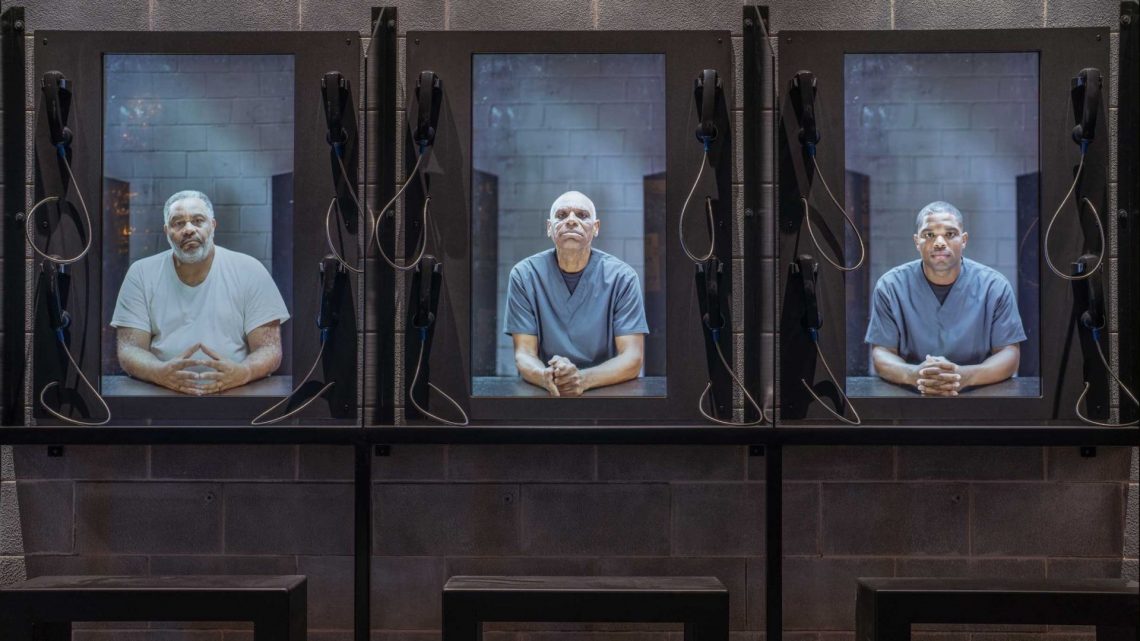
Towards the end of the museum is an exhibit on mass incarceration that features voices of people who have been wrongly condemned, unfairly sentenced, and unjustly treated in the American legal system. We saw stories of children prosecuted as adults and those suffering brutal conditions in some of our nation’s prisons and jails. There was a wall of letters from prison and a series of recorded video of actual people who had spent time in prison that were incredibly powerful. One letter was a person pleading for help for one of his fellow inmates who had life in prison without parole. Instead of asking for help for himself, he was only concerned with getting legal help for his fellow inmate. One of the the people in the videos talked about being falsely imprisoned as a 16 year old and the decade that he had lost in prison, all the lost experience and time with family and friends.

Photo credit: The Legacy Museum

These two exhibits amongst so much at this museum weighed heavily on our group. It conveyed to us the ways in which oppression and racism are interwoven into the fabric of America that is held together by white supremacy. A young man working for the Equal Justice Initiative named Solo said to us that Abraham Lincoln may have won the Civil War, but the ideological battle that occurred during the Reconstruction years was lost to white supremacy. The war that America faces today is an ideological one that activist groups and people who care for justice cannot lose again. The Equal Justice Initiative through their Legacy Museum, Peace and Justice Memorial and other educational outreach seek to educate Americans on the throughline between the history of slavery to where we are today. An honest reckoning with this history and legacy are necessary to create the racially just country we seek to see.

-Sav Baird and Tyler Wagner

Filed Under: Civil Rights Immersion 2022

Dexter Avenue King Memorial Baptist Church

May 16, 2022 By liwanag

Monday, May 9, 2022

Today, our group met a wonderfully kind and intelligent woman named Wanda at the Dexter Ave. King Memorial Baptist Church. During our time with Wanda, she created a safe space for us to learn and engage with one another at the very same church Dr. King once preached at. 

One thing she said stuck out to me as I sat there, soaking in all the history, memories, and knowledge that Wanda shared with us. She had been discussing activism and social justice when she told us that you have to ask yourself is the cause great enough to accept the cost. She told us how Dr. King experienced heavy costs from constant high levels of stress to internal and external pressures for the cause of civil rights. Despite what ended up costing him his life, Dr. King was dedicated to equal rights and to achieving these rights through nonviolent means despite the constant violence he and the Black community faced every day.

I suppose you have to ask yourself if you can handle everything that comes with stepping out into the limelight and speaking your mind. Dr. King was willing to accept the cost, can we?


-Sav Baird

Filed Under: Civil Rights Immersion 2022

  • « Go to Previous Page
  • Go to page 1
  • Go to page 2
  • Go to page 3
  • Go to page 4
  • Interim pages omitted …
  • Go to page 12
  • Go to Next Page »

Primary Sidebar

  • Facebook
  • Instagram
  • Twitter

Contact Us

Moreau Center
St. Mary's Student Center, MSC 162
5000 N. Willamette Blvd.
Portland OR 97203

T: (503) 943-7132
E: moreaucenter@up.edu

Hours: 8:30am-4:30pm
Monday-Friday

Copyright © 2026 · News Pro with Full Header On Genesis Framework · WordPress · Log in