• Skip to primary navigation
  • Skip to main content
  • Skip to primary sidebar

Moreau Center Social Justice Programs

  • Home
  • Immersions
    • Affordable Housing
    • Border Immersion
    • Civil Rights
    • Community Organizing and Resistance (CORE) Immersion
    • Environmental Justice
    • L’Arche Bologna
    • Nicaragua
    • North Portland Civil Rights
    • Rural
    • Tanzania
    • Urban
  • Service Plunge
    • Blog Updates
  • Interns for Justice
  • Donate
  • Archived

National

5/12/2024

May 15, 2024 By savoia

Today, we saw the end of the border. This experience made me more aware of the humanitarian crisis that many migrants are facing. People migrate for various reasons, including lack of resources, domestic violence, and threats to their lives. However, this crisis has often been unrecognized due to the presence of a negative culture that portrays them as criminals. I became aware of the presence of this culture, as I saw that significant investments have been made in surveillance technology and border expansion, but not so much into organizations that help migrants, such as Samaritan. 

During our trip, we also visited Las Milpitas Community Farm, where we heard the story of a Mexican migrant. Her story highlighted the discrimination that migrants often face in public spaces, including in healthcare services. Obtaining good quality healthcare is very important for migrants because their lack of accessibility of resources through their way to their destination countries, negatively affects their physical and mental state. One thing that has affected their mental state is their lack of documentation because it makes them constantly fear being deported. This negatively affects their ability to build relationships because they feel obligated to hide their identities. Listening to her story, also made me aware of additional struggles that migrants might  face. One of her children has autism, and has been told that it is very necessary for them to socialize. This incentivized her to be involved in her community. She has not only worked at this community farm, but also has worked at ensuring that migrants know their rights. This made me realize that the negative culture towards migrants prevent migrants from being seen as contributors.
Filed Under: Border Immersion 2024

5/11/2025

May 15, 2024 By savoia

It’s one thing to know about it and a completely different thing to see it. Today we had the opportunity to drive down to the US-Mexican border. On our way down we stoped for a water drop. Due to the Prevention Through Deterrence policy, which began in 1994, crossing the border has become more dangerous than ever. Because of this many individuals are forced to take more dangerous routes across the border. This results in longer trips, which can cause people to get lost due to border patrol interference and rugged terrain. No More Deaths, Tucson Samaritan’s and other organizations place water jugs in the desert. The water that is placed is life saving as this is one of the only sources of clean drinking water for a lot of migrants. However, when ICE agents find these water jugs, they will dump out the water and or confiscate it (but usually the latter). This practice is inhumane and disgusting but it unfortunately happens every day. 

After, we drove down to Nogales, a community that is divided by the wall. And I saw a scene that will stay will me for ever. I saw small fingers clinging to the wall. Eyes peeping through the holes. I want all of you to imagine being so close to your loved ones and still being so far from an embrace. That is the reality of so many. That is the purpose of a wall, to divide, to separate and to keep people far from each other. Razor wire and other fencing has been added in recent years to keep people from gathering. To keep people from participating in what makes us human, being together.

Later we had the opportunity to talk with Manuel. Manuel explained how the wall has slowly become bigger and been intentionally designed to keep people apart. Manuel lives in Nogales on the Mexican side, every time he crosses he must go the roundabout way to enter through the port of entry. While sharing his experience Manuel also told us the a story that made my blood boil. This is the story of Jose, a 16 year old boy on Mexican side. An ICE officer shot him 16 times on October 10th, 2012. The forensic report found that Jose had already been murdered by the 3rd shot. Jose was unarmed and not in US jurisdiction. Because of the organization of community members and not because of the law of the land, the ICE agent was taken to trial and found innocent; history has shown us time and time again, the lives of BIPOC mean nothing, we are seen as disposable as if we don’t have dreams. Are simple act of being is a seen a threat. BIPOC individuals continue to be taken from us and our aggressors are not held accountable. Again, the ICE agent was incorrectly pronounced innocent, while at the same thousands of immigrants are being criminalized for seeking a better life every day. 

The idea that we simply need immigration reform is a clear lie. It is not enough to reform immigration, it is not enough to demand more training. What is needed is the removal of the system altogether. The wall must come down and ICE must be abolished. That is what justice means and what we must do to protect our community. 

In solidarity,

Haniel and friends

Filed Under: Border Immersion 2024

5/10/2024

May 12, 2024 By savoia

Today was our second full day at the Borderlinks facility and it was spent learning the background and context for what we will be doing for the remainder of our time here. The first activity of the day walked us through the the United States’ history of citizenship, immigration, and borders. From it’s conception, the US has had shifting, but clear, stances on who is and is not an American. From the erasure and genocide of the Indigenous peoples that existed long before Europeans arrived, to enslavement of Africans, exclusion of Chinese, up to present day quotas and limits from particular countries, there have always been strict limitations on who qualifies for citizenship.

From there, we watched short docuseries by No Mas Muertes, a humanitarian organization based in southern Arizona dedicated to stepping up efforts to stop the deaths of migrants in the desert. The series, Disappeared: How Border-Enforcement Agencies Are Fueling a Missing-Persons Crisis, focuses on three different Border Patrol practices that increase the likelihood of someone dying or disappearing while crossing the border. Part 1, Deadly Apprehension Methods, documents how Border Patrol agents chase groups and individuals causing them to scatter in remote terrain, where these border crossers are more likely to become lost, injured, or to disappear. Part 2, Interference with Humanitarian Ais, details the intentional destruction of over 3,000 gallons of water left out for border crossers, implicating the US Border Patrol in the majority of this destruction. They documented how Border Patrol agents engage in the widespread vandalism of gallons of water left for border crossers and routinely interfere with other humanitarian aid efforts in rugged and remote areas of the borderlands. Part 3, Left to Die: Border Patrol, Search and Rescue, and the Crisis of Disappearance, focuses on a discriminatory and deadly emergency response system in the borderlands. The series brought to light the many challenges that migrants face when attempting to cross the US-Mexico border, and how societal beliefs and US policy have fueled the crisis.

After lunch, we attended a panel discussion about relationships to the earth and to each other at the Ethnic, Gender, and Transborder Studies Sociology  Summit. Two of the panelist spoke to issues that were very inline with the content of the immersion; Amber Ortega, a local Indigenous activist, and Blake Gentry, with Alianza Indigena Sin Fronteras. Their presentations both touched on how US policy has caused great harm to indigineous peoples domestically and abroad. The summit’s overarching theme was around climate change, and the discussion spoke to these topics with that lens. Gentry’s presention included data from his research around climate migration and through interviews with migrants found that the majority of them were relocating due to the impacts of a changing climate. Unfortunately however, US policy does not include these as a legitimate reason to immigrate here.

The day was wrapped up with an incredible discussion with one of the Borderlinks staff, Wendy. She told us about her immigration experience with harrowing details about the challenges she and her family faced trying to access a better life than her home country of El Salvador. Afterwards, she taught us how to make pupusas and we shared a meal with her.

  • Nicole Rooney

Filed Under: Border Immersion 2024

05/09/2024

May 12, 2024 By savoia

What a strange alarm, I think as I begin to stretch. Day three had officially began and I quickly scrambled to get my things in order. And soon enough we were off as Tucson awaited. But first we made our last stop in Phoenix AZ. We had the opportunity to learn from Rekha, an immigration attorney at Phoenix Legal Action Network (PLAN). PLAN Works in solidarity with the local immigrant community to reimagine justice in Arizona. Their work supports keeping Arizonan families together, challenging and changing anti-immigrant narratives, building community power, and democratizing legal knowledge. We had the opportunity to learn converse and ask questions all over a delicious box of donuts. 

After a delightful hour and some, we headed off to Tucson, but first a quick stop for lunch at In and Out! Before arriving at Borderlinks, we stopped by the Tucson Museum of Art, I was able to a see so many wonderful artists and paintings! Soon after we arrived at Border-links, where we will be staying for the rest of the week! We were welcomed by Ren, our delegation leader. They gave us a tour of the place, showed us to our room and just like that our educational journey began (officially). For the rest of the afternoon we participated in workshops, walked with a person on their journey to migrate to the U.S. and it quickly became apparent that certain people had an easier time getting to the United States than others. 

When I look at the immigration system, I see it’s not broken. It’s working exactly as it’s supposed to work. Favoring some groups of people and turning its back on others. It’s not a bug; it’s a feature. The people who have money or fit a certain profile, white, are in the fast lane. But the rest are being overlooked, and just have to hope that they’re the lucky ones.

As the day wrapped up, we then had a lovely reflection led by Benji. We than had a fantastic dinner of mash potatoes, with steamed vegetables, salad and rice. We finished our night at The Red Light Lounge.

Today was filled with travel, learning, connecting, reflecting, feeling, and solidarity. 

– Haniel and the Border immersion team! 

Filed Under: Border Immersion 2024

05/08/2024

May 12, 2024 By savoia

On our second, and last full day, in Phoenix, we visited the Heard Museum, Phoenix Indian School Visiting Center, and helped with the dinner service at Andre House one last time.

The museum was full of beautiful indigenous art; from what I saw most of the art was from American southwestern tribes. We all split off into little groups to walk about the exhibits. From baskets to traditional clothing to fences, everywhere I turned there was something new to look at and read about!  I wanted to make sure that I took my time, but this ended up backfiring a little because I was not able to look at all of the exhibits. 

After I got done with the first exhibit, I rushed to get to the Away From Home: American Indian Boarding School Stories. This proved to be such a powerful yet emotional experience. I was met with the sound of a train upon entering with explanations/ quotations over pictures of indigenous people being (forcefully) transported to boarding schools. This was immediately followed by a vintage looking barber’s chair covered in hair with sounds of scissors. This explained how when indigenous people (forcefully) arrived to boarding schools they were ripped of their regalia, their hair was cut off, and they were either put into a military suit or a Victorian dress, they were also given a new religion, as well as being told that they could no longer use their native languages. 

Unfortunately, I had to rush through this exhibit that entails such an erased and important part of American history. Towards the end however, there was more of an emphasis on indigenous resilience with the start of “Indian Clubs” in high schools and how people are now aware and straight to heal from generational trauma. 

While I did have knowledge about this history, seeing it presented the way that it was today provided an emotional aspect. Seeing the faces of indigenous people lined up in front of the different boarding schools and little indigenous children lined up for similar pictures made me feel so much grief for the people who experienced their own erasure, but also for the people who are currently experiencing generational trauma. 

While at the visiting center, we got a wonderful tour by a woman named Elena. In the historical buildings she talked about how the school was run and how it was like a military base. The indigenous people there were given processed food which proved to be damaging to the health of the people while being there but also leading to high rates of diabetes within currently communities. This was to the point where chairs needed to be extended in the theater where plays were put on and classes were picked. Speaking of the theater, the outside was made of bricks some of which have been engraved with the names of people who (forcefully) attended that school. Elena explained that there’s two stories for the names. One being that when anyone was in trouble, they would have to stand facing the building and eventually after being in trouble for so long, they would engrave their own names on the bricks. Two, people came back and engraved their names as a memento of their presence and wanting to be remembered after the boarding school was closed.

From this tour, I learned that there was a fear (obviously) within a lot of indigenous people to the point where a lot of them changed their last names to more Hispanic names. This led to a lot of people thinking that they were Hispanic only to discover that their grandparents/ ancestors when to the boarding school. A lot of people are discovering their indigenous roots now because their family members do not talk about their boarding school experiences. I can’t even begin to image how emotional this discover is for those people! 

These were such intense and educational experiences! 

– Jessica Arevalo Ontiveros 

Filed Under: Border Immersion 2024

05/07/2024

May 9, 2024 By savoia

Today managed to somehow be both hectic yet minimal. We started off with getting up bright and early at 4:00 AM to meet up for our flight, and this fatigue followed us throughout the rest of the day. Despite the slog, we got to the airport, made our way to our terminal, and got onto the plane without losing anyone, at least not yet. Luckily the flight was only 2.5 hours but as soon as we got down to Phoenix, we got flashbanged by both the heat and light of the bright burning Arizonian sun. We stepped out into a grey, baren, desert environment that loudly declared we were not in Portland anymore. Lastly, after some shenanigans, we finally arrive at Andre House to begin our day of service.


We quickly met everyone on staff, then all separated to do different chores; my group went to “porter.” Portering was explained to us as something Brother Andre was know for, sitting out front, holding the door, and interacting people. This is a way to provide a human connection to the population we are serving. Thus, we spent our time talking and meeting the regulars of Andre House and provided some small services like handing out snacks and returning laundry. I very much enjoyed this role because I was able to simply converse with people, attempting to break down the power dynamic of helper and receiver.


The final activity we had was dinner prep, which was hectic! Because it was an ‘all hands-on-deck’ situation, each of us had individual roles in the whole ordeal. I was put on serving pudding in the second dinner line. This fluctuated from high stress from a huge crowd of people coming in, to slow and quiet, then suddenly back to a ton of people. Once we finished though, we all spent our time cleaning up the whole building, getting it ready to do it all again the next day!

– Benjamin Barrero

Filed Under: Border, Border Immersion 2024

3/8/24: Emmett Till

March 8, 2024 By Carrina

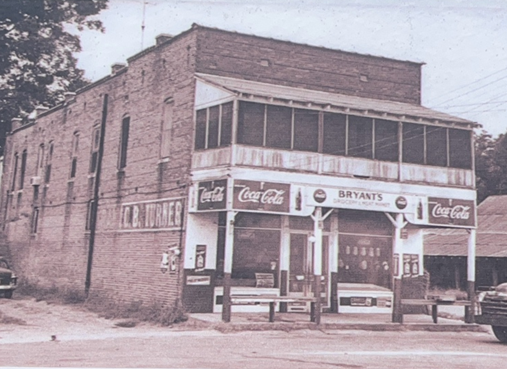
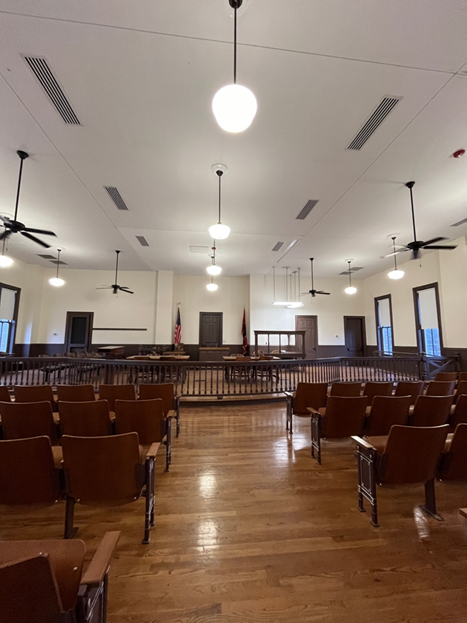
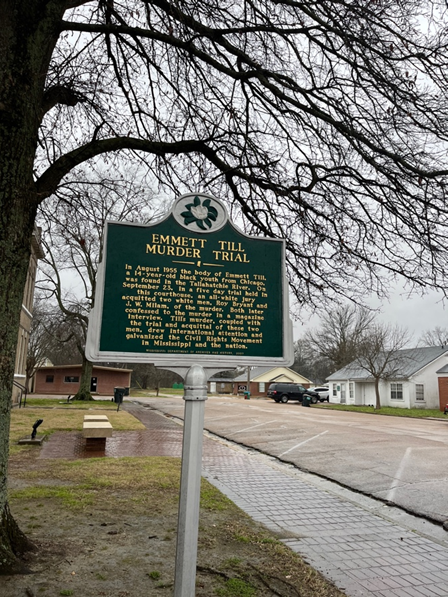
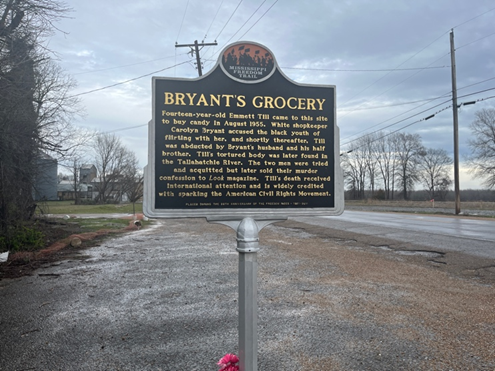
On Friday, March 8th, during the last day of the Civil Rights Immersion we had the privilege of visiting the Emmett Till pilgrimage in Greenwood/Glendora/Sumner, Mississippi. Emmett Till’s story inspired many social and justice activists, including Rosa Parks, who refused to give up her seat on the bus. In an immersive experience, we learned about Emmett Till’s story by visiting key places that played a significant role, such as Bryant’s Grocery & Meat Market, the Black Bayou Bridge, the Interpretative Center Museum, and the courthouse. Emmitt Till’s story is incredibly powerful and has left a lasting impact on my life by empowering me to stand up and advocate for those who are unheard and unjustly mistreated.

– Elena Mulul

Filed Under: Civil Rights, Civil Rights Immersion 2024 Tagged With: Black Bayou Bridge, Bryant Grocery, Emmett Till

3/6/24: “The only tired I was, was tired of giving in” – Rosa Parks

March 6, 2024 By Carrina

On Wednesday morning, we departed from Montgomery to visit the last of the three cities in Alabama, Birmingham.

Our first stop that day was the City Hall where we met with Mayor Woodfin’s department of Racial Equity and Social Justice. There we were greeted by a few of their staff that gave their time to talk to us about what they have worked on since the mayor created the division along with other staff who walked by to say hi to us. A few of the things they mentioned to us was the PEACE Act which focused on police accountability and creating a better connection with citizens, civic engagement classes that last for 7 weeks and collaborate with police departments, and Birmingham Promise which gives financial support to students to attend a university in Alabama. We also talked about how Redlining has been an issue for a long time. One side effect of these almost-century-old maps that might not be known are health implications. One way that these side effects have been shown in the community is by the fact that minority women have the highest maternal issues. Another issue that they have to navigate is the fact that Birmingham has Dillon Rule, bills have to pass through the state capitol, and that has been a barrier for progress. Something that I thought was really great on the mayor’s behalf was that he has his Thursdays free for anyone in the community to chat with him for 15 minutes about anything that they want to, and that showed to me how much he wants to listen to the people he impacts the most.

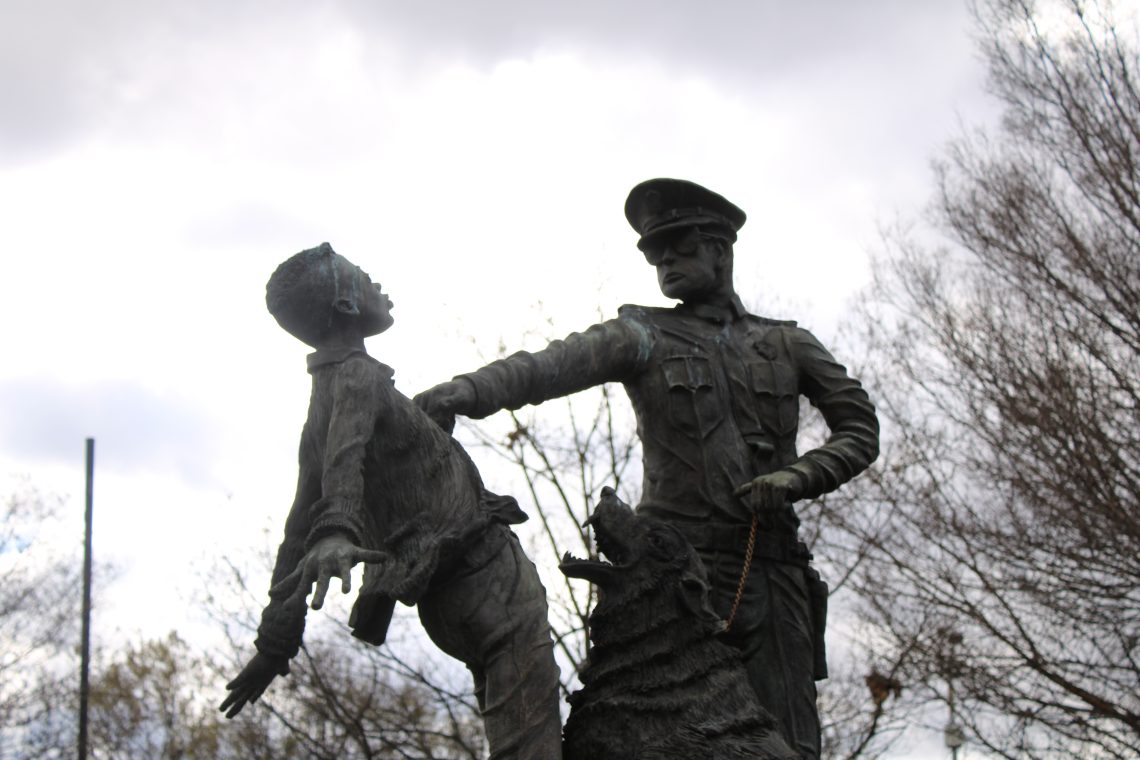
Next, we paid a visit to Kelly Ingram Park. There they had a listening tour that you could hear by calling the number provided. There were monuments and statues remembering the events that had occurred in the 60s. The bombing of 16th street church which killed 4 little girls, the children’s march which was attacked by dogs and fire hoses before arresting hundreds of children, racial discrimination in surrounding white owned businesses, and much more. The statues and monuments in the park had very animate expressions and it seemed surreal to me that we were standing in the same place where those events had happened only a few decades ago.

Our last stop in Birmingham was the Birmingham Civil Rights Institute. The experience felt like a story of black history in the United States that you could walk through. It gave an idea of what it was like to be a person of color during the Jim Crow era. There were exhibits visualizing standard of living differences, segregation practices of “colored” and “white” facilities, freedom riders’ bus replica, Civil Rights heroes especially Dr. Martin Luther King, Rosa Parks, Rev. Fred Shuttlesworth, and A.G. Gaston. There is so much to learn about when it comes to how the Civil Rights movement began and how necessity and courage fueled everyone’s drive for permanent change in the name of social justice.

– Cristopher Diaz

Filed Under: Civil Rights, Civil Rights Immersion 2024 Tagged With: Birmingham, civil rights, Jim Crow, Kelly Ingram Park, PEACE Act, Redlining, Rosa Parks

3/5/24: Selma

March 5, 2024 By Carrina

Upon arriving in Selma, we had anticipated a simple day of museum visits and learning about the historic Selma to Montgomery Marches of 1965. However, our experience surpassed expectations as we embarked on an immersive journey guided by our tour leader. Transported back to the years spanning 1526 to 1867, we were deeply moved as we attempted to walked in the shoes of individuals of color. This day, above all else, left a profound emotional impact on myself and my fellow travelers. Reflecting on our experience, words failed some, evoking feelings of disgust and anger, yet ultimately leaving us all motivated to confront the ongoing racism in our world.

Amelie Polk

Filed Under: Civil Rights, Civil Rights Immersion 2024 Tagged With: civil rights, Selma

3/2/24 – New Orleans

March 2, 2024 By Carrina

Care
Open
Volunteering
Emotional
Nonprofit
Assistance
Neighborly
Transformative

Helpful
Others-first
Understanding
Selfless
Empathy

We started off the day volunteering at Covenant House. This organization and location
specifically provides housing for New Orleans youth ages 16-22, no matter the reason. First, we
spent a couple hours going through the donated clothes and sorting out the ones to keep. After
sorting and folding the clothes, we got to take some to hang up in the clothing closet. Then we
got to walk around and do a mini-tour of the building and also discuss Covenant House’s
mission. What stuck with me the most is how open the doors to covenant house are. This place
has no waitlist whatsoever, and is not just a shelter but also a place that provides resources and
support for the youth staying there. For example, some of the things mentioned were job
searches/resume building, connecting with family, food and clothing, healthcare, parenting for
youth who are current or expecting parents, among many others.

Our next activity was visiting an exhibit called The Trail They Blazed. This was a traveling
exhibit that was at the library of the university we stayed with (University of Holy Cross) near
the New Orleans area. It covered multiple events and organizations during the civil rights
movement in New Orleans area from the 50s-70s. The Desire neighborhood at the time became a
hotbed for activism, which led to the formation of the National Committee to Combat Facism
(NCCF), which is associated with the Black Panther Party. The NCCF provided free breakfast
for school kids, political education classes, voting transportation, grocery shopping for elders,
and distributed the Black Panther Party’s newspaper. Another topic the exhibit covered was
boycotts, many of these led by college students my age. They organized sit-ins to desegregate
lunch counters, advertised and led consumer boycotts, despite the risk of expulsion from their university (which unfortunately occurred to many students). Their efforts eventually led to integrated dining and restrooms, fairer hiring practices, and appropriate accommodations being made. Being a college student, this exhibit made me realize how much power we have to make the changes we seek. Now more than ever, it is crucial that we use our voice to speak up for injustice, whether here or the other side of the planet.

Kaylee Gunderson

Filed Under: Civil Rights, Civil Rights Immersion 2024, Uncategorized

  • Go to page 1
  • Go to page 2
  • Go to page 3
  • Interim pages omitted …
  • Go to page 12
  • Go to Next Page »

Primary Sidebar

  • Facebook
  • Instagram
  • Twitter

Contact Us

Moreau Center
St. Mary's Student Center, MSC 162
5000 N. Willamette Blvd.
Portland OR 97203

T: (503) 943-7132
E: moreaucenter@up.edu

Hours: 8:30am-4:30pm
Monday-Friday

Copyright © 2025 · News Pro with Full Header On Genesis Framework · WordPress · Log in