• Skip to primary navigation
  • Skip to main content
  • Skip to primary sidebar

Moreau Center Social Justice Programs

  • Home
  • Immersions
    • Affordable Housing
    • Border Immersion
    • Civil Rights
    • Community Organizing and Resistance (CORE) Immersion
    • Environmental Justice
    • L’Arche Bologna
    • Nicaragua
    • North Portland Civil Rights
    • Rural
    • Tanzania
    • Urban
  • Service Plunge
    • Blog Updates
  • Interns for Justice
  • Donate
  • Archived

Rural

Indulging

October 24, 2022 By Tyler

By Oswaldo Martinez, Raychel Brown and Rochus Sison

Today, we went back to Nuestra Casa and we indulged. The students and staff of Nuestra Casa gathered for a potluck. We witnessed the community come together to bring food and laughter around the table.

As the clatter of dishes being put away faded in the background, we gravitated towards Sister Mary Rita – the founder of Nuestra Casa. However, this isn’t her only achievement. She indulged us with stories about her life and her impact on the global community. Sister Mary Rita was part of the founding of Heritage University (which we visited yesterday), spearheaded a low income housing program in Lake Oswego, took part in social justice missions in Nicaragua and across Africa, started a Spanish-language program at a local university, and continues to serve as an educator in the valley.

Seeing the work Sister Mary Rita has done in social justice and activism has shown us that one person really can make a sustainable impact. Listening to the stories of people like Sister Mary Rita and the people of Nuestra Casa has enriched our education and expanded our perspectives. We are forever thankful for this experience that we have been allowed to participate in. 🙂 <3 xoxo
Filed Under: Rural, Rural 2022

Heritage University: educating the community

October 20, 2022 By Tyler

By Kevin Figueroa-Rangel

After having visited the Alvarez pepper farm, we visited Heritage University. We were introduced to Isaias, the student life director at the University. He went over the various programs that the institution offers, as well as the resources they provide the students with to help them succeed academically. He mentioned that the university, with the help of generous donors and other grants, covers 90% of the cost for nearly every student. Moreover, he mentioned that most students will actually find themselves attending without having to pay a single dime in tuition.  Given that the cost of attending college is increasing each year, it was nice to see that there are institutions that are prioritizing the education of their students. Towards the end of the visit, we were given the opportunity to speak with several students who currently attend Heritage. The biggest takeaway from the short QnA session was that most of the student body, after eventually completing their degree and graduating from Heritage, is interested in staying near the institution in order to give back to the community. This truly helped emphasize how strong of a community Heritage has and will continue to build as time passes.

Filed Under: Rural, Rural 2022

Northwest Justice Project and Jesuit Volunteers

October 20, 2022 By Tyler

By Brooke Niemer

Yesterday afternoon we visited Northwest Justice Project (NJP) where we listened to a presentation about what NJP does and specific details about the H2A program. The H2A program for migrant farmworkers is something that has been discussed throughout our time so far on the immersion, but we still had a lot of unknowns. This presentation provided the specifics of what it covered, how it worked, and who it was intended for. One thing that stood out to me is when they showed an example of an H2A visa which explicitly stated the dates of when they would be considered documented within the U.S. This stood out to me because the effects of their labor will have a much longer effect than their time for this particular visa since they are helping provide fresh produce to people which will have a positive effect on their health. One of the presenters is a Jesuit Volunteer, and we continued our time together during dinner.

After we visited NJP, we walked over to the Yakima house for the Jesuit Volunteer Corps NW and had a community dinner with them. Four people who we had never met before invited us into their house and community for dinner and a lively conversation. One thing that stood out to me was their passion for making connections and community. We were able to hear about how they chose JVC, their service placements and what their role is, the history of the JVC house, and the fun things that they engage in. They also asked very thought-provoking questions about our immersion and what brought us here, which made me feel very welcomed in their community. Their generosity and kindness are something that I will always remember.

Filed Under: Rural, Rural 2022

Instant Community

October 20, 2022 By Tyler

By Gus Smith

Yesterday (Tuesday), our group sat in on a class for native Spanish speakers who were learning English, run by an organization called Nuestra Casa. Leading up to our visit, I was nervous. I’d practiced Spanish with native speakers very sporadically, and feared that I wouldn’t be able to understand or keep up with the things they might say to me. Upon our arrival to the church building that houses Nuestra Casa’s classrooms and offices, that fear started to disappear. Those I met inside were some of the most caring and friendly people I’ve ever had the pleasure of interacting with. The immediacy and energy with which they welcomed us broke any ice there might have been and allowed us to feel the level of relaxation necessary to form real connections. All of that happened before we even entered the classroom, but  continued inside. The students, who were full grown adults, many with children, had a passion for learning and a desire to engage with us that made it really easy to give help when it was asked for, or offer it when it appeared necessary. That mix of factors created an instant community between all of us that I’ve rarely seen anywhere else. Everyone was appreciated, recognized, and included, and I’m very excited to return to Nuestra Casa tomorrow for our next class.

Filed Under: Rural, Rural 2022

Inaba Farms

October 20, 2022 By Tyler

By Oswaldo Martinez, Raychel Brown and Rochus Sison       

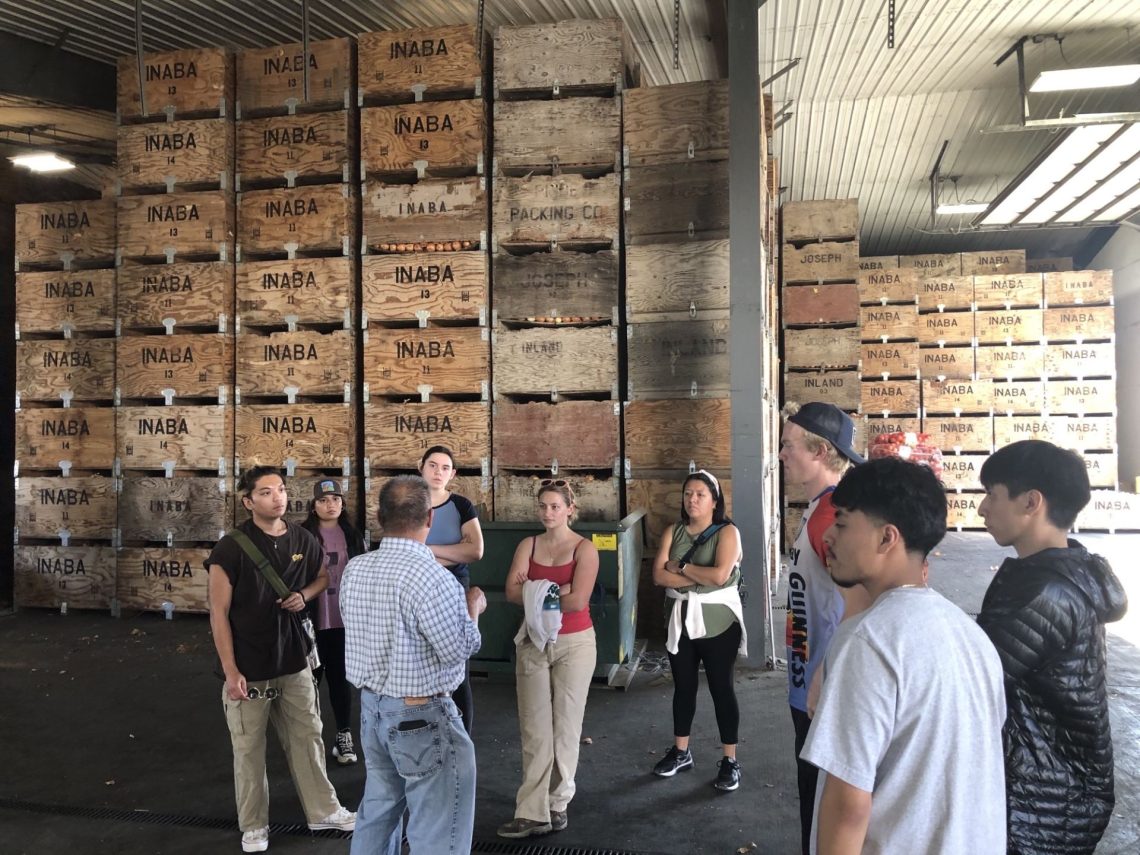
     Today we visited Inaba Farms and talked to Lon Inaba. His family has owned this farm for three generations, but now he is selling it to the Yakama Nation. This will be a big step for the farm and the indigenous people reclaiming the land. He touched briefly on how chain grocery stores negatively impact the ‘growers’ – also known as the farmers. If produce is too big, too small, scuffed, or misshaped, they get thrown away because grocery stores don’t want them. The chains’ selectivity and idolization of the “perfect” produce leads to an accumulation of food waste.

Rural Immersion participants listen to Lon Inaba while in one of the buildings storing produce like squash.

         We saw a perfectly good crate of green bell peppers all being donated to an organization because they didn’t fit the criteria of the superstores, which leads to growers having more cautions when picking and shipping produce. This gave us the ability to pick some ‘imperfect’ food of our own. We were able to pick our own bell peppers and squash to take back to the farm we are staying at.

  Mr. Inaba believes to help fix this system we need to make sure to support local farmers by buying from local farms. He referred to this as being a “selective consumer”. This means knowing where your produce comes from and knowing the impact your purchase has on the food system.

Filed Under: Rural, Rural 2022

Sorry for Coming to Your Country

October 30, 2019 By Tyler

I asked him “So where are you from?” he replied that he was born and raised right outside Tijuana, México. He told me that he first came to the U.S. when he was 14. After he got married, he decided to return to the U.S. to give his kids a better education, and a safer life. He explained to me about the danger that he experienced there daily, the fear he lived in, and how he has found so much refuge and hope in being here in the Yakama Valley. Then he looked at me and said “I’m sorry for coming to your country, but I had no choice. I had to do it for my safety.”

I’m sorry for coming to your country.

I didn’t know what to say. I teared up. Over this week we have learned so much about the constant hurdles that are thrown at people who “aren’t from around here”. We have learned about the injustices that keep people waiting for 20+ years if they want to enter the U.S. “legally”, so they are given almost no choice but to enter “illegally” if they want to give their children a safer life. We have learned about the agricultural industry, and how big businesses repeatedly take advantage of farmers, and exploit their workers. We learned the extent to which we as UP members perpetuate injustice merely by thinking of picking and harvesting as “low-skilled labor” (it is, in fact, quite difficult, dangerous, and requires a lot of skill and precision to harvest safely). We learned about how this racism and injustice is SO ENGRAINED in the development of our country that we are still endorsing systems and mindsets that unapologetically oppress.

To put it bluntly: we learned that even those of us who are well-meaning, kind, and champions for social justice are still the Whos who are oppressing. I had known this man for an hour. We were working on pronunciation and conversations in a Level 1 English Language Learning classroom. I asked his story, and he graciously and courageously told me where he was at. But he felt the need to apologize. He felt the need to justify the simple desire to live and work without fear for his and his children’s lives.

This whole week has been memorable and impactful. This particular story, however, will stay with me a little more deeply than the others. I am a college student. In my own mind I have no power, no authority, and I frequently don’t know what’s going on. For me, there is no reason anyone would ever feel the need to justify their being to me. And yet this brave, kind man called me to senses. There is something very wrong. We can’t be brushing this under the rug anymore. No one should feel the need to justify their existence.

Filed Under: Rural

Nuestra Casa

October 30, 2019 By Tyler

Yesterday we visited Nuestra Casa. It is an establishment in which English is taught as a second language to native Spanish speakers. As a group, we were invited to join them in a potluck, in which everyone would bring a dish of their choice. For these people who have endured so much, have gone through so many hardships, and aren’t making the most money – for them to invite us and cook traditional foods made me feel so grateful. Even though they don’t have the most, they are still so giving. They are also very hopeful. They are here when many people from the US want to kick them out, they live in fear of not knowing if they will get deported, and they are here away from their families and friends. And yet, besides all that this group at Nuestra Casa that we met up with was still so loving, forgiving, friendly, warm, and hopeful. To see someone who isn’t in the easiest of positions to be able to keep such a positive mentality is inspirational and really makes me think of how many little things we take for granted, when we need to open our eyes and realize everything we have. Seeing them be so loving, forgiving, and hopeful really resonates with me in that no matter what your situation, it cost nothing to be kind and loving, and to keep fighting and keeping a positive outlook. Things may be hard and they may suck, but the only way you’re going to get through that is by staying positive and digging down a little deeper. So, thank you to those at Nuestra Casa – without even knowing that you all made such an impact – for showing me what strong character looks like and with that I can work towards bettering myself.

-Zach Marx

Filed Under: Rural

Immigration and Agriculture – Interconnected

October 17, 2019 By Tyler

              This afternoon we met with Eamonn Roach, an immigration attorney in Washington. He gave a brief overview of immigration law and policy of the 21st century. One of the major points that he brought up that stuck with us was the lack of major immigration policy change since the 1980s and the Reagan administration. It is sad to see the times changing, and yet the laws of the land haven’t. This lack of adaptation has left millions of people in the dust, particularly Latino farmworkers. The lack of change and modernization of the system has also created a huge backlog for migrant applications for visas and green cards, creating uncertainly and unneeded stress in the lives of the applicants and their families for several years. This is unhealthy for the migrants that are seeking refuge, better jobs, or opportunities for better lives for them and for their families.

              Earlier in the day, we got the chance to tour Inaba Farm. This farm is owned by a third-generation United States citizen with Japanese descent. They grow both conventional and organic produce, and they even let us take home some squash, onions, and watermelon. Inaba Farm was one of the first farms in the region to build housing for their workers, which was a nice change of pace from what you hear in the news. The owner taught us that you can make a profit off your investments without ripping off or mistreating your workers. After our lunch break, we did volunteer work at the Northwest Harvest food bank distributor, and we packed nearly 2500 pounds of pears, which will feed 1861 people. We felt an overwhelming sense of joy for providing food to families in need, but we also felt disgusted by the fact that so many people cannot afford to buy adequate food for their families.

-Jordan Duran and Saron Mekonnen

Filed Under: Rural

Teaching and Learning

October 16, 2019 By Tyler

              Tonight, we went to Nuestra Casa, a nonprofit that provides ESL classes, citizenship, health and childcare services, for the local Latino community.  We were all divided into different groups where the UP Spanish-speaking students were placed into the first two levels with the locals knowing very little English. As a Spanish minor, I helped teach in the level one class, not knowing it would require the most Spanish. I was very nervous because I am very shy about speaking Spanish and am scared about making mistakes. However, after introducing ourselves to the class, the Spanish-speaking students welcomed us with open arms. They complimented us on our Spanish, the very little we already said, our majors and they were very sweet. After walking through multiple activities like weather and sickness phrases, and different dialogues like job interviews, buying a house, and more, I was not as scared of making errors or feeling uncomfortable with my Spanish abilities. I truly felt their acceptance of us and their appreciation with being there to aid them. Seeing the students struggle with pronouncing words like happened, job and throat, made me realize what a privilege it is to speak English fluently and what an advantage it is. This experience showed me what life is like for these non-English-speaking students is like and how I can be an advocate for them. They were so brave and bold with their language risks that it demonstrated that I can do the same and share the same mentality. I left Nuestra Casa feeling the impact the place left on my life, my perspective and a desire to find a way to volunteer in an ESL class in Portland. With a smile on my face and my stomach hurting from the laughter of their jokes, helped create a safe, light hearted and warm environment not only for us, the teachers, but most importantly, the students. Although, this is not the end of the immersion, I can positively say this has been my favorite part.

-Asia Gates

Filed Under: Rural

Heritage University

October 16, 2019 By Tyler

              One of the most memorable destinations we visited today was Heritage University, the only non-tribal college built on tribal land in the Yakama Nation. The statistics presented by Melissa Hill, the Vice President of Students Affairs at Heritage University, shows that 65% of their students are Hispanic, of whom the majority are women. Yet, while 90% of the Washington population has a high school diploma, the percentage drops dramatically when it comes down to the Yakama Nation and nearby towns. This makes college impractical and somewhat unreachable to many kids, since their parents, as Melissa Hill suggests, might know the value of love, hard work, and community, but not the power of education. Thus, the goals of Heritage University are not only to enrich students’ knowledge and help them pursue their dreams, but also to educate students about their rights and their potential of changing the future. We had great discussions on food insecurity and ethnicity, as well as on the “then what?” that addresses responsibilities and actions that we might take to bring positive changes to rural communities. One quote I really liked from Melissa Hill is that none of us have the choice to choose our identities, and we should be proud of who we are, of who our parents are, and of the land in which we were born and raised. We had a tour around Heritage University campus, and it was amazing to see how the university, started as an idea proposed by three women, has become a place where knowledge is valued and all identities are respected.

-Anh Nguyen

Filed Under: Rural

  • Go to page 1
  • Go to page 2
  • Go to Next Page »

Primary Sidebar

  • Facebook
  • Instagram
  • Twitter

Contact Us

Moreau Center
St. Mary's Student Center, MSC 162
5000 N. Willamette Blvd.
Portland OR 97203

T: (503) 943-7132
E: moreaucenter@up.edu

Hours: 8:30am-4:30pm
Monday-Friday

Copyright © 2025 · News Pro with Full Header On Genesis Framework · WordPress · Log in