• Skip to primary navigation
  • Skip to main content
  • Skip to primary sidebar

Moreau Center Social Justice Programs

  • Home
  • Immersions
    • Affordable Housing
    • Border Immersion
    • Civil Rights
    • Community Organizing and Resistance (CORE) Immersion
    • Environmental Justice
    • L’Arche Bologna
    • Nicaragua
    • North Portland Civil Rights
    • Rural
    • Tanzania
    • Urban
  • Service Plunge
    • Blog Updates
  • Interns for Justice
  • Donate
  • Archived

Local

The Importance of Preserving History

March 8, 2023 By Tyler

          On the fourth day of our civil rights immersion experience we received a tour of Vanport, visited a black owned book shop called: Third Eye Books and had a potluck with some of the church members from The First AME Zion. where we were not only able to connect with the members, but were even lucky enough to hear about the experience of living in Vanport from one of the church’s members.

Pilar: Something that stood out to me throughout the day was the theme of history that kept coming up throughout the day. In Vanport, the place was rich with history of different groups that existed and used the land for different purposes. In Po’Shines a member from the restaurant spoke to us about the history of how the establishment got its name, its ties with social justice and community work, as well as how the establishment had lasted throughout hard times. In Third Eye Books, the owners shared the history of the place and the importance of a Black-owned business having literature that represented perspectives from Black people. The theme of history today taught me that the history and the stories we tell are important in shaping how people see these events.

Nyibol: I moved to America about 13 years ago and have not really made an effort to educate myself about the history of Oregon beyond the stuff they teach you at school. I have had a lot of “what? I did not know that this thing or place meant or did this.” Today Heather (our Vanport tour guide) shared a poem by Kaia Sand, from the book that said “how do I notice what I don’t notice” and that poem resonated with me because often times I tend not to notice my surroundings. I wrote a paper about Vanport and completely forgot about it but touring it and learning even more today made me realize just how little I knew about the place. Being in the land where many at the time called home and seeing where things used to be, I found it hard to picture this once being a home to thousands. Just putting the two and two together even was hard for me. I found it really interesting how all of the things that said “Vanport” did not put Oregon next to it making the fact that it was once a city known, but how it just said “Vanport” alone leaving it’s meaning to those who do not know what that is a mystery.

Going on the tour as well as talking with the members of the church/community made us realize the importance of preserving these stories and using storytelling as tool to stay connected and keeping history alive.

-Pilar Hernandez and Nyibol Duop
Filed Under: North Portland, North Portland Civil Rights 2023

Be “Real”

March 8, 2023 By Tyler

On Sunday, we started off the day attending the church service at the First AME Zion Church that is our home base for the week. This is the oldest Black church in Oregon, and I believe the oldest in the PNW if I remember correctly. I found myself deeply touched by the sermon and the community who welcomed us in as guests. I could feel the power and significance of this place in terms of belonging and mutual support, especially for elders, in the Portland Black community. I was surprised to see how small the congregation was (less than ten overall not including our group) and I was saddened to think of the loss of community over the years in a historic church like this that is such a crucial part of the Black community here as gentrification and various factors pushed Black Portlanders out of this area. I enjoyed our conversation with one of the congregation members after the church service. He had been away for a number of years but came back to this church to seek solace and support in the community after the passing of his daughter.

Being in religious spaces has usually been an uncomfortable experience for me as a member of the LGBTQ+ community, and I find myself feeling deeply uneasy and guarded in predominantly white religious contexts. Somehow I knew going into Sunday that this would not be my experience here, and I was correct in this assumption. I anticipated I would be treated with kindness in this church, and that I would be invited into this space as a guest without expectations or judgement, which I found to be true. I think the students and I each were all able to resonate with the sermon in different ways. The message was to be “real” with God, yourself, and those around you. It gave me a lot to think about with how I interact with others and how to do so in an authentic way, and also how I can be more honest with myself too. As a choir kid since age four, I enjoyed getting to participate in the church service by singing along, even though I didn’t know the songs beforehand. I noticed in the comments and reflection afterwards that the students enjoyed the music as much as I did too. The service also discussed performativity, and doing things for the sake of tradition, or appearances and social recognition. This opened up a lot of good reflection for me about intentionality in how I show up in the world and not losing touch with the “why” behind things. This conversation was presented through the lens of lent, why or why not someone would fast, and challenging tradition for tradition’s sake without a purpose and driving factor behind it. I was able to resonate with the messages of the sermon even without a religious background or affiliation. I also think it was interesting attending a service led by a woman, and I heard good reflections from the students about how they experienced this positionality.

We spent the afternoon walking around North Portland and seeing different locations relevant to Portland’s Black community and history. As we started off down the street near the church, we found ourselves (especially me, to be frank) excited by the different places we saw in the business district near the church – trendy coffee shops where we stopped to get (expensive) lattes, “hip” restaurants, patisseries (one of them is a favorite of mine, with pricey but delicious croissants), cutesy donut shops, yoga studios, and breweries. As our conversations progressed, and we visited the different stops on our route, it hit us more viscerally what had been right in front of us – very clear, palpable examples of gentrification. Some of us had been to the area before but hadn’t thought critically about this before, and many of us had different conflicted thoughts about this. We saw newly built apartments that I’m pretty certain I could not afford, even as a white person with generational wealth, a graduate degree and a “good job”, let alone the Black community that were homeowners here in past years. We saw the pieces of empty land that were cleared for Legacy Hospital to be built, displacing 300+ families, with the promise of affordable housing which never came. We had good conversations about how and where we choose to spend our money, who owns the businesses we frequent, and the impact we can have by being mindful as consumers and residents of a community. It was a rewarding day and I am grateful for the experiences and conversations we had.

-Holly Peterson

Filed Under: North Portland, North Portland Civil Rights 2023

Facing Our Privileges

March 7, 2023 By Tyler

              On the third day of our North Portland civil rights immersion experience, we met with community leader, poet, and activist Velynn Brown at One H.O.P.E. Fellowship. We listened to her and her family’s story of their experience as a Black family in Portland. As part of our time with Velynn we wrote about our personal Racial Autobiographies. This activity led us through questions that made us consider our own racial backgrounds and experiences. Some of these questions made us reflect on our experiences with racism, our privileges, and how to move forward while considering these issues.

Reid: As a Japanese person born and raised in Honolulu, Hawai’i, I would be considered a minority in much of the world. However, this is much less so the case in my hometown where Asian people make up a much larger part of the population there than in the rest of the continental United States where white people make up much more of the population. Since Asians are highly represented in Hawai’i, this activity made me consider the privilege I was granted, especially as a Japanese person, considering Japan’s history of imperialism. Though I am considered a person of color, in Hawai’i I have the privilege of not having to think about my skin color and background as well as not having to fear violence or discrimination against me or my family either. This activity also made me consider my own biases I had formed during my development, even as a minority, and how I ought to address them in the future.

Sheridan: As a white woman who grew up in the San Francisco Bay Area, this activity made me address my privileges and consider how I do not always think about my race. Growing up my parents never felt the need to have a discussion with me about race. This lack of conversation is a form of white privilege itself. When completing this activity, we tried to reflect on our first encounters of race and racism, and I realized that I did not have a particular moment growing up that race stood out to me. My hometown is a diverse area and I could not pinpoint what my first encounter with race was, until I visited my family in rural Missouri. I remember recognizing how different rural Missouri was compared to the Bay Area, and the lack of diversity in the area shocked me. It was on these family trips back to Missouri where I also had my first encounters of racism, from off hand racist comments from older family members who did not know many non-white people and thought nothing of their racist jokes. Through this writing activity I also thought about how I could have productive conversations with these family members and if there is a way for me to share what I have learned so far on this immersion with them. I really appreciated the difficult issues that this activity made me reflect on and I hope to continue to grapple with my privileges and biases throughout this immersion and the rest of my life.

              Speaking with Velynn Brown and completing this activity helped us create an action plan for moving forward and addressing our biases, as privileged members of our hometowns. We feel immense gratitude towards Velynn and the community members we are meeting on this immersion, as we hear their stories, learn about Portland, and strive to become more culturally aware of the spaces we occupy.

By: Reid Matsuda and Sheridan Todd

Filed Under: North Portland, North Portland Civil Rights 2023

Indulging

October 24, 2022 By Tyler

By Oswaldo Martinez, Raychel Brown and Rochus Sison

Today, we went back to Nuestra Casa and we indulged. The students and staff of Nuestra Casa gathered for a potluck. We witnessed the community come together to bring food and laughter around the table.

As the clatter of dishes being put away faded in the background, we gravitated towards Sister Mary Rita – the founder of Nuestra Casa. However, this isn’t her only achievement. She indulged us with stories about her life and her impact on the global community. Sister Mary Rita was part of the founding of Heritage University (which we visited yesterday), spearheaded a low income housing program in Lake Oswego, took part in social justice missions in Nicaragua and across Africa, started a Spanish-language program at a local university, and continues to serve as an educator in the valley.

Seeing the work Sister Mary Rita has done in social justice and activism has shown us that one person really can make a sustainable impact. Listening to the stories of people like Sister Mary Rita and the people of Nuestra Casa has enriched our education and expanded our perspectives. We are forever thankful for this experience that we have been allowed to participate in. 🙂 <3 xoxo

Filed Under: Rural, Rural 2022

Heritage University: educating the community

October 20, 2022 By Tyler

By Kevin Figueroa-Rangel

After having visited the Alvarez pepper farm, we visited Heritage University. We were introduced to Isaias, the student life director at the University. He went over the various programs that the institution offers, as well as the resources they provide the students with to help them succeed academically. He mentioned that the university, with the help of generous donors and other grants, covers 90% of the cost for nearly every student. Moreover, he mentioned that most students will actually find themselves attending without having to pay a single dime in tuition.  Given that the cost of attending college is increasing each year, it was nice to see that there are institutions that are prioritizing the education of their students. Towards the end of the visit, we were given the opportunity to speak with several students who currently attend Heritage. The biggest takeaway from the short QnA session was that most of the student body, after eventually completing their degree and graduating from Heritage, is interested in staying near the institution in order to give back to the community. This truly helped emphasize how strong of a community Heritage has and will continue to build as time passes.

Filed Under: Rural, Rural 2022

Northwest Justice Project and Jesuit Volunteers

October 20, 2022 By Tyler

By Brooke Niemer

Yesterday afternoon we visited Northwest Justice Project (NJP) where we listened to a presentation about what NJP does and specific details about the H2A program. The H2A program for migrant farmworkers is something that has been discussed throughout our time so far on the immersion, but we still had a lot of unknowns. This presentation provided the specifics of what it covered, how it worked, and who it was intended for. One thing that stood out to me is when they showed an example of an H2A visa which explicitly stated the dates of when they would be considered documented within the U.S. This stood out to me because the effects of their labor will have a much longer effect than their time for this particular visa since they are helping provide fresh produce to people which will have a positive effect on their health. One of the presenters is a Jesuit Volunteer, and we continued our time together during dinner.

After we visited NJP, we walked over to the Yakima house for the Jesuit Volunteer Corps NW and had a community dinner with them. Four people who we had never met before invited us into their house and community for dinner and a lively conversation. One thing that stood out to me was their passion for making connections and community. We were able to hear about how they chose JVC, their service placements and what their role is, the history of the JVC house, and the fun things that they engage in. They also asked very thought-provoking questions about our immersion and what brought us here, which made me feel very welcomed in their community. Their generosity and kindness are something that I will always remember.

Filed Under: Rural, Rural 2022

Instant Community

October 20, 2022 By Tyler

By Gus Smith

Yesterday (Tuesday), our group sat in on a class for native Spanish speakers who were learning English, run by an organization called Nuestra Casa. Leading up to our visit, I was nervous. I’d practiced Spanish with native speakers very sporadically, and feared that I wouldn’t be able to understand or keep up with the things they might say to me. Upon our arrival to the church building that houses Nuestra Casa’s classrooms and offices, that fear started to disappear. Those I met inside were some of the most caring and friendly people I’ve ever had the pleasure of interacting with. The immediacy and energy with which they welcomed us broke any ice there might have been and allowed us to feel the level of relaxation necessary to form real connections. All of that happened before we even entered the classroom, but  continued inside. The students, who were full grown adults, many with children, had a passion for learning and a desire to engage with us that made it really easy to give help when it was asked for, or offer it when it appeared necessary. That mix of factors created an instant community between all of us that I’ve rarely seen anywhere else. Everyone was appreciated, recognized, and included, and I’m very excited to return to Nuestra Casa tomorrow for our next class.

Filed Under: Rural, Rural 2022

Inaba Farms

October 20, 2022 By Tyler

By Oswaldo Martinez, Raychel Brown and Rochus Sison       

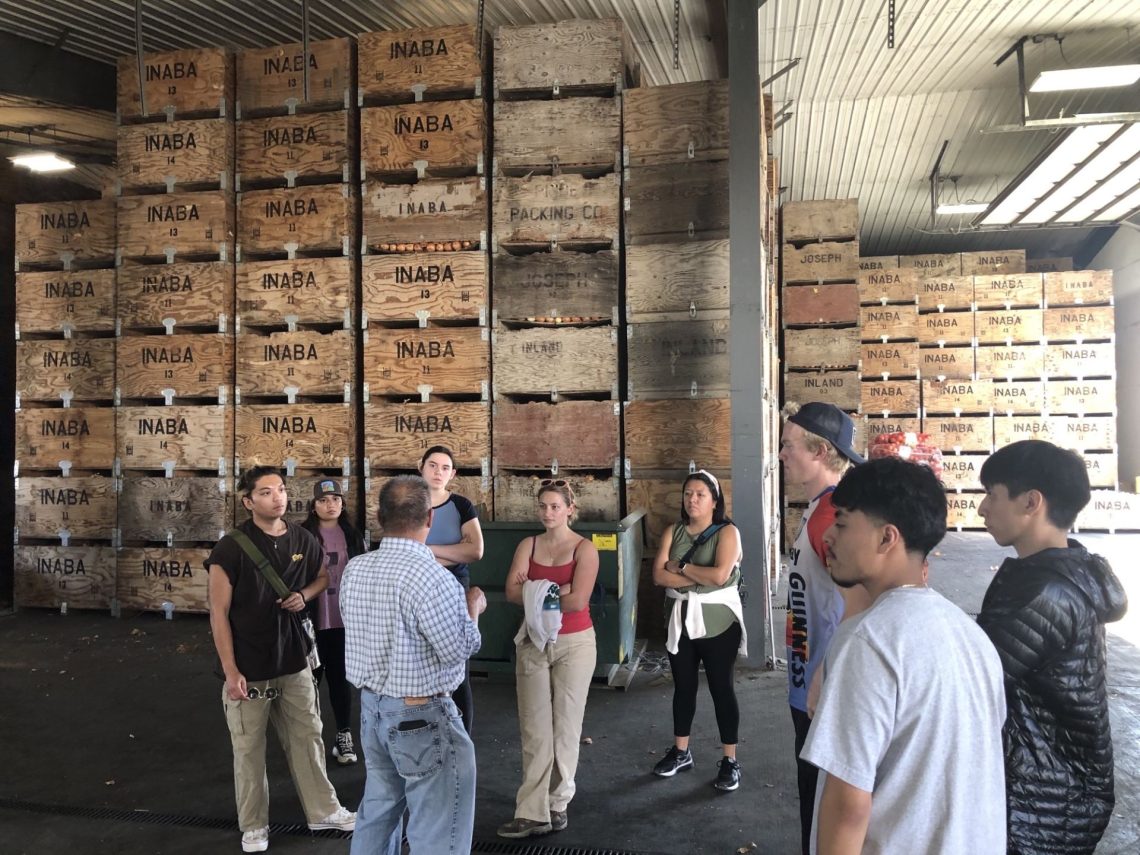
     Today we visited Inaba Farms and talked to Lon Inaba. His family has owned this farm for three generations, but now he is selling it to the Yakama Nation. This will be a big step for the farm and the indigenous people reclaiming the land. He touched briefly on how chain grocery stores negatively impact the ‘growers’ – also known as the farmers. If produce is too big, too small, scuffed, or misshaped, they get thrown away because grocery stores don’t want them. The chains’ selectivity and idolization of the “perfect” produce leads to an accumulation of food waste.

Rural Immersion participants listen to Lon Inaba while in one of the buildings storing produce like squash.

         We saw a perfectly good crate of green bell peppers all being donated to an organization because they didn’t fit the criteria of the superstores, which leads to growers having more cautions when picking and shipping produce. This gave us the ability to pick some ‘imperfect’ food of our own. We were able to pick our own bell peppers and squash to take back to the farm we are staying at.

  Mr. Inaba believes to help fix this system we need to make sure to support local farmers by buying from local farms. He referred to this as being a “selective consumer”. This means knowing where your produce comes from and knowing the impact your purchase has on the food system.

Filed Under: Rural, Rural 2022

The Power of Storytelling

March 10, 2022 By liwanag

Narratives or stories are powerful and show up in every part of our lives. We watch, listen, and learn about stories every single day of our lives. Stories are a retelling of characters’ experiences and their problems. The reason why we enjoy and attach ourselves to stories is that we want to understand how characters, settings, events, actions, interactions, and results are all interconnected with each other. However, the purpose of why stories are so important is that they create and re-create meaning(s) through interactions and public messages. 

The importance of storytelling was a recurring theme that I experienced throughout the whole immersion, especially when we meet with Bruce from Vanport Mosaic. Vanport Mosaic is a memory-activism platform that amplifies, honors the present, and preserves the silenced histories that surround us to understand our present and create a future where we all belong. Vanport Mosiac amplifies the stories of Portland’s African American Community to expose the struggle, perseverance, and resilience that continues today. 

The presentation of multiple first-person narratives exposed personal thoughts, feelings, and experiences. The things I learned from these narratives helped me understand more aspects of Vanport. Beatrice shared that she didn’t realize she was homeless until later in her life. Jackie shared that they had to learn to meet people and experience new cultures in Vanport because everyone who lived in Vanport was from other parts of the country. Lurlene shared that people don’t talk about Vanport. Lee talked about the segregation in the city of Portland, but also in Vanport. Ben shared that there are so many opportunities to hate, but you can use that hate to drive for change. Myrtle shared that she lost everything during the flood because people thought they could go back and get their stuff. Kent shared that getting on the street is easy by just organizing and educating those to create change. Donna shared that she didn’t just lose her house, but also her church, her parent’s business, and her community. Even though these are specific parts of each story that caught my attention, each story has so many more messages that are important for the history and experiences in Vanport. Listening to different stories exposes issues that were not brought up before and/or need to be discussed. Being an Organizational Communication major, listening to these stories helped me understand systems and structures that are purposely placed in our society. 

The reason I signed up to participate in the North Portland Civil Rights Immersion was that I realized I did not have any historical knowledge about the city I reside in. The University has no aspect of the curriculum or an option to take a Portland history class. I felt like I needed to find a way to learn more about the history of Portland. Throughout this whole immersion, I have learned about the history of Vanport, the African American community, and so much more. The best part of this immersion was listening to every single narrative because each one was unique. Having over a year left of my educational journey, I can’t rely on the classroom to be my only source of historical knowledge. Sometimes you have to seek out history and deal with the real world on your own time.   

By Bella Metcalf 

Filed Under: North Portland, North Portland 2022

Visiting New Columbia

March 10, 2022 By liwanag

Tuesday, March 1st was a day spent engaging with the community and getting to know how people interact and build community despite change. Previously during this immersion, we had learned about the Columbia Villa, a public housing site that housed predominantly low-income people of color. In 2001 the neighborhood received a grant that enabled the revitalization of Columbia Villa into New Columbia. We spent the day visiting the neighborhood with the goal of understanding what life was like, and how the revitalization efforts affected the residents. 

We started the day meeting with Shalonna Jackson and Michael Mangum, two community organizers who work for Home Forward, which is an organization that focuses on blending affordable rental homes as well as owner-occupied homes to revitalize the New Columbia neighborhood. Shalonna and Michael spoke about their experiences with working with Home Forward as well as the history of the neighborhood. 

Next, we talked to two women, Lei and Larena, who worked at the Charles Jorden Community Center in the New Columbia neighborhood. They spoke about the importance of the community center and how it plays a role in creating a sense of belonging for the residences.

Afterwards, our group spent time cleaning the neighborhoods’ community garden. During this we got the chance to speak with one of the members of the neighborhood. She told our group about how the garden provides a deep meaning to her because it gives her an outlet to engage with others in the community as well as spend time outdoors. To me, this encounter was significant because it made me realize how having a sense of belonging and community can be so impactful for peoples’ well-being. We ended our time at New Columbia talking with Charles, who works for the local grocery store in New Columbia. He shared his food, coffee, and experiences with our group.

Throughout all our interactions with people in New Columbia it was clear how passionate they were about their community and how eager they were to share their passion with our group. I left this experience feeling inspired to engage in my own community in a more meaningful way, as well as hopeful to the future of New Columbia because of the passion the community members expressed.

After our long day of visiting New Columbia, we went back to the Church where we were staying and invited member of the Church over to join us for dinner. Reverend Marva brought us her homemade pie, cake, and lasagna, all very delicious! We spent the night exchanging our stories and hearing about their personal experiences. We also learned about the Church’s history and how gentrification has led to the Church’s decline in membership. 

Throughout the day I felt immense gratitude towards those who shared their stories with our group, as well as a gratitude for those who care deeply for their community. Getting to understand the passion and care people have for their community was contagious and made me want to engage in my own community more.

By Kari Thordarson

Filed Under: North Portland, North Portland 2022

  • « Go to Previous Page
  • Go to page 1
  • Go to page 2
  • Go to page 3
  • Go to page 4
  • Interim pages omitted …
  • Go to page 6
  • Go to Next Page »

Primary Sidebar

  • Facebook
  • Instagram
  • Twitter

Contact Us

Moreau Center
St. Mary's Student Center, MSC 162
5000 N. Willamette Blvd.
Portland OR 97203

T: (503) 943-7132
E: moreaucenter@up.edu

Hours: 8:30am-4:30pm
Monday-Friday

Copyright © 2026 · News Pro with Full Header On Genesis Framework · WordPress · Log in