• Skip to primary navigation
  • Skip to main content
  • Skip to primary sidebar

University of Portland Museum

  • Home
  • About
  • List of Entries

Objects

Lost and Overdue

March 3, 2025 By Carolyn

As the center of University of Portland’s academic and research hub, the Clark Library has over 195,000 print volumes, 785,000 eBooks, 128 databases, and over 94,000 online journals, and during the 2023-2024 academic year, over 18,000 items were checked out. During that same period, the library recorded nearly 260,000 encounters with students, faculty, staff, and guests. With so many visitors, it is not uncommon to see almost every seat occupied by a student with a laptop and books spread out across their work area.

Clark Library lends items for a specific period of time, depending on user type and format. Materials are also loaned outside of the library within a NW regional library consortium and through Interlibrary Loan as part of a network of libraries multiplying and sharing resources. Most libraries today inventory and track collection use through an automated integrated library system using the barcodes on library materials and user ID cards.

But, back in the days before automation, checking out library materials was a face-to-face, personal operation. The loan card from the book pocket — bearing either the handwritten borrower name or an ink stamp of the patron ID number on the card — was filed away in a checkout file box until the book was returned. After a book came back to the library, the card was reinserted into the book pocket and the book placed back on the bookshelf for the next user.

But sometimes the circle is broken. Yes, occasionally a book is not returned! Never returned, recirculated, shared; and instead marked missing or permanently lost. And fines ensue, requiring the patron to contribute to the cost of replacing the book.

Human error, absentmindedness, the press of events come into the account (or at least claimed in excuse) when a missing book reappears (weeks, months, or even a year), found when a student or faculty member packs up their room or office at the end of the academic term. Other items, resurface in the library itself: having been misfiled on the library shelves. Such are the usual detours in library lending. But then there are exempla such as Physical Optics by Robert W. Wood checked out by Robert Wright, ’66 in 1963, never returned and likely lost forever.

But no, here is a happy ending tale, the story illustrating responsibility, accountability, character. Imagine a moment in November 2024 when a surprised Bob Wright uncovers Physical Optics in his home storage — the first inside page signed by Brother Godfrey Vassallo, CSC, physics professor at UP — still in his possession a full sixty years after he checked it out!

Confession and contrition follow.

Mr. Wright contacted Clark Library and explained the story to Interim Library Dean, Christina Prucha.

Two people holding a book
Robert Wright, ’66 returns Physical Optics to Christina Prucha, Interim Dean, Clark Library
(photo courtesy of Robert Wright)

As a student at UP from 1961-1966 Col. Wright was an Air Force ROTC cadet and commander of the Mitchell Rifle drill team who changed majors from math to physics in 1963. After graduation, he and his wife packed up everything (including the on-loan book) to embark on a 27-year Air Force career, followed by military retirement and time as a government contractor. Col. Wright had taken at least one physics class in 1963 (taught by Brother Godfrey); perhaps explaining this particular book. Physical Optics traveled with the Wrights throughout Bob’s career – Arizona, Michigan, Puerto Rico, Texas, Utah, Virginia, Illinois, England, Nebraska, Germany, Hawaii, Washington State, Virginia, and finally, Portland, Oregon.

In 1963 the overdue fine was five cents per day. Mr. Wright calculated his debt at the steeper rate of twenty-five cents over 22,424 days, for a fine of around $5,600 total. Dean Prucha told Mr. Wright he was in luck as the library did away with fines several years ago.

Physical Optics is currently on display in the Clark Library’s Serres Room on the upper level.
Filed Under: Objects, Objects 1 Leave a Comment

Anchoring to Port

January 25, 2024 By Archives

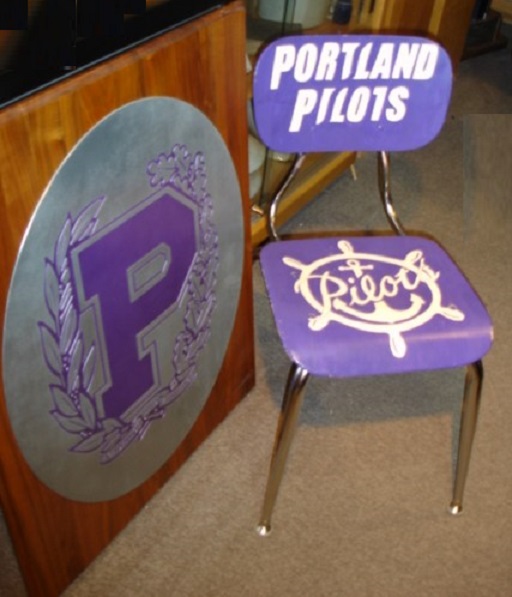
P logo plaque and Portland Pilots Pilot Wheel logo chair.
Portland Pilots Chair (University Museum)

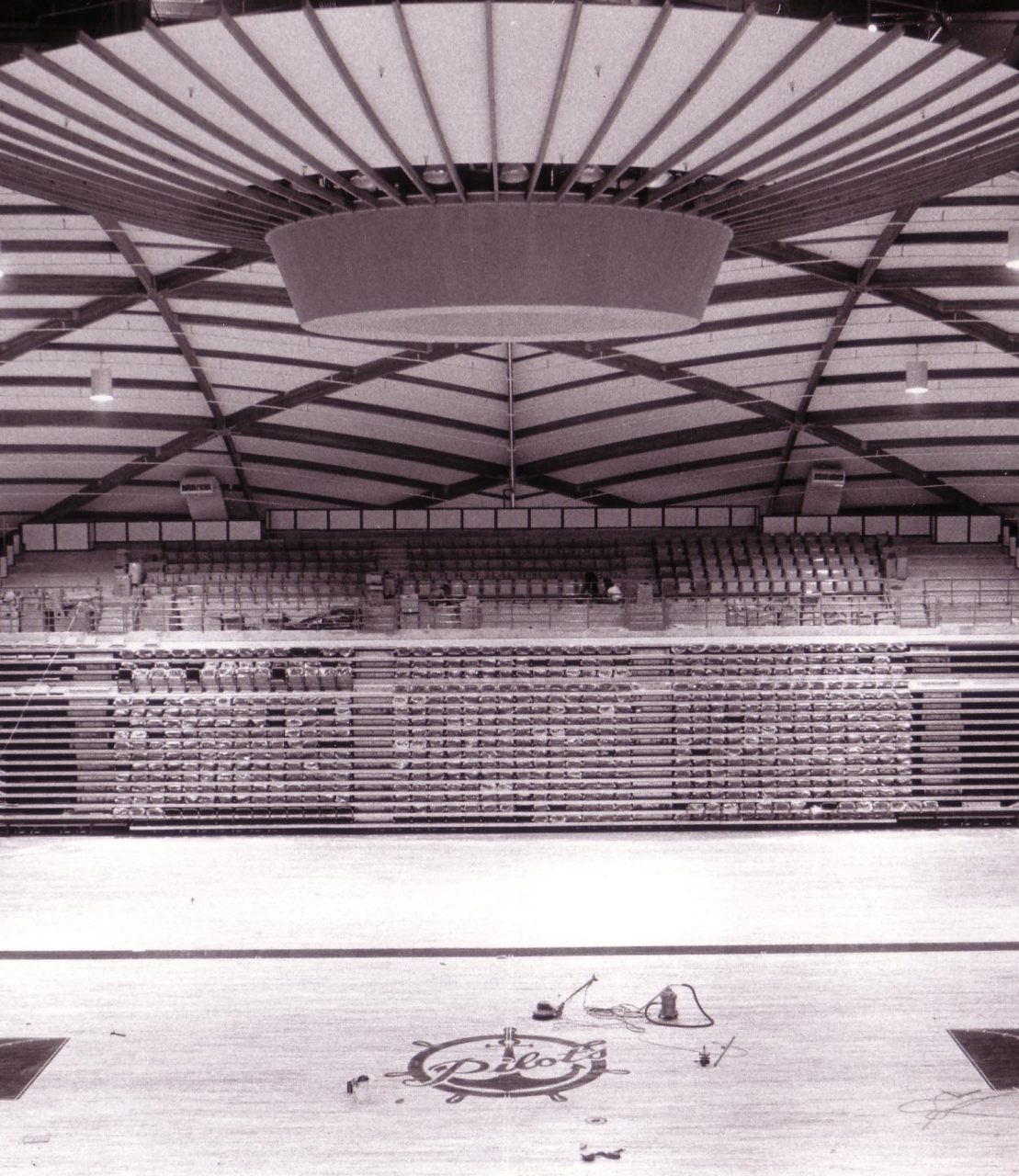
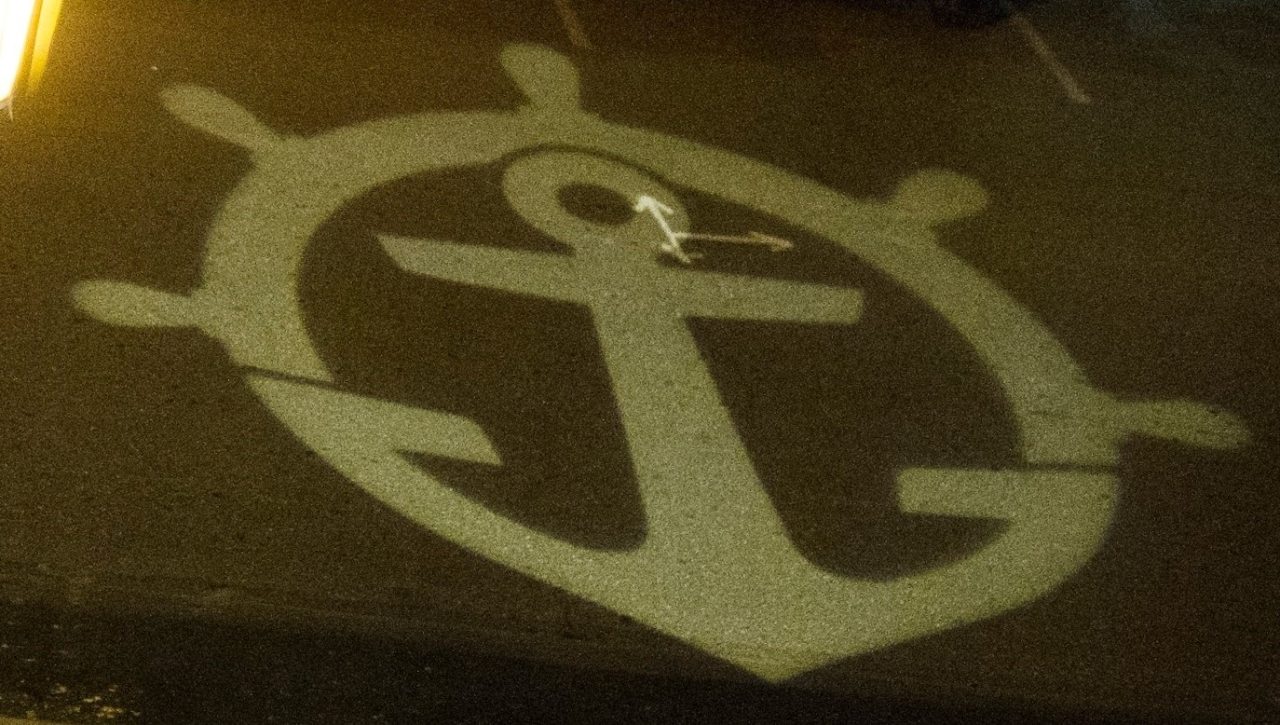
For decades the emblem painted at center court in the Howard Hall basketball arena was an Anchor superimposed on a Pilot’s Wheel.

The ship’s wheel comes to us with Wally Pilot, the tug-boat captain who navigates ships to port in the traffic lanes of the Willamette River. The anchor is borrowed from the University Seal, which repeats the Cross and Anchor motif of the Seal of the Congregation of Holy Cross.

A neat and efficient symbol expression of the University, where students learn to navigate the disciplines and skills of nursing, education, engineering, science and business inspired by the charism and values of the religious community which has been with the University since our founding in 1901. Except, however, despite appearing on the hardwood, sports programs, and courtside seating, when it came to branding, the symbol was not available for marketing because UP never filed for a formal trademark.

Pilots wheel and anchor logo on a 1977-78 Basketball guide book.
Basketball Guide, 1977-78
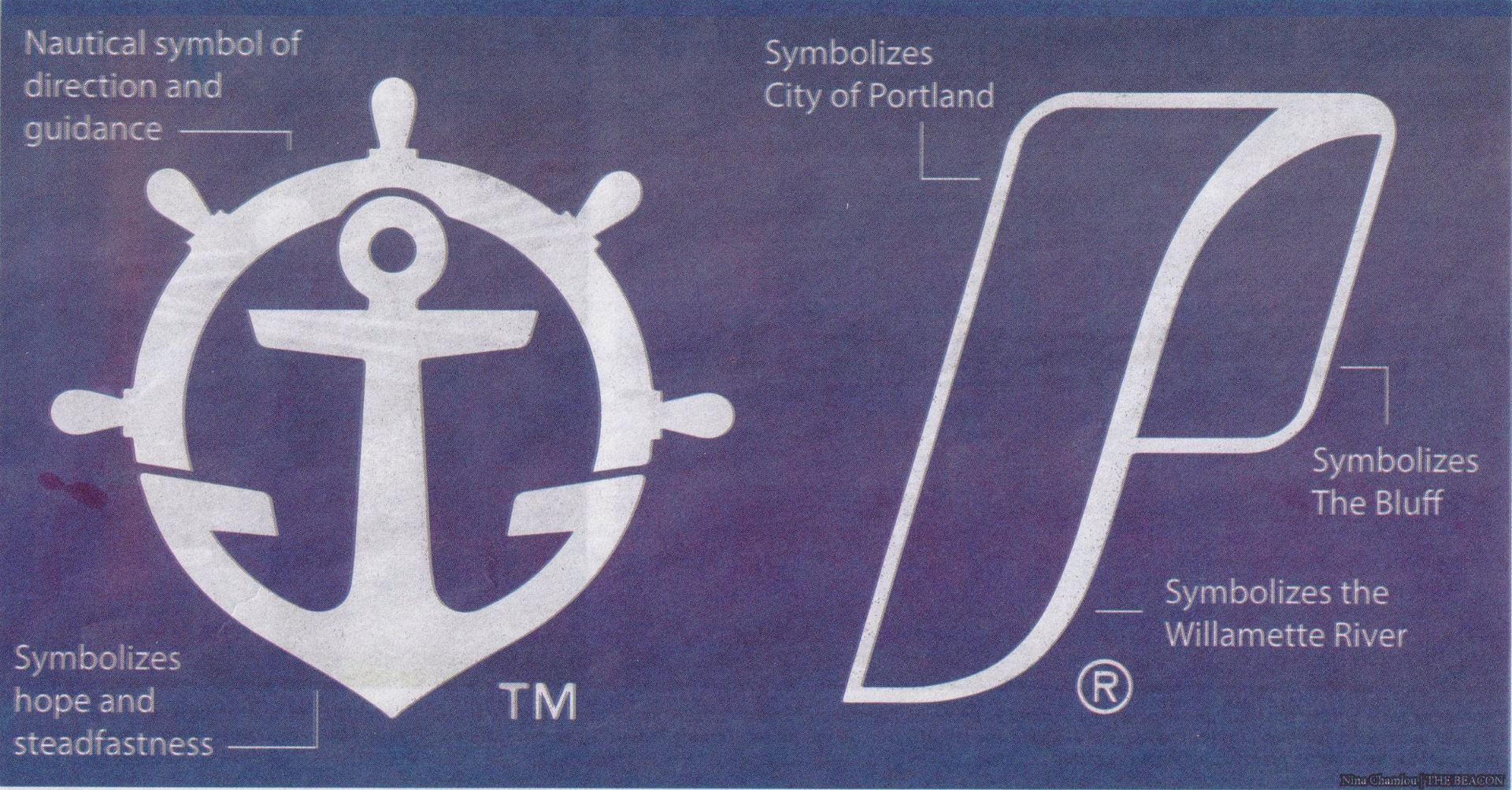
Description and explanation of the Pilot Wheel and Anchor logo and Flowing P logo.
Wheel and Anchor and Flowing P logos decoded, Beacon, October 30, 2014

The current symbol – the Nautical Wheel – was introduced (and trademarked this time!) ten years ago. Still anchor and wheel, but now UP’s very own sports brand; and today very ubiquitous, adorning our home sports arenas, team uniforms, bookstore sweats, coffee mugs, posters, stocking caps and polo shirts. (The flowing capital ‘P’ was introduced in 2007.)

See the full marketing story: Brand refresh brings new logos, The Beacon, October 30, 2014.

Slideshow of University of Portland Logos

  • Pilots Wheel and Anchor logo on the center of a basketball court.
    Pilots Wheel and Anchor logo on the Chiles Center court, 1984
  • Pilot House Wheel and Anchor logo on beverage coaster.
    Pilot House Beverage Coaster, 2015
  • Inflatable Wheel and Anchor Logo
    Inflatable Wheel and Anchor Logo
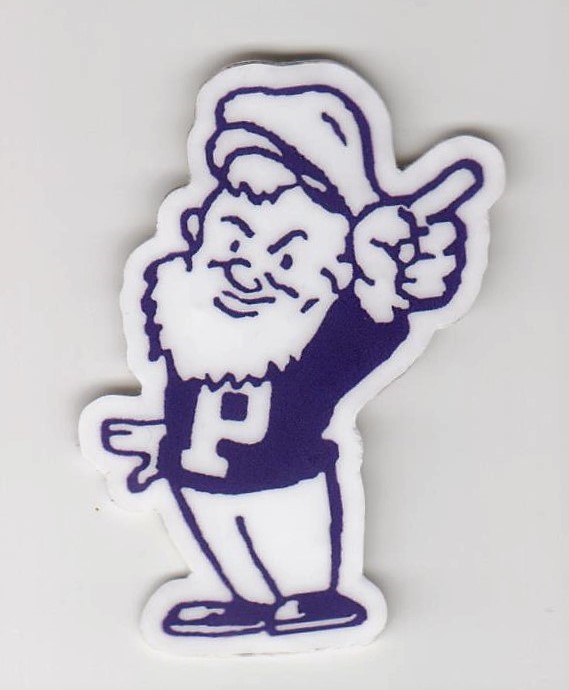
  • Bearded river pilot with cap and P shirt.
    Wally Pilot Sticker, 2023
  • Projected image of the Pilot Wheel and Anchor logo.
    Logo projected through window onto Portsmouth Ave.

Filed Under: Objects, Objects 1 Leave a Comment

University of Portland Medal

December 6, 2023 By Archives

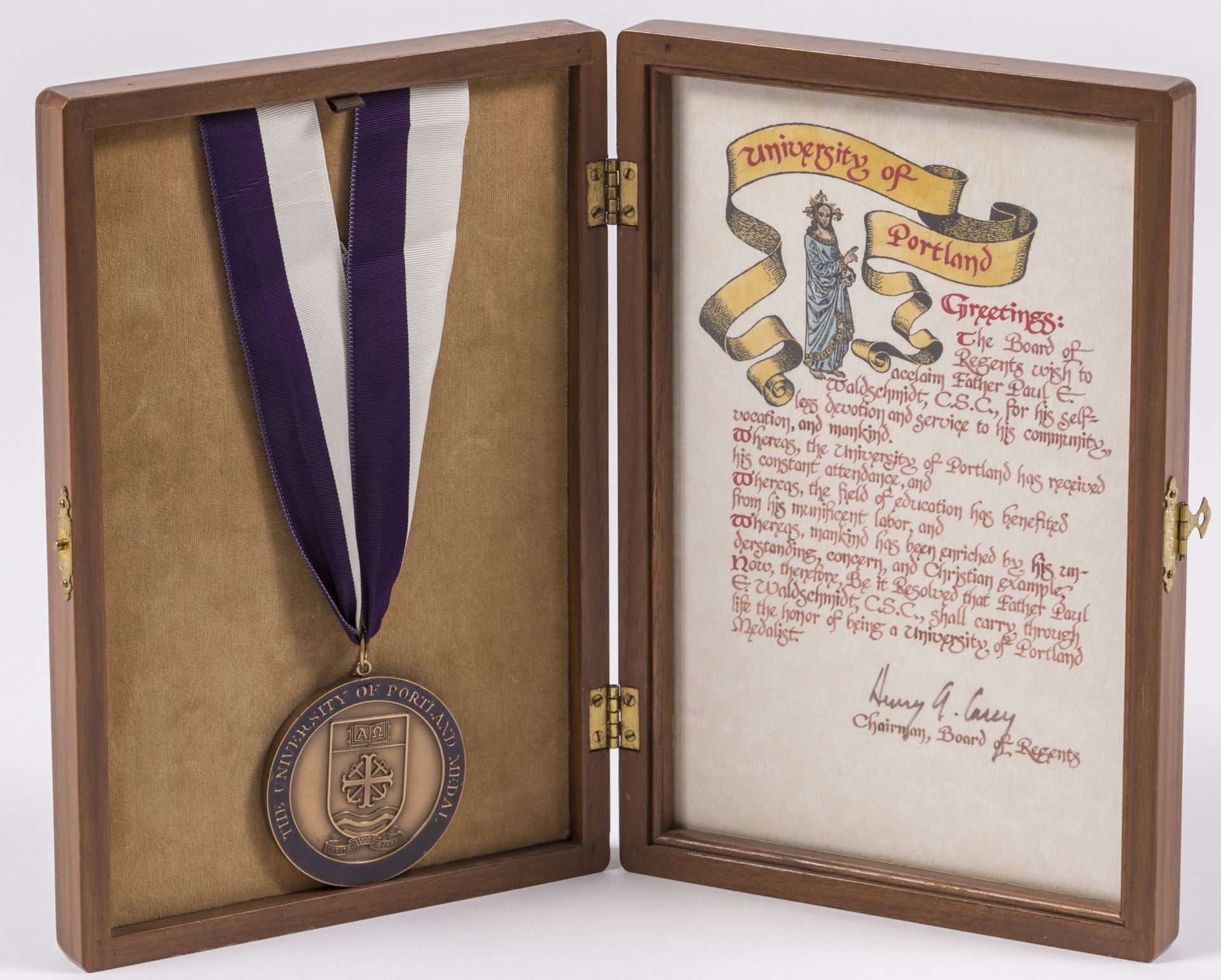
The University of Portland Medal (1972-1983) was established in 1972 by the Board of Regents of the University and awarded to Oregonians of achievement, of selfless community service, as well as to members of the University’s family of friends. The medal was last awarded in 1983.

Medal attached to a purple and white ribbon, descriptive text, and recipient Father Paul E. Waldschmidt.
Portland Medal for Rev. Paul E. Waldschmidt, CSC, 1972

A successor award was established in 1995; The Christus Magister Medal is presented at Commencement to honor persons of distinction in the fields of art, science, education, government.

YearPortland Medal RecipientYearPortland Medal Recipient
1972Rev. Paul E. Waldschmidt, CSC1978Robert B. Pamplin, Sr.
Ira C. KellerMaurie D. Clark
Judge John F. Kilkenny
Arthur J. Decio1979Ernest Hayes, Ph.D.
1973Fred A. Stickel1980John A. Elorriaga
Luther G. Jerstad
1981Sr. Veronica Ann Baxter, S.N.J.M.
1977Harriet Osborn Jeckell
J. Anthony Giacomini1983Lawrence Welk

Here we have a list of “University developers” who are today woven into the landscape of the University: Fr. Waldschmidt was our 15th president and has given his name to the administration building. Mr. Clark is remembered at the Library; for ten years Director of Nursing Service, Harriet Osborn Jeckell was both a graduate and faculty member of the School of Nursing (1934-1958); Dr. Hayes was the Dean of the School of Education from 1965-1979; and Mr. Pamplin has given his name to the School of Business.

Related Post: Brushes with Fame

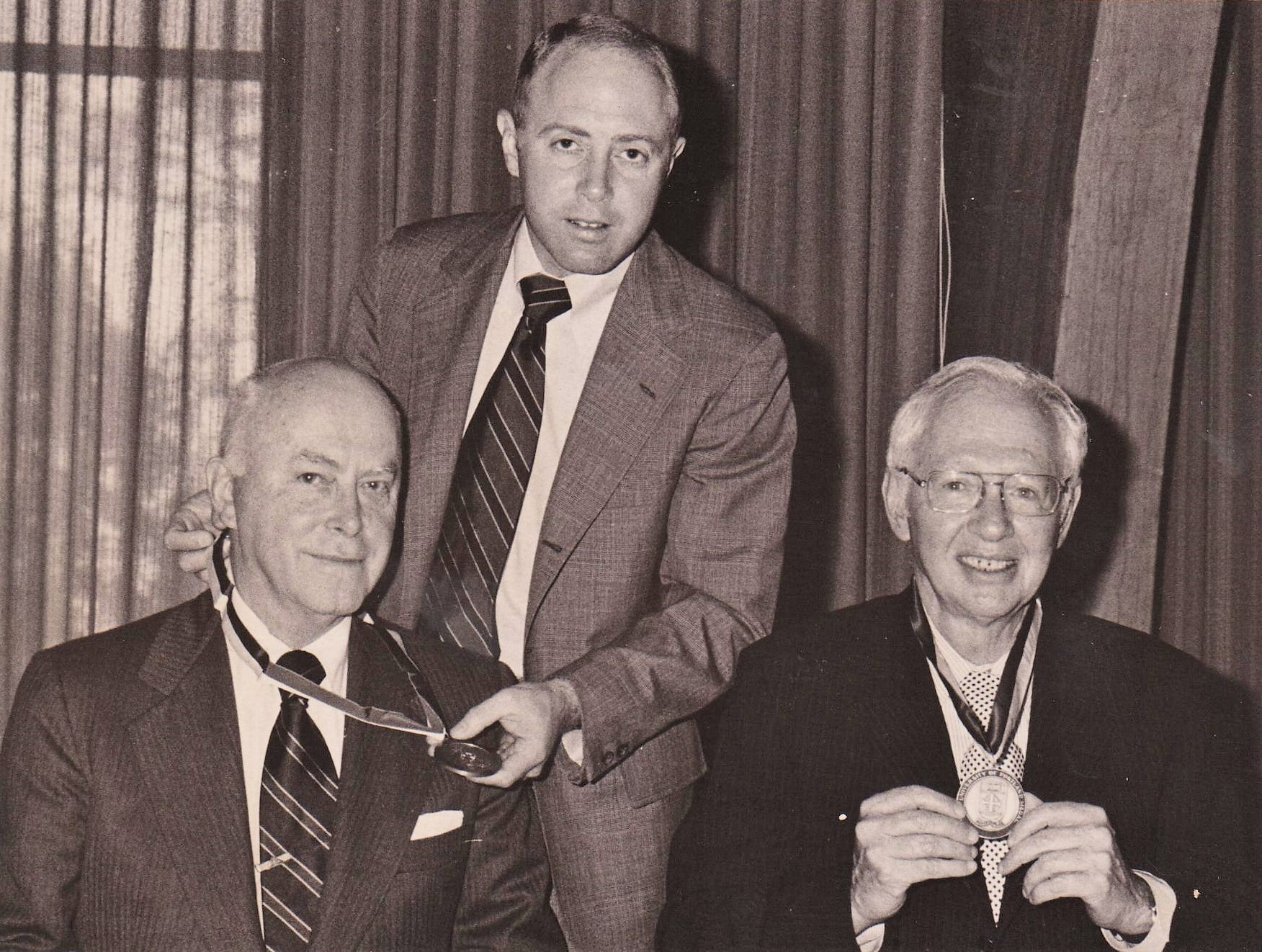
Man standing behind two individuals who are wearing an award medal around their necks.
Chair of the UP Board of Regents, Robert Pamplin, Jr. Awards the University of Portland Medal to his father, Robert Pamplin, Sr. and Maurie Clark, 1978
Newspaper photograph of a man standing behind two individuals showing their award medal.
Robert Pamplin, Jr., Board of Regents Chair, presents University of Portland Medals to Harriett Osborn Jeckell and John Anthony Giacomini, 1977

Filed Under: Objects, Objects 1 2 Comments

UP Museum at 30

October 11, 2022 By Carolyn

Selections from the University Museum, 1987

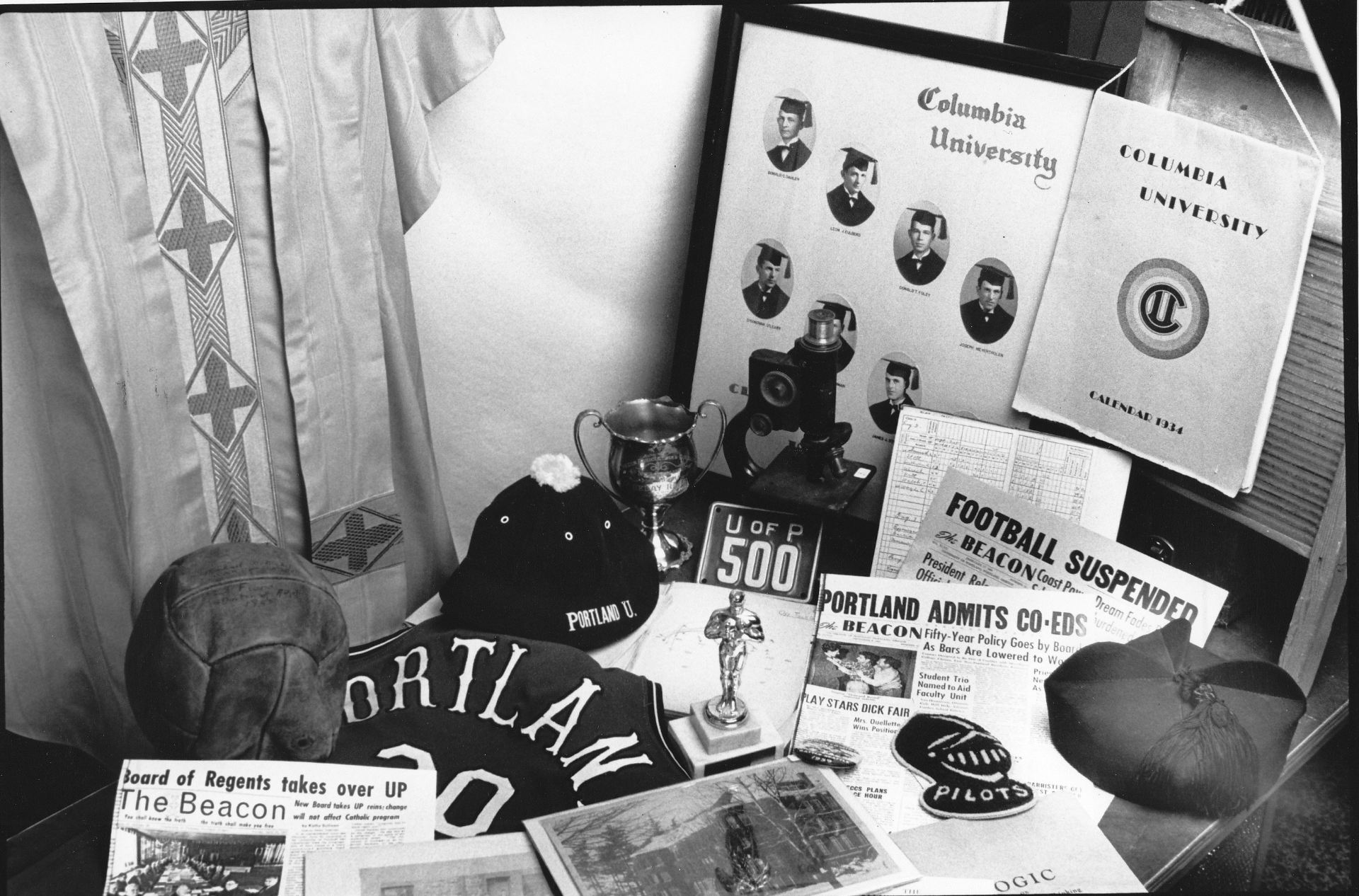
The University of Portland history museum was the brainchild of Dr. James Covert, Professor of History (1961-1997), while researching his 1976 book “A Point of Pride: The University of Portland Story“. Dr. Covert realized the need to save, preserve, and display treasured memorabilia and photographs connected to UP history. The “Heritage Room” was dedicated and opened to the public on October 15, 1992 during the four-day celebration of 90 years of Holy Cross at UP and the rededication and renaming of West Hall to Waldschmidt Hall; a one-room museum space in Shipstad Hall housing items donated by faculty & staff, alumni, and friends.
Family Weekend, 2022

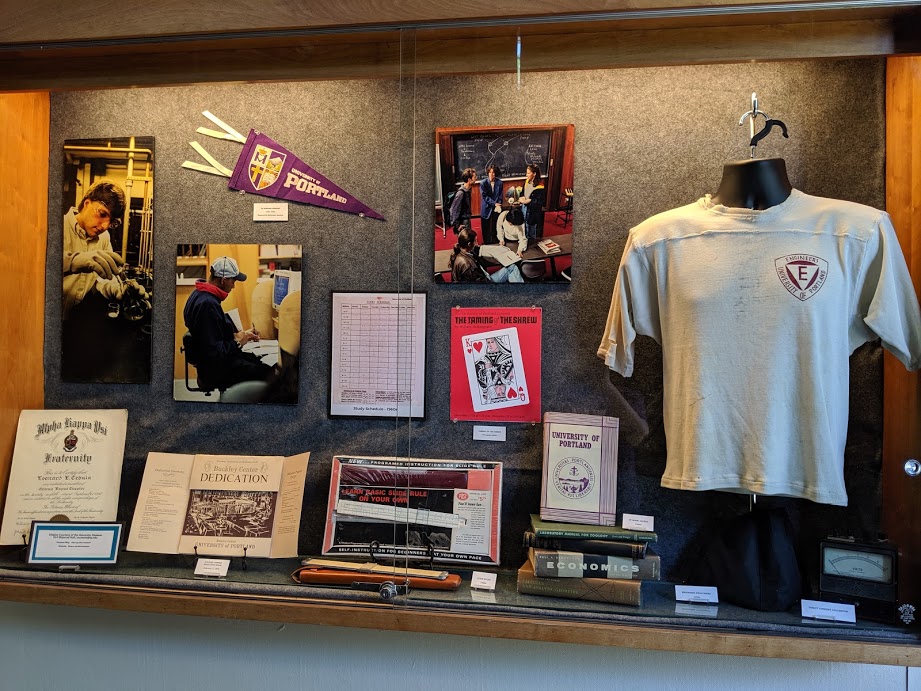
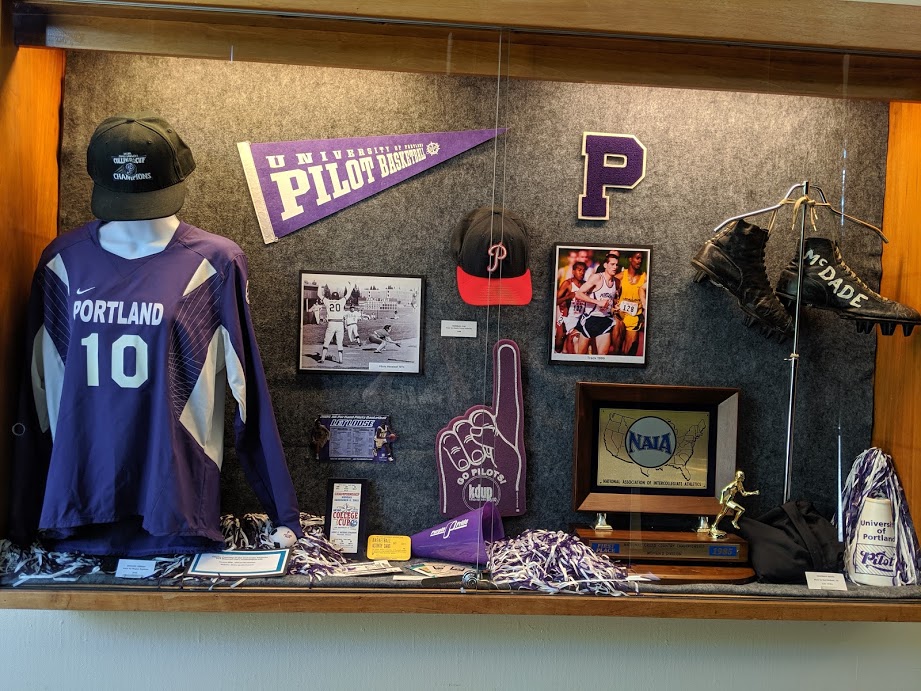
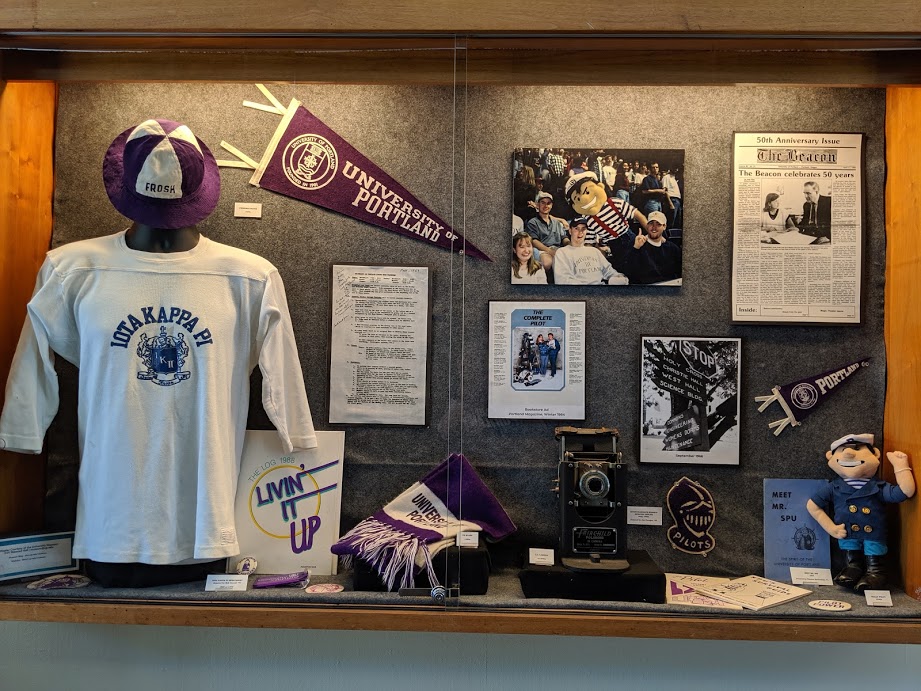
In the 30 years since its opening many students, campus members, alumni and friends have visited the museum to learn about UP history and reconnect with the past. Display cases in campus buildings share event or theme displays drawn from our collections, and the museum contributes to the Library’s Covert Gallery and a display case on the Library’s lower floor.

In recent years the museum has been actively engaged in outreach opportunities to bring the museum directly to event spaces at the alumni reunion, family weekends, orientation, to name just a few. Archives & Artifacts staff host “PortLog“, a blog to share UP history in the form of posts to reach people across campus and beyond. PortLog posts and collection pieces are also shared on the Clark Library’s Facebook page.

In our efforts toward preservation goals, the museum collaborates with the Clark Library Digital Services team to digitize elements of the museum collection and present them online allowing visits to the museum from any device or location from around the world.

Dr. Covert’s vision continues on.

PortLog Posts highlights:
Dr. James Covert
Hours and Bases
A Given Life: Naming Rights

Digital Collections:
Digital Museum
University Songs
UP Presidents

Museum Displays

Academic Display, Alumni Reunion, 2019

Athletic Display, Alumni Reunion, 2019

Social Life Display, Alumni Reunion, 2019


Filed Under: Objects, Objects 1 Leave a Comment

Entrepreneurial Spirit

May 18, 2022 By Carolyn

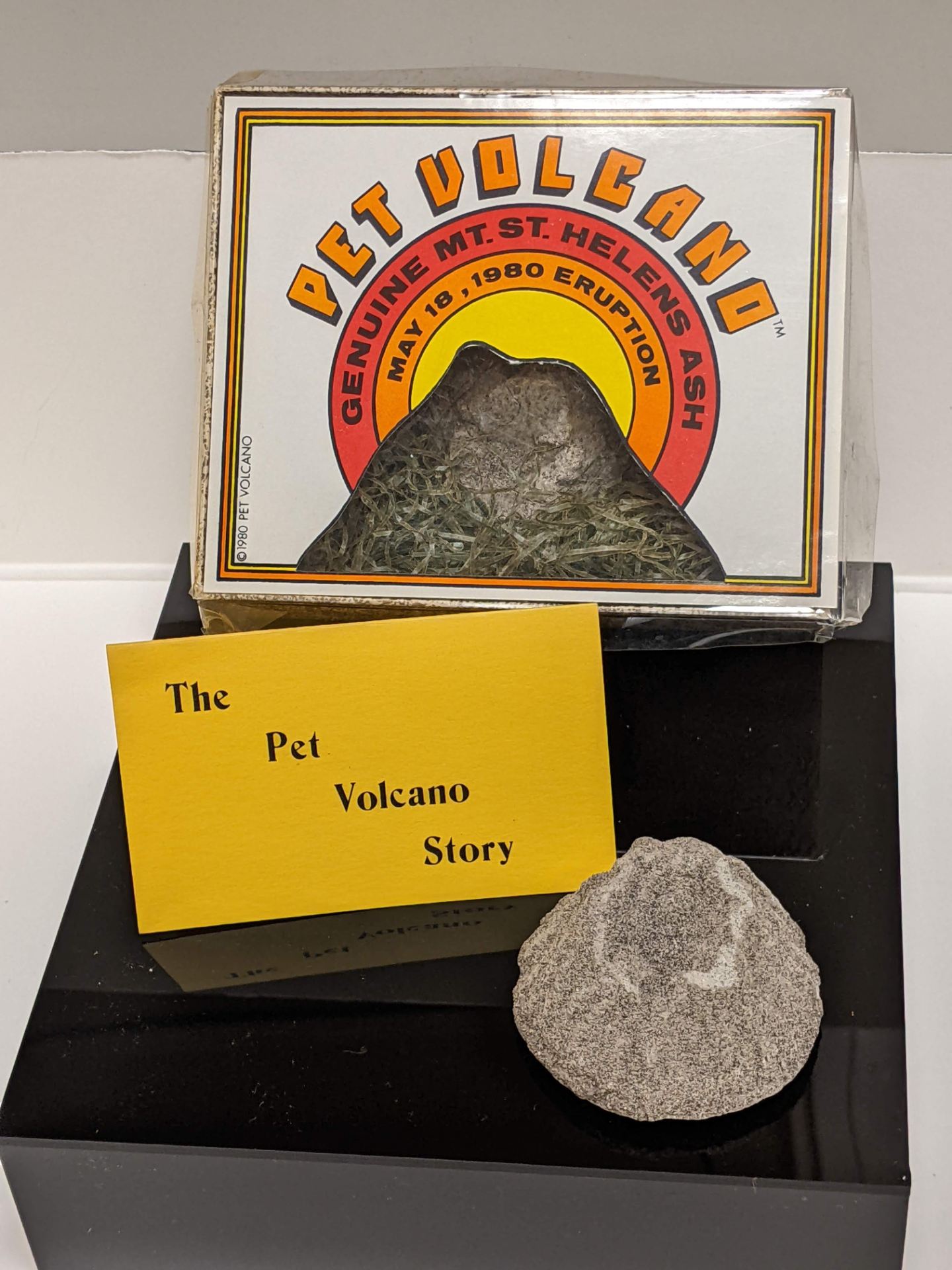
Pet Volcano, 1980

The Mt. St. Helens volcano exploded on May 18, 1980. One of those events that anchors one of those do you remember where you were when it happened questions in Pacific Northwest history. And for those who grew up here, evokes memory of seeing a thin layer or more of ash covering streets and objects, cars and trees, and lawns and mailboxes and sidewalks and park benches around Washington and Oregon, including the Portland metro area and the UP campus.

Click to enlarge image

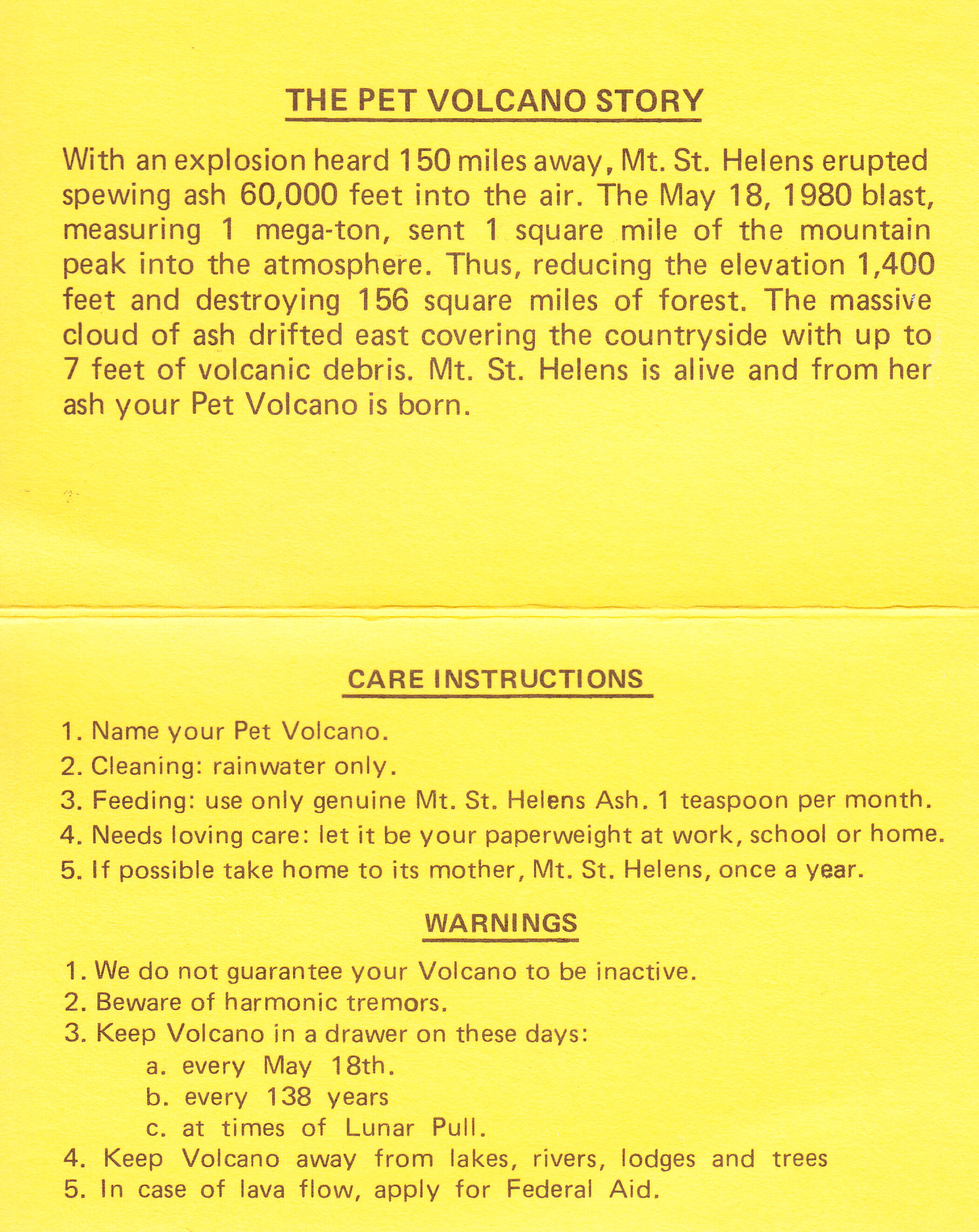
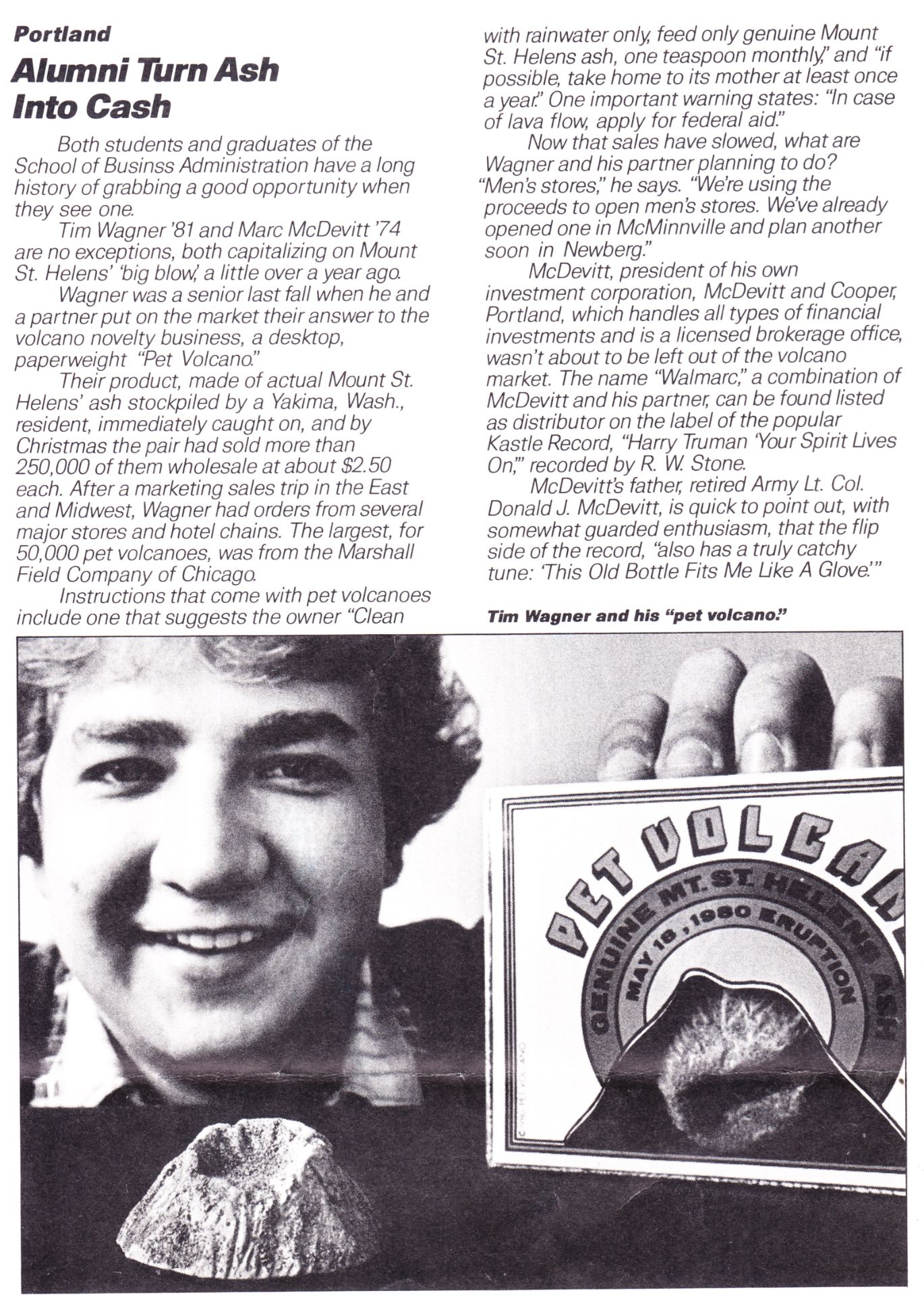
Naturally, over time, some of that ash has been donated to the University Museum. Little glass jars with post-it-notes affixed, discarded by the original collector, seeking preservation and adoption on Museum shelves. But then too, we have the curious exemplum of a quite clever, lightning quick exploit-the-moment entrepreneurial insight. The Pet Volcano. The brain-child of two alumni entrepreneurs, Tim Wagner, ’81, and Marc McDevitt, ’74, the Mt. St. Helens ash was repurposed to create a novelty desktop paperweight. Their limited edition Pet Volcano had 250,000 sales by Christmas 1980. An original Pet Volcano with its box cover still lives in the UP museum.

Portland magazine, Summer 1981, vol. 1 no. 2, p. 9

Filed Under: Objects, Objects 1 Leave a Comment

Silly Hats, Masks, a palimpsest

August 17, 2021 By Carolyn

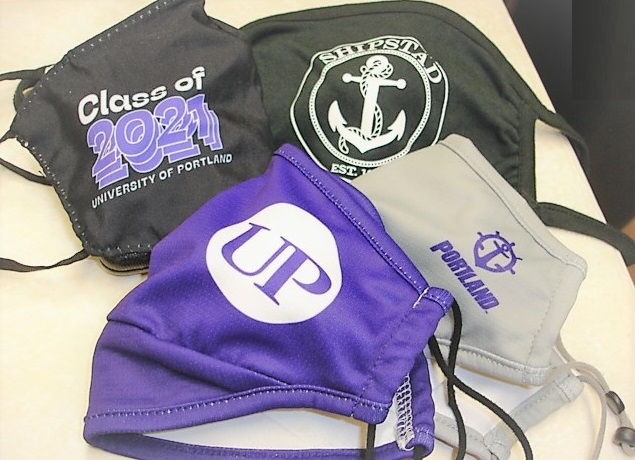
Four University of Portland Face Masks. Class of 2021, Shipstad Hall, UP, Portland
University of Portland Face Masks, 2021

In the new circumstances, as vaccinations and other mitigations make Covid-19 a lesser anxiety, a new generation of students and staff at UP may find donning face masks as colorful, various, and incongruous a fashion choice as the Freshmen Beanies once sported by an earlier generation of our citizenry.

two students wearing freshmen beanie caps
Two freshmen students wearing beanie caps, 1963

Readers paging or scrolling through the Log yearbooks from the 1950’s and 60’s will likely spot individuals or groups of students wearing UP-colored beanie caps. The captions and descriptions beneath the photos identify these capped students as freshmen.

black and white photo of freshman students buying beanie caps
Students buying beanie caps, 1960

This not-entirely-voluntary student life tradition begun around 1949 (running until circa 1970), REQUIRED incoming freshman students to purchase and wear a beanie cap during their first weeks on campus. Throughout this period freshman were to be seen with beanies on their heads for classes and events. And being caught without a beanie would result in the offender paying a minor fine, either a small cash amount or performing public-service (i.e. scrubbing the exterior of Early Hall).

Cover page of Meet Mr. SPU autograph book
Meet Mr. SPU Autograph Book, 1967

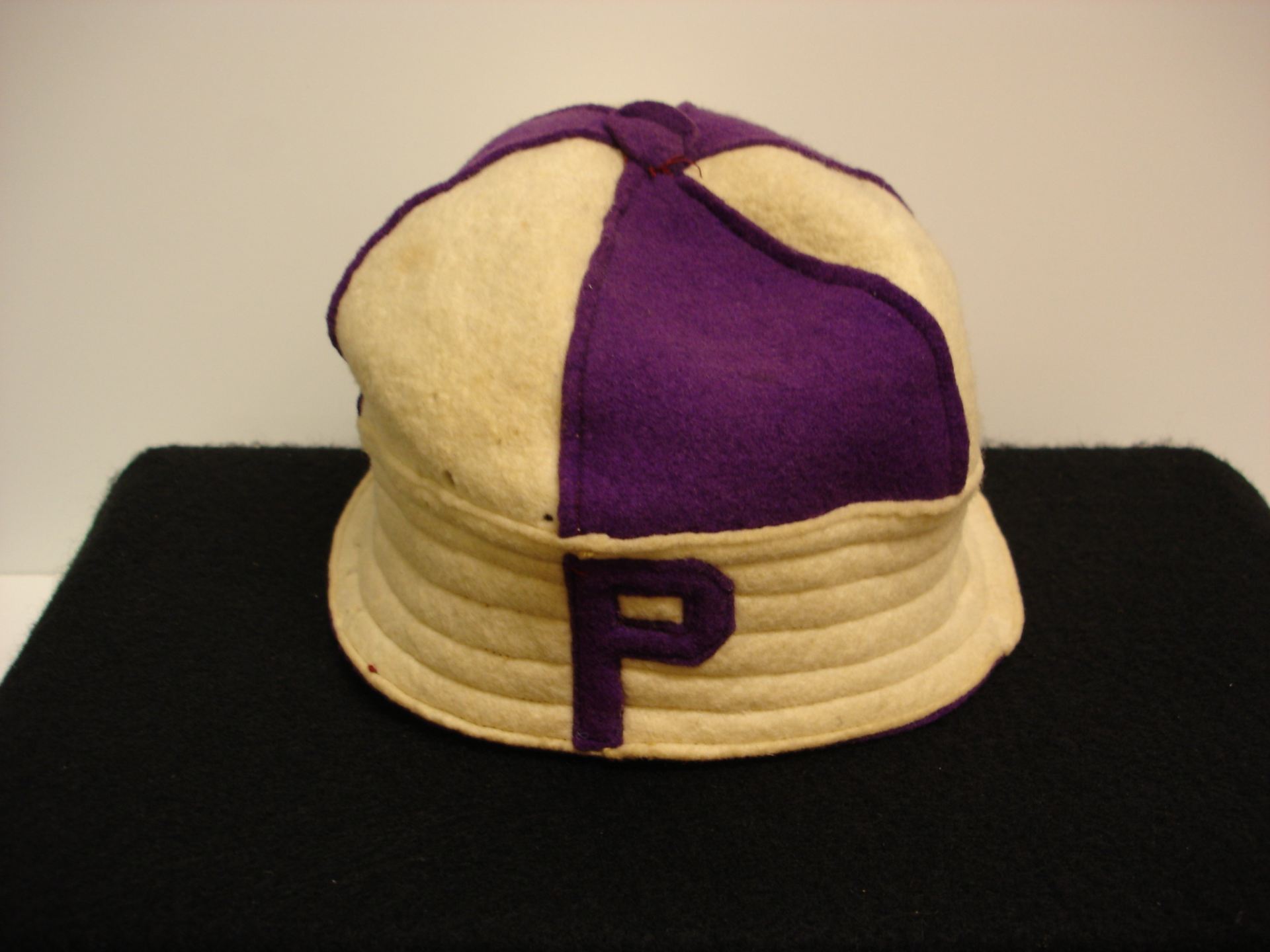
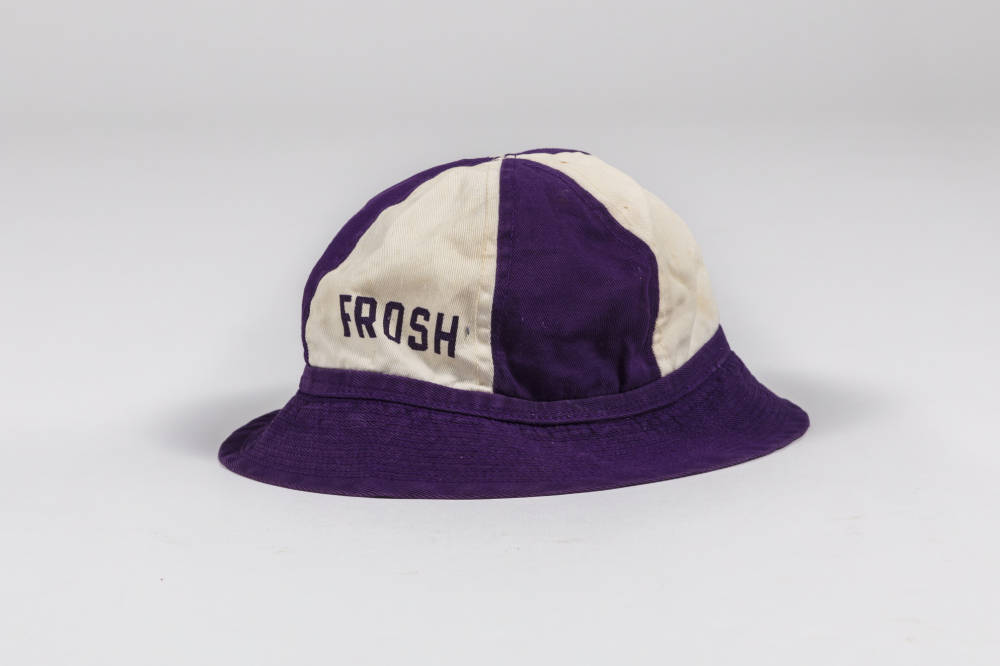
Beanie caps went through design and style changes over the years. Some simple purple and white beanies (1949-1954), other years, solid purple caps with or without a white pom and Portland or Pilots branded across the front (1955-1960). The last generation (1962-1969) beanies returned to alternating panels bearing the University colors, with or without the designation “FROSH” across the front.

Thomas Rothschild, ’71, recalls “Freshmen had to wear the beanie for at least one month. During that month freshman were required to get fifty upper classmen signatures in a small notebook entitled Meet Mr. SPU The Spirit of University of Portland” and signatures of two student body officers. The length of time for wearing a beanie could be shortened if freshmen emerged as victors in the annual freshman-sophomore tug-of-war. Some 50+ years later, beanie caps are still spotted at University alumni reunions.

Click on image for slideshow

white beanie cap with purple band
Freshman Beanie Cap, ca1950s
purple and white wool beanie cap
Freshman Beanie, ca1950s
purple beanie cap with white pom
Freshman Beanie, 1958
purple and white panel beanie cap
Freshman Beanie, 1967
Freshmen students wearing beanie caps
Freshmen wearing beanie caps, 1963
four girls sitting on the grass, one is wearing a beanie cap
Students sitting on the grass, 1953
rectangle sign with picture of face mask
One of the “Mask Required” signs on the UP campus, August 2020
sign posted at entrance to campus with limited access and mask requirement information
Pilots Prevent sign posted at main entrance to campus, August 2020

View some of our vintage beanie caps on display in Buckley Center in the first floor display case across from the Studies Abroad office.

Additional beanie photos from the LOG
https://digital.up.edu/collections/list/collections/3?search=beanie&applyState=true

Filed Under: Objects, Objects 1 Leave a Comment

Baseball-Fever every Spring

May 12, 2021 By Carolyn

A game of catch, a ball & bat, a chalk diamond.  Baseball has proved a perennial pastime for UP students from the earliest boarders ‘til today.  The Shipstad quad– since before we built Shipstad– was the site for campus baseball-field(s) from the 1920s forward.  And still today, the green space invites students onto the lawn to toss a baseball back and forth playing catch, combining at times into a half-organized pick-up game setting up one tangle of students to guard the bases and fields in competition against a batter who tries mightily to hit-in a run for the team.

right-handed leather baseball glove
Reach Company right-handed fielders glove, ca1908

Displayed alongside other items of athletic memorabilia in the University Museum is a vintage, well-worn right-handed leather baseball glove used by Columbia University student athlete, William Grussi, class of 1908.

The use of baseball gloves dates back to the 1860s with some fielders wanting to have protection for their hands. At first it was just a work glove, or a modified glove without finger tips. By the 1890s leather padded gloves and mitts were standard issue for regular play.

right-handed leather baseball glove
Reach Company baseball glove with full web, ca1908

The circa 1908 glove used by Grussi features a full, solid web between thumb and forefinger to create a pocket for catching a baseball. Webbing was a new feature for baseball gloves between 1900-1910 and is the precursor to the see-through web style that is still in use today.

Grussi’s glove was made by the A. J. Reach Company, a U.S. manufacturer of sporting goods in the late 1800s and early 1900s. Founded in 1874 by former major league baseball player, Alfred James Reach, the Reach company made its name manufacturing its own baseballs and branching out to other athletic equipment including baseball bats, mitts and gloves. Reach later sold his business to one of his competitors, A.G. Spalding Bros., which manufactured the Reach gloves under the original name before transitioning to the Spalding brand.

Baseball Glove in Clark Library Digital collections:
https://digital.up.edu/Documents/Detail/baseball-glove-circa-1908/106118

References:
A.J. Reach Company:
http://www.antiquefootball.com/a_j_reach.htm

Baseball glove dating guide:
http://keymancollectibles.com/glovesmitts/fullwebgloves.htm

Filed Under: Objects, Objects 1 Leave a Comment

Spirit of Portland U Pennant

August 25, 2020 By Carolyn

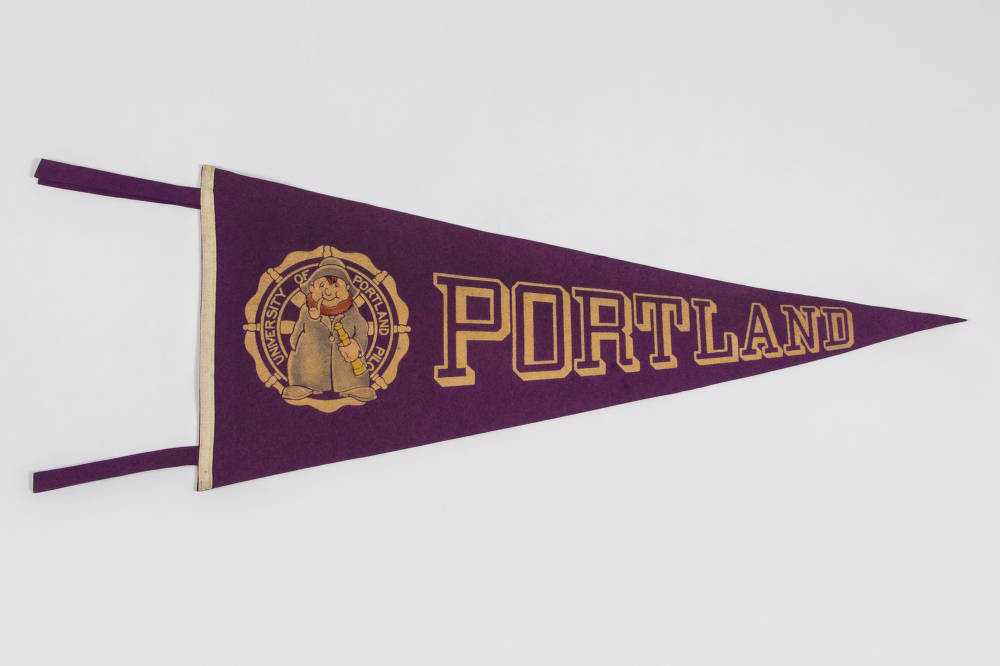
Portland Pennant, late 1940s

This Spirit of Portland U pennant (circa 1948 or 1949) is one item in the Student Life collection of the University Museum. Dr. Manuel Macias was the donor, a 1951 alumnus, long-time professor of Spanish (1958-1995), and faithful student scholarship donor — a true Pilot.

Bookstore, ca1962 (click to enlarge)

The colorful pennant design logo prominently features then-new University mascot, Spirit of Portland U (SPU) – a river pilot with rain gear and spyglass – created in 1948 by Nolan Drurey, class of 1949, winner of a Beacon-sponsored mascot design contest. One of the early items for sale in the University Bookstore with the new mascot design.

SPU’s image spread to spirit and campus swag and publications — 1948 Homecoming (napkins and coasters), student book covers, Pilot Student Guides, student body ID cards, t-shirts and more, as pictured in this photo from the University Bookstore.

The SPU rally-squad mascot (a student inside animating the heavy costume) evolved through the years and embraced a name change to become Wally Pilot in the 1970s. Our earlier post about Wally Pilot tells the backstory.

Additional References:
Spirit of Portland U (SPU): https://up.contentdm.oclc.org/digital/collection/p16472coll10/id/414/rec/27

Wally Pilot:
https://sites.up.edu/museum/?s=wally+pilot

Filed Under: Objects, Objects 1 1 Comment

Battling Germs

July 28, 2020 By Carolyn

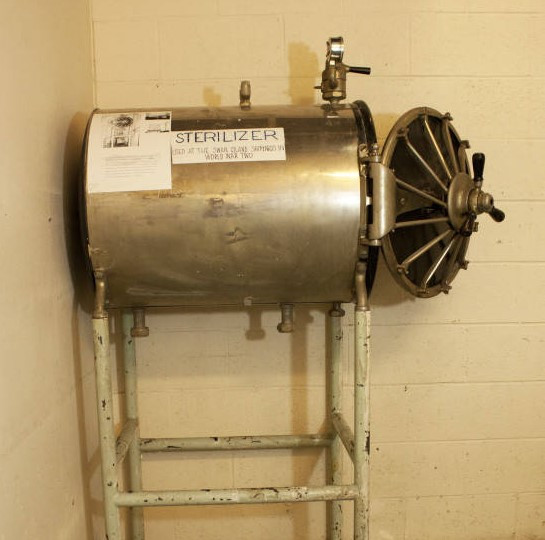
Deep in the museum basement storage room in Shipstad Hall is a very large World War II-era Autoclave Sterilizer manufactured by the American Sterilizer Company. The hand-made sign reads: Sterilizer Used at the Swan Island Shipyards in World War Two

Autoclave Sterilizer (click to enlarge)

The curious-minded might wonder the part a sanitizer might play in industrial shipbuilding, during World War II, or even before, or after. How does it fit?

Swan Island names the area below the Bluff. During World War II the Portland airport and the Henry J. Kaiser shipyard were both located on the island. The shipyard operated under the authority of the U.S. Maritime Commission’s Emergency Shipbuilding program. They built war-ships there for the Navy; big ships, armored ships, ships for offense and attack. Rather urgently. The work and workers did not stop but had three-shifts for 24-hour production.

Front of Autoclave Sterilizer Chamber (click to enlarge)

A sterilizer autoclave is not used for industrial battleship production (examination gives no evidence of that sort of wear and tear). However, Kaiser furnished a Child Service Center to provide 24-hour child care while parents (women filled the gaps in the labor shortage) worked at the shipyard. Children using the center were inspected upon arrival and sent immediately to the infirmary for additional care if any signs of illness appeared. An autoclave does sanitize medical instruments. These Child Service Centers operated from November 1943-September 1945.

When the war ended, shipyards declined, and the Child Service Center shuttered its doors; much of their production material was repurposed as well. The University acquired a number of War Surplus items for use in the classrooms, and even as classrooms. The biology department and science programs received quantities of supplies and equipment, the sterilizer a prime specimen, a first-rate industrial-grade laboratory upgrade for biology and science instruction.

References:
“Child Care for Swan Island Shipyard Workers.” Oregon History Project, https://oregonhistoryproject.org/child-care-for-swan-island-shipyard-workers/. Accessed 3 June 2020.

Curd, Mary Bryan. “Child Service Centers, Swan Island Shipyards.” Oregon History Project, 19 Nov. 2019, https://oregonhistoryproject.org/articles/child-service-centers-swan-island-shipyards/

Willingham, William F. “Swan Island.” The Oregon Encyclopedia, 1 June 2018, https://oregonencyclopedia.org/articles/swan_island/#.XtaA9zpKjI

Clark Library Digital Collections

Filed Under: Objects, Objects 1 1 Comment

Tonsillectomy Bag

June 17, 2020 By Carolyn

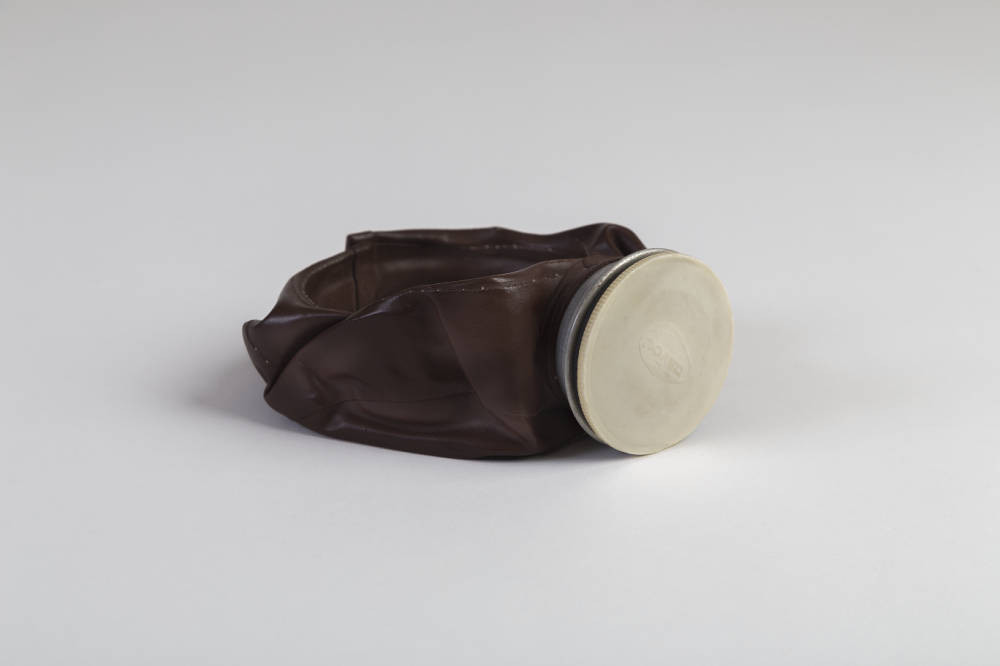
Tonsillectomy Bag (click to enlarge)

The tonsillectomy (tonsil-removal surgery) has been a rite of passage for many children (especially children from classic family television from the 60s and 70s). After-care always promising ice-cream treats!

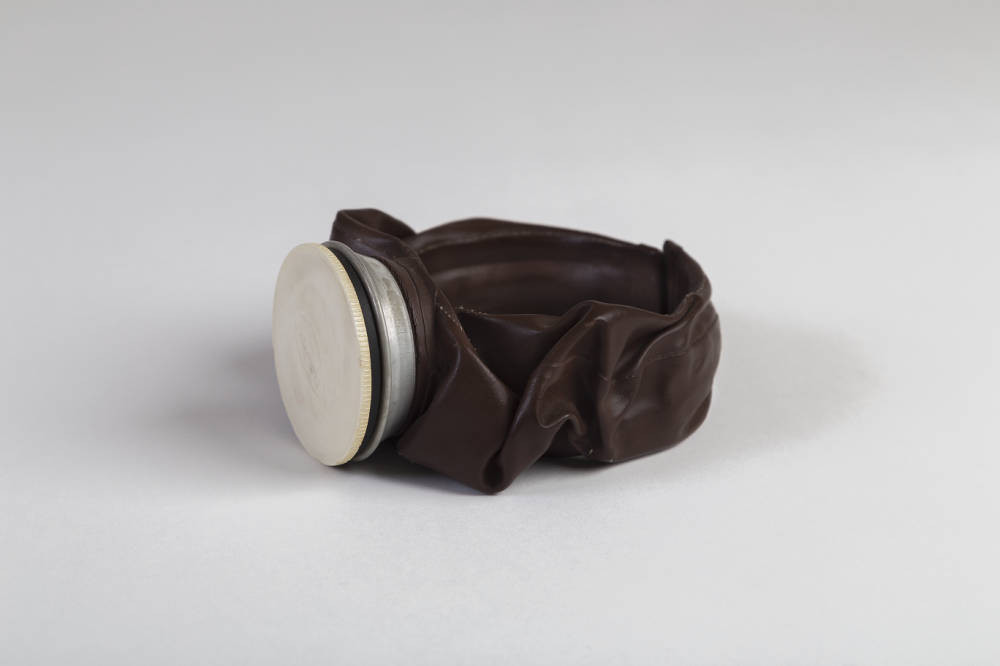
Side View (click to enlarge)

In real life, discharge instructions suggest applying cold-therapy externally in order to reduce swelling and inflammation. Today’s therapies might favor using a bag of frozen vegetables or a sealed bag of ice. Before ziploc, the Davol Company (maker of rubber medical supplies) produced this ugly, but functional item. A brown, rubber circular bag for cold water or ice and wrapped around the neck to secure in place. Estimates place its manufacture in the 1940s or 50s.

University Museum, Nursing Collection, M2009.9.4

Filed Under: Objects, Objects 1 1 Comment

  • Go to page 1
  • Go to page 2
  • Go to page 3
  • Go to Next Page »

Primary Sidebar

Hours and Location

University of Portland Museum
014 Shipstad Hall

Available by e-email at:  museum@up.edu

Digital Collections

Explore some collections and resources from the Archives and Museum available online through Digital Collections


Social Media

Follow us on Facebook

Follow us on Instagram

Ask Us Anything

Ask Us Anything

We'd Love to Hear from You! Questions? Comments? Topics?

This form is protected by reCAPTCHA and the Google Privacy Policy and Terms of Service apply.

Copyright © 2026 · News Pro with Full Header On Genesis Framework · WordPress · Log in

Subscribe

Subscribe By Email

Get every new post delivered right to your inbox.

This form is protected by reCAPTCHA and the Google Privacy Policy and Terms of Service apply.


Loading Comments...