• Skip to primary navigation
  • Skip to main content
  • Skip to primary sidebar

University of Portland Museum

  • Home
  • About
  • List of Entries

Archives

DEI : Gateways & Opportunity : Again Please; Try, Repeat again

January 25, 2023 By Archives

There is an unfortunate banner headline in the student newspaper for December 8, 1950; which reads: PORTLAND ADMITS CO-EDS: Fifty-Year Policy Goes by Boards As Bars Are Lowered to Women (vol. XLVIII, number 10, p.1).  There are many ways the words can be misread by us seventy plus years later.  The actual news was the announcement “that all colleges of Portland will be open to Co-eds starting with the second semester”, effective January 27, 1951.  The only barrier being dropped was that which barred women from enrolling as general undergraduates.  Admissions standards (academic record, test scores) for women and men would remain the same.  In point of fact, women students had been receiving University of Portland degrees in the College of Nursing since 1938 and graduate programs in the Humanities and Library Science well before this 1950 announcement removing barriers in all colleges.  Still, the headline is a landmark, and draws a clear demarcation defining a before and after. 

There is no similar headline or news story in University of Portland history regarding racial integration of the student body.  There is no before and after in this area, because there was no exclusion practiced in this area.  Diversity was always a goal.  In the first years—and after—UP defined itself as an international school and advertised its ability to draw students from different parts of the globe.

1948 Jan Alumni Bulletin p11

The 1904-05 student list has a student with a home address in Mexico.  We record students from the Philippines & Peru in 1920-21; and brag at having over 19 citizens from The Kingdom of Hawai’i attending in ‘48-‘49.  The Geographical Location of Students table given at the end of the 1968 Bulletin counts 57 International students; 14 from Chile, 11 from Hong Kong.

During this same period when women were breaking down barriers of opportunity at UP, noteworthy but less noticed, three alumni — Alvin Batiste ’49, William McCoy ’50, and Fred ‘Hap’ Lee, Jr. ’50 —  achieved success and brought distinction to the University in their post-collegiate careers.

Alvin Batiste was a chemical engineer at the Bonneville Power Administration following his Engineering Masters (Washington State), and became Director of the Model Cities Program, Portland, OR in 1969.

William McCoy entered public service after graduation and served ten years on the Multnomah County Welfare Commission before being elected to the Oregon State House in 1972; he returned to UP in 1976 as Speaker at summer commencement and received an honorary doctorate.

Fred Lee’s story is included in the book, Joel S. Franks, Asian American Basketball: A Century of Sport, Community and Culture (2016).  While at UP, Hap Lee was one of the first Chinese American varsity basketball players in the country; a pioneer in integrating collegiate sports.
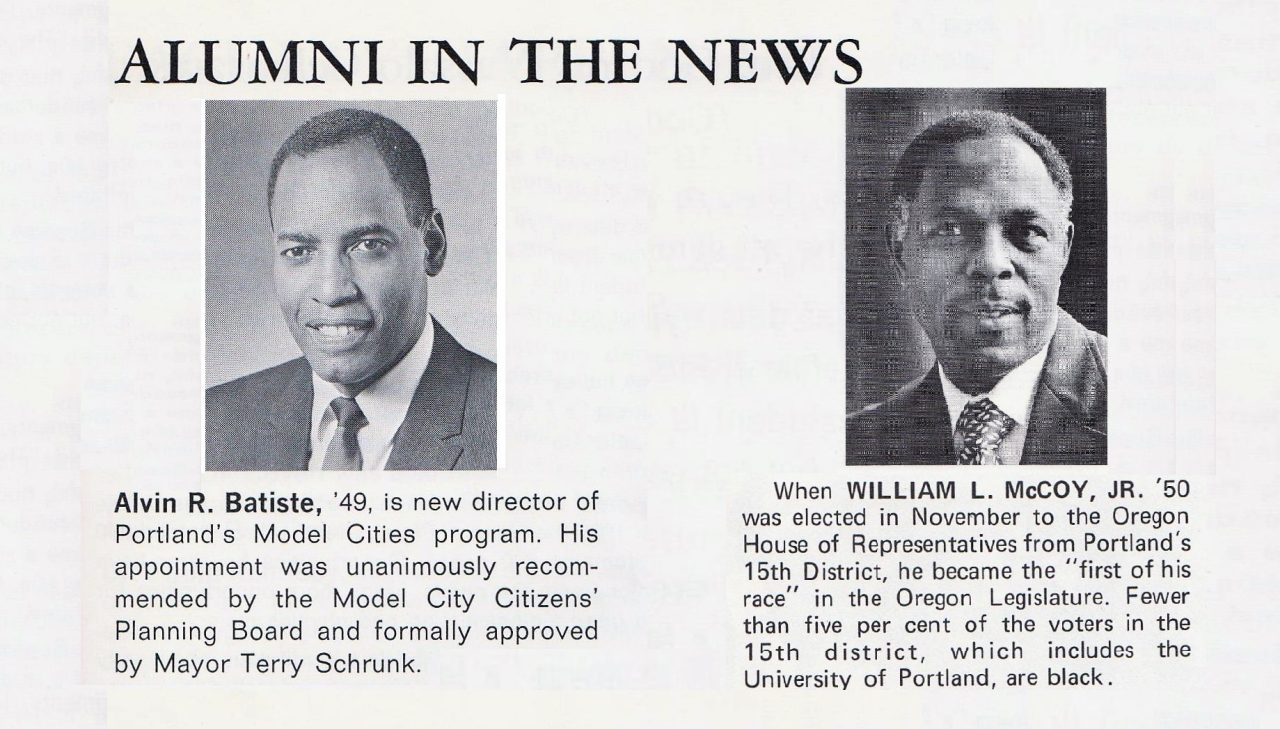
Alumni Bulletin

Athletics is a reliable source of undergraduate diversity, and here also, the UP Athletic Hall of Fame has promoted the contribution of minority community athletes to our campus life: John Freeman ’49; Andy Johnson ’53; Jim Winters ’56; Karyl Wing Johnson ’85; Lorena Legarde ’85.

When the University reached its half-century birthday, classrooms and sports teams were racially integrated and women were students on campus—even before the administration officially reversed and repudiated the ‘all-male’ policy– perhaps because education, access, opportunity had been the point all along.

A snapshot of time.  Describing a campus neither exclusive nor exclusionary.  A selective and partial history.  But pointing towards an ideal of access and opportunity.  One moment in the life of UP history illustrating how diversity was a normal value, uncommented, without fanfare of headlines, simply part of the fabric and experience of campus life, circa 1950.  Try.  Forward.  Repeat.  Try again.  Then and now, a work-in-progress.
Filed Under: Values, Values 1 Leave a Comment

Diversity Belongs to the Recipe

November 17, 2022 By Archives

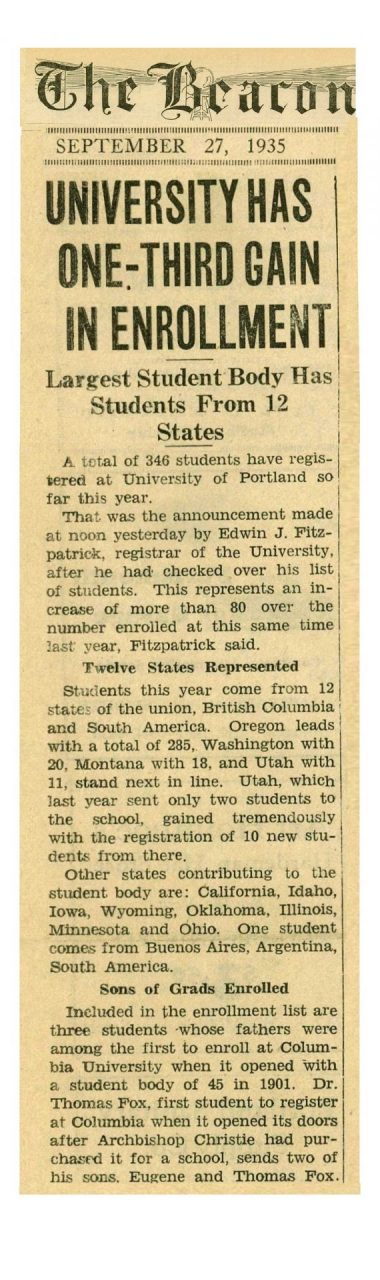
The University has always boasted of the international students attracted to our campus.  A student body that comes from around the globe is a validation, a marker of excellence.  This bit of bragging goes back to when the Kingdom of Hawaii was a foreign nation and was part of our self-promotion; though legacy enrollment was also an important affirmation.  As evident in this exhibit from 1935, when your numbers stand at 346 total enrollment, you will cherish the origin-story of every student.

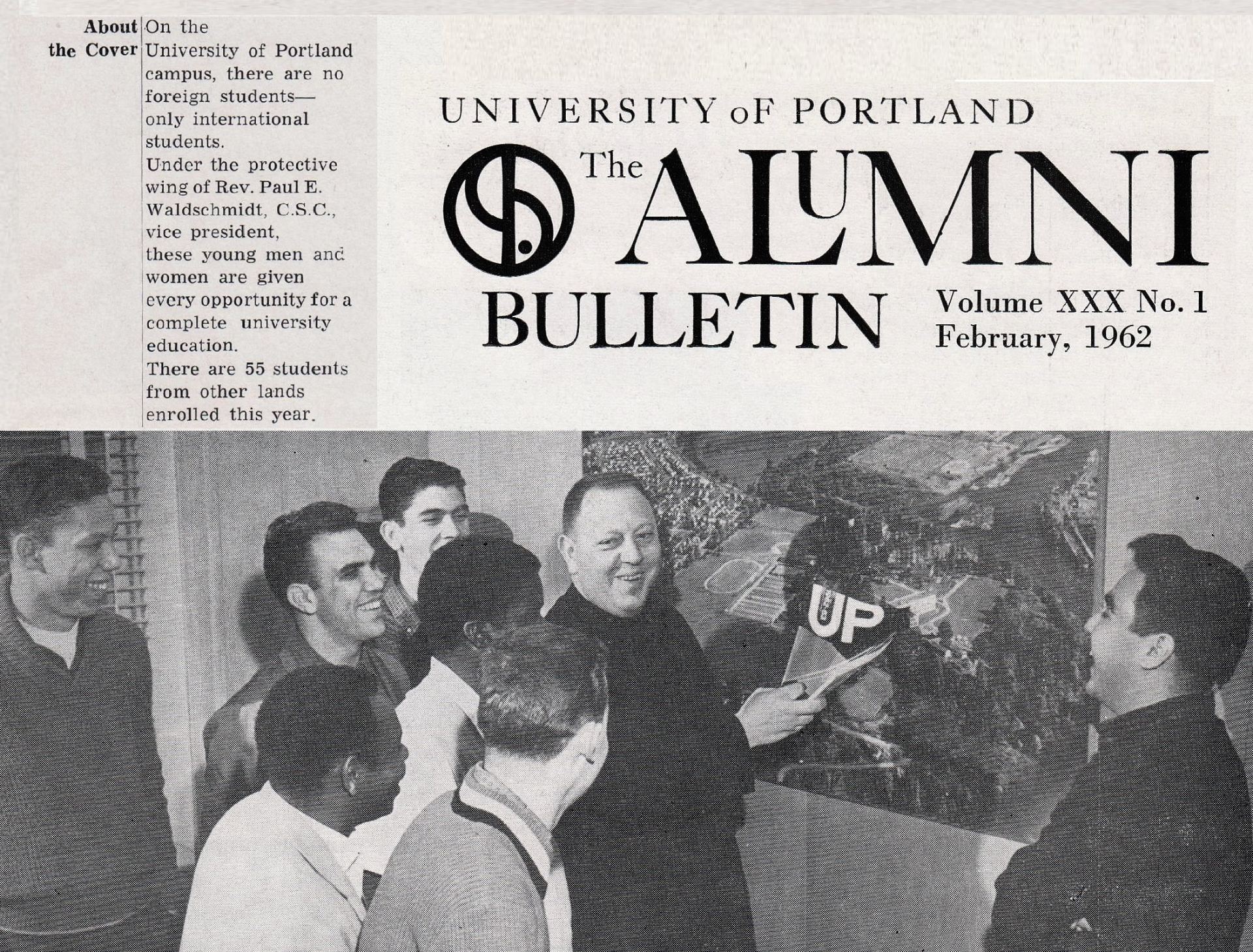
To employ a botanical metaphor: enrollment policy worked to attract students from far and wide, grafting the new limbs to the established trunk of local Portland students and alumni, thereby nourishing the growth of the whole through a diversity of membership on campus.  Already in 1949, working with UNESCO, the University dedicated scholarship support to ensure opportunities for students from beyond American borders.  In a 1962 address to the City Club of Portland, then-Vice President Rev. Paul E. Waldschmidt, CSC, described the dynamics of drawing International Students to UP as a sort of reverse Peace Corps, a good-in-itself, fostering global understanding and citizenship.  Against some abstract strategy of representation, these early notices found in the Beacon and Alumni Bulletin (below) narrate emphases of incorporation.

International Student Enrollment

The title Director of International Students appears within the Division of Student Life for the first time in 1962.  (A parallel position for Black and minority students begins in 1970.)  The goal of this office is to assist students in navigating college, American culture, legal paperwork.  And International Students did continue to enroll at the University through the next decades. Through the 1960s, the percentage of international enrollees increased from a steady-state 3-5% until achieving 6% and a total of 100 persons in 1969. The years between 1977-1982 represent the peak for International student enrollment, each year averaging over 400 International students, together constituting a full 15% of the entire student body.

            And there, within the diversity success-story, an unusual housekeeping challenge emerges.  A body of Muslim students at a Catholic college, students with a different spiritual diet; with different traditions, calendar, weekly rituals than that which the brothers and priests were familiar.

The Muslim Prayer Room

The earliest practice is not easy to construe.  But there are weekly notices in the Beacon from 1985 onward listing Mehling Hall auditorium as the location for Friday Prayers.  And while the early history of the Christie Hall prayer room is hazy, it seems to be the case that from about 1977, UP boasted a Muslim Prayer Room as an ornament for the Catholic campus. 

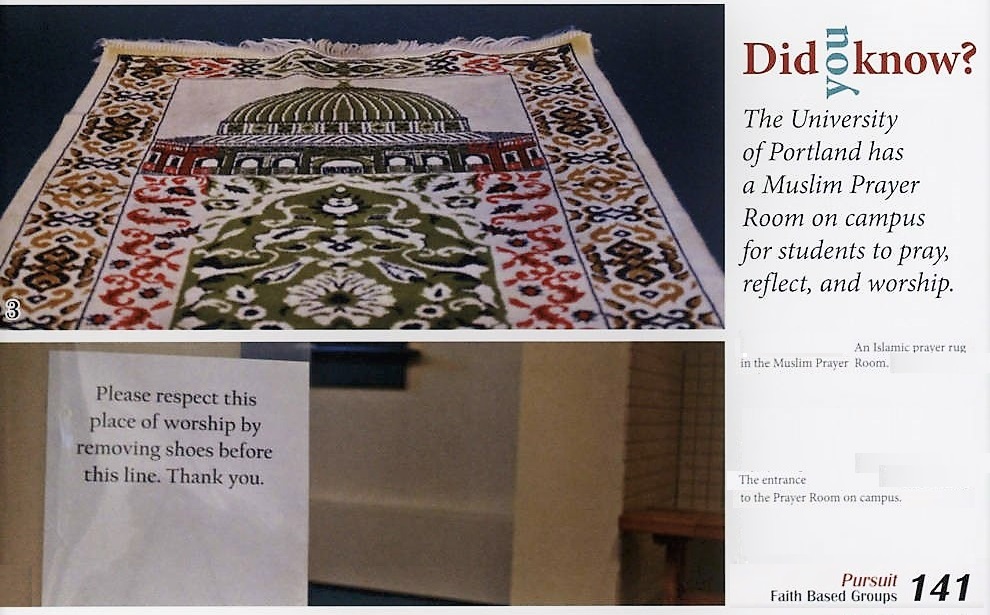
During the decade when we drew increasing numbers of students from outside the US, in order to meet the personal needs of Muslim students, the University opened a public-use area in Mehling for congregational prayer and created a dedicated space-apart in Christie where individuals could repair privately to observe the cycle of daily prayers belonging to their religious expression.

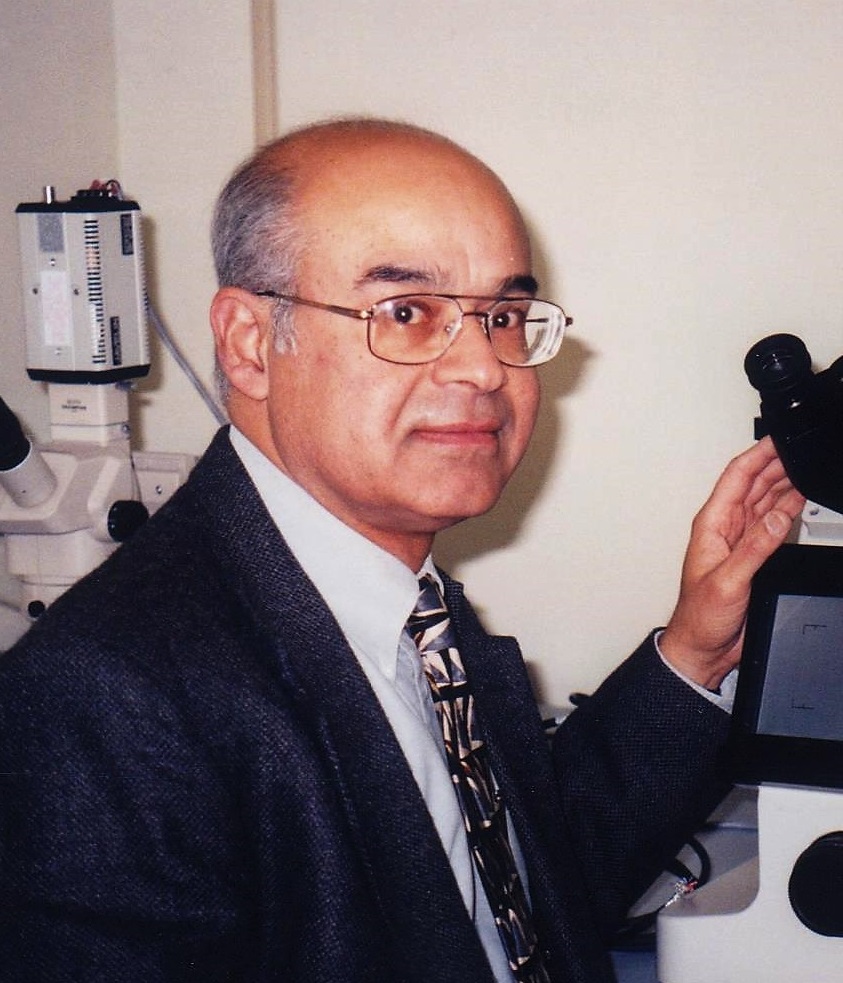
Dr. Khalid Khan, Engineering

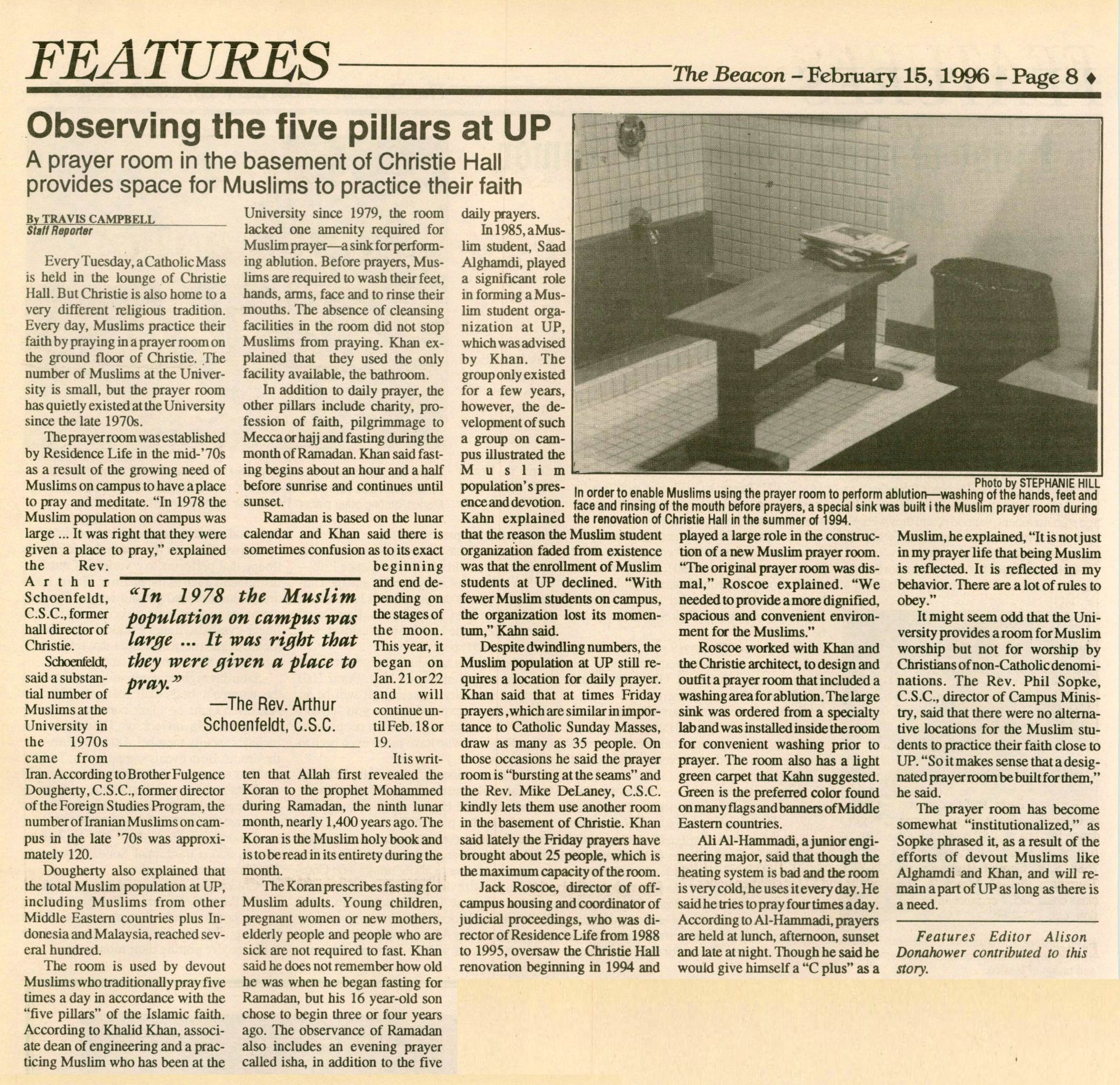
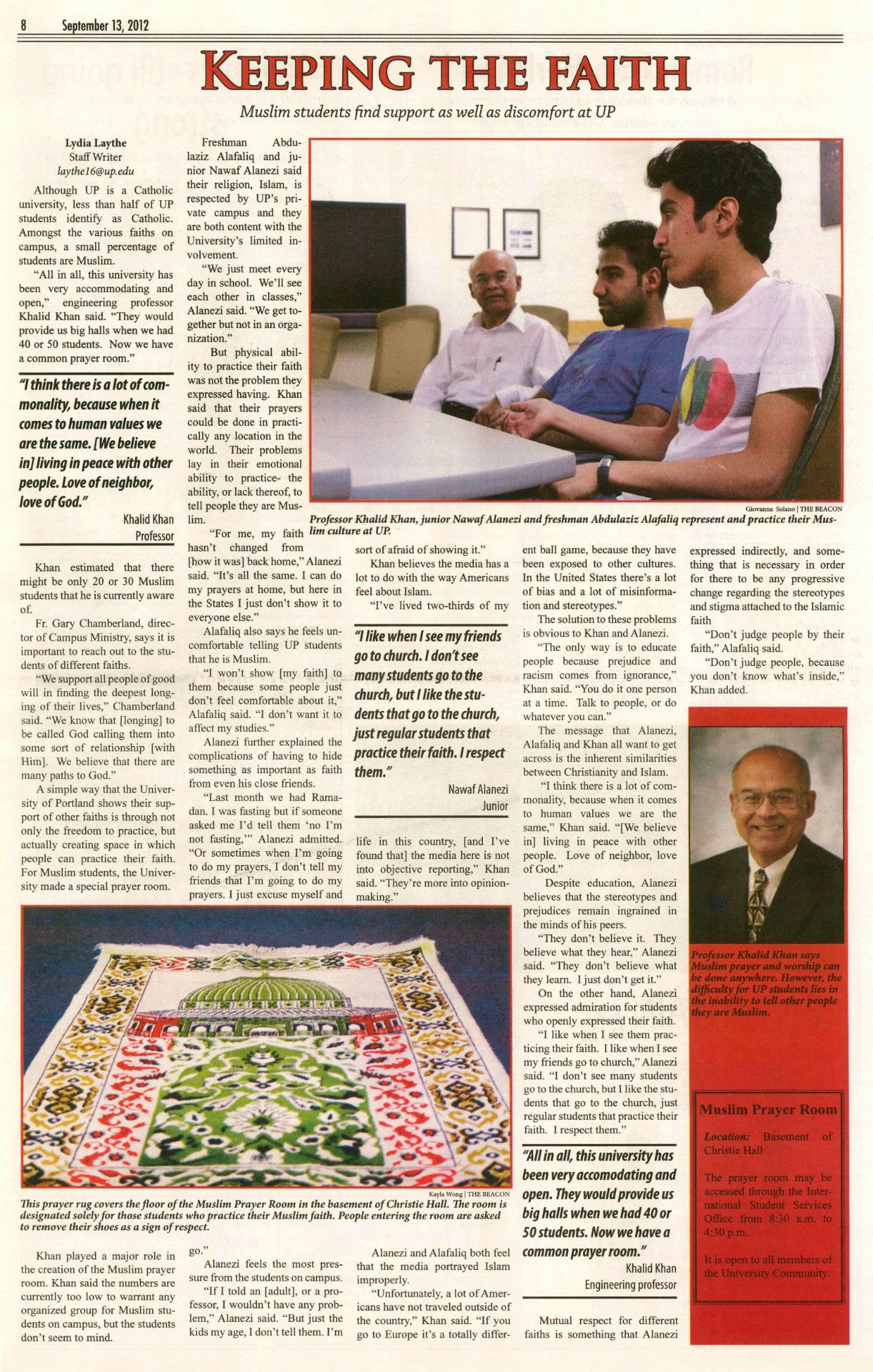
Our information is more ample after Professor Khalid Khan, PhD, joined the School of Engineering (1979-2018) and assumed the role of faculty liaison to the Muslim Student Association.  The Association brought symposia, teach-ins, guest-speakers, and provided awareness and engagement to campus.  Also, periodic recurrent Beacon feature articles exploring faith-dialogues, Ramadan, and the possibilities and limits of cultural diversity on a Catholic campus (see select Beacon sampling below).

Dr. Khan was an advocate who worked together with students, the Office of Residence Life, and with Student Services to help design and establish the Muslim prayer space.  He was a regular speaker on religious panels presented at UP and was an organizer of the Faculty Senate 1993 Challenge of Diversity project to engage UP faculty and students in curriculum and cross-cultural dialogues.  The Prayer Room is on the ground floor of Christie Hall.  The prayer space is provided with facilities for ablution, scriptural resources, and orientation towards Mecca.

2013 Log, p. 141

Supplemental Exhibits (click to enlarge):

1949 Alumni Bulletin
1962 Alumni Bulletin
The Beacon, February 15, 1996
The Beacon, February 27, 1997
The Beacon, February 1, 2001
The Beacon, September 13, 2012

From UPBeat:
https://sites.up.edu/upbeat/up-muslim-prayer-room-did-you-know/

Filed Under: Values, Values 1 1 Comment

1901-1928: More Catholic or More College?

August 16, 2022 By Archives

Lintel piece, Christie Hall; the first addition to campus in 1911, this residential dormitory was named in honor of the University founder. The seal of the priests and brothers of the Congregation is placed between the lamps of learning.

Archbishop Alexander Christie founded this school on the Bluff in 1901 intending to establish a Catholic University for Men.  This ambition is too often simplified (and falsified) as ‘a college for male Catholics’, thereby reducing the mission to the demographic.   The first issue of the University Catalogue (1902)—which provides statements concerning the history, mission, organization of the new institution—does not give evidence of any attempt to create some special Catholic club here at the north end of the growing city of Portland.

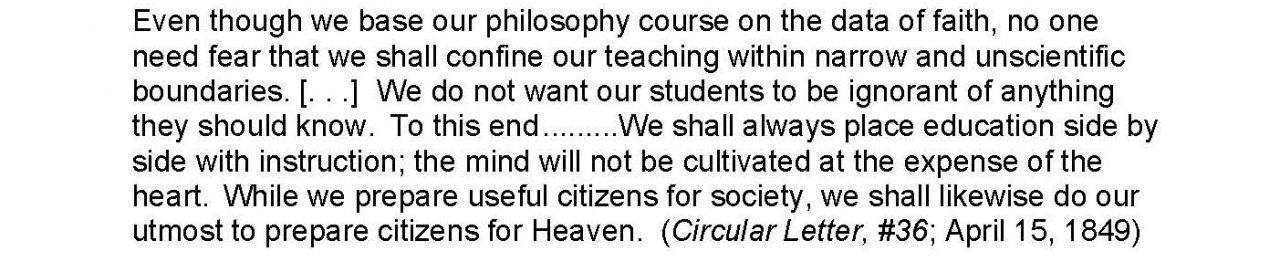
The opening paragraph of text in the first Bulletin: 1902

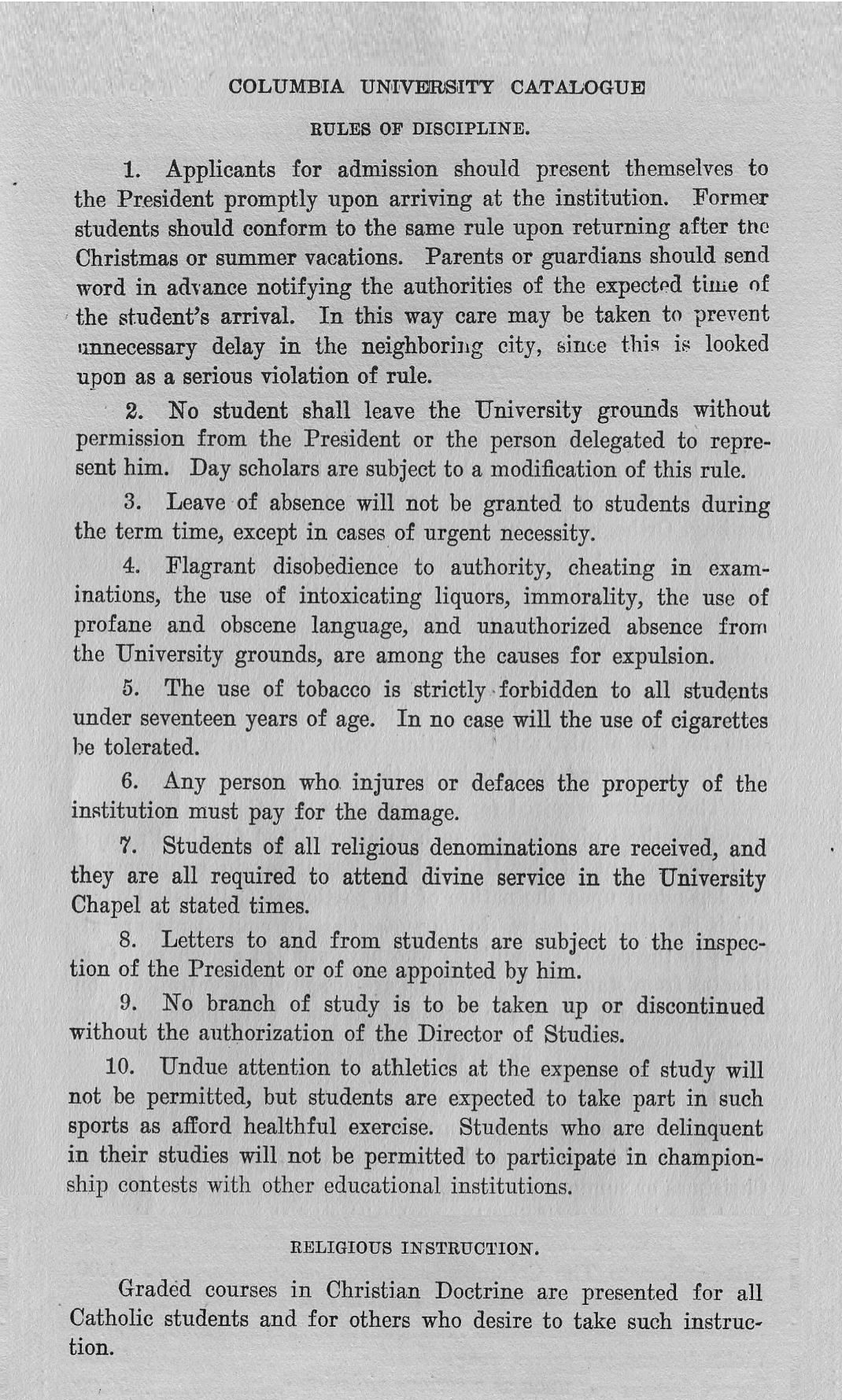
The ideals and tolerances of student conduct is described a few pages later;

Note particularly how in the regulation of student discipline, religious practice falls behind tobacco usage as a signal of the student’s moral standing.  Also, while these paragraphs and rules are routinely reproduced in the pages of the Catalogue each year, the comment about a ‘New Notre Dame’ is stricken after the first year; and by 1907 the religious observance rule is expanded to read: “7. Although students of all religious denominations are received, the University is nevertheless a strictly Catholic institution, and all students are required to attend divine service in the University Chapel at stated times.”  The mandatory stated-times, however, are not stated.

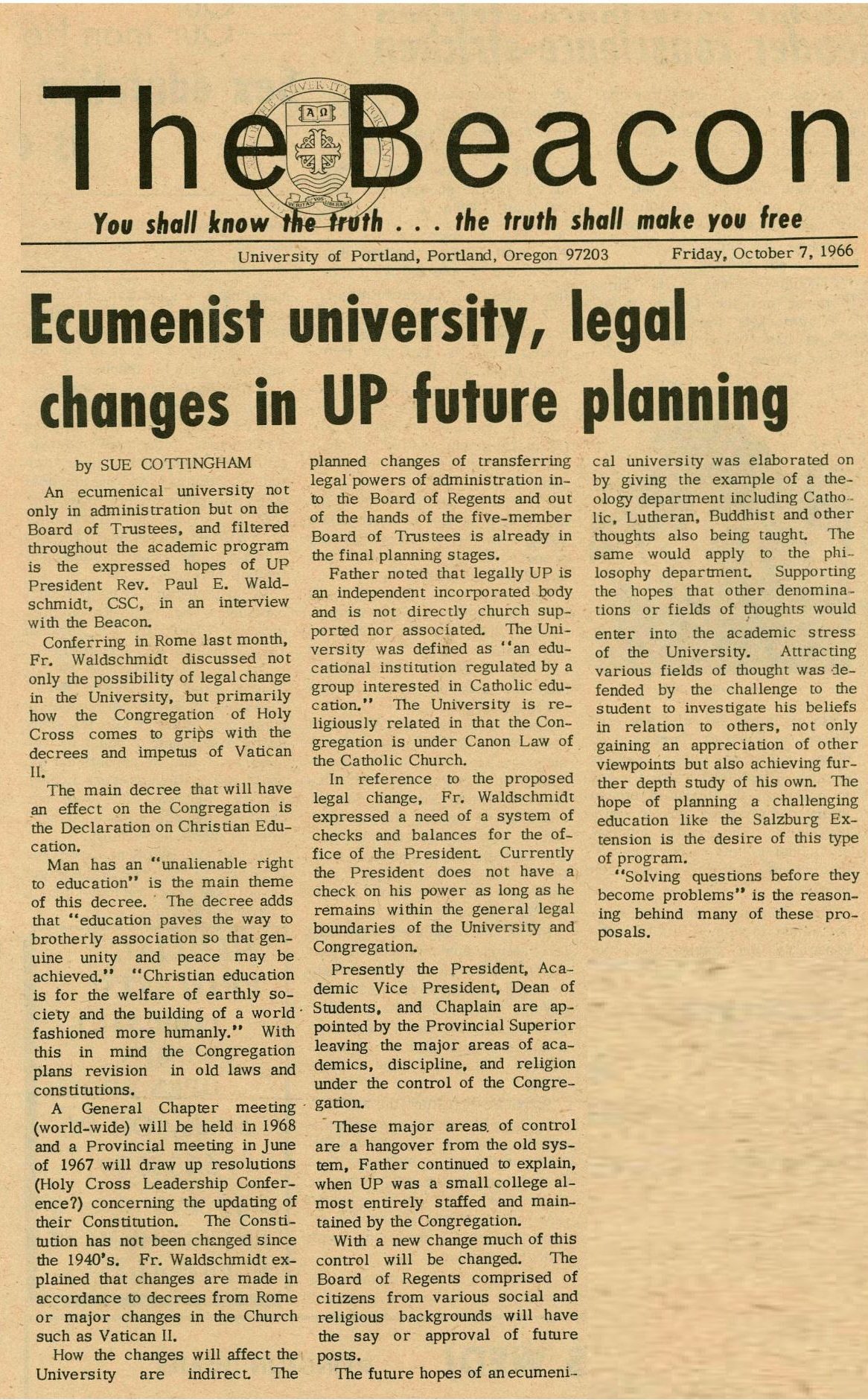
In fact the obvious tension between open-admission without religious test or discrimination, versus a policy of enforced observance means that the rationale and language of this requirement will continue to be adjusted and modified throughout the University’s history.  Further, of course, the dialogue between ‘Catholic University’ and freedom of individual observance remains in tension still today.

Beginning about 1911 (and repeated with minor revisions until the 1950s), the Catalogue frames student conduct regulations in these words: “The Faculty maintain that an education which gives little attention to the development of the moral part of a youth’s character is pernicious, and that it is impossible to bring about this development where students are granted absolute relaxations from all Faculty government while outside the class-room.  A young man must learn obedience to law by the actual practice of obedience, not merely by appeals to honor.

Yet this surveillance model is replaced in 1914. While repeating the formula: The Faculty maintain. &c., the University quietly admits the disciplinary model is frankly paternal.  But then expands this description in a new direction, a direction that reflects the priests and brothers own commitment to embodying the same model of life in their own religious fraternity. Transmitting education and ideals by living together side-by-side: “The Faculty and students form one big family, not only meeting in the class room but partaking of the same wholesome fare in a common dining-room, living in the same buildings, enjoying recreation together on the campus and attending Divine services in a body in the chapel.  The underlying principle of the school is the combination of secular training with positive religious instruction in a constant religious atmosphere.  The institution is strictly Roman Catholic but admits students of other denominations and respects their conscientious beliefs.”

Here, showing awareness of an environment of pluralism, the values of honor and conscientious belief are restored and formally privileged, which is to say, expanding the dignity of the person over required uniform obedience to external regulations.  And this, in turn, recovers a theme perfectly familiar to the Holy Cross Brothers and Priests insofar as it expresses agreement with the educational program found in the writings of the Reverend Basil Moreau, CSC, the Founder of the Congregation of Holy Cross.

Two further considerations apply for us when reading these student-life rules a century later.  First, the imposition of religious observance was much diluted insofar as the larger percentage of students lived off-campus and beyond any system of supervision.  Second, throughout the early twentieth century, The State of Oregon was actively hostile to religious-affiliated schools.  Resulting in The Compulsory Education Act of 1922, which required that all primary education (ages 8-16) be conducted exclusively in public schools; effectively eliminating all private, military, or religious-based grammar and high school institutions.  The result of a ballot initiative, the U.S. Supreme Court declared the measure unconstitutional before it could take effect in the state. (See, Lawrence Saalfeld, UP faculty 1959-61, Forces of Prejudice in Oregon 1920-1925; also, James T. Covert, A Point of Pride, pp. 63-64.)  At the time of the legislation, our high school division (which could not have survived under the new law) was the financial driver and health of the school.  Both the character and viability of the University thus centered upon resolution of the civic and internal dialogue around the role of religion in student and academic life.  A dialogue that is complex, convoluted, and contemporary still today.

The Beacon, October 7, 1966

Filed Under: Values, Values 1 Leave a Comment

  • « Go to Previous Page
  • Go to page 1
  • Go to page 2

Primary Sidebar

Hours and Location

University of Portland Museum
014 Shipstad Hall

Available by e-email at:  museum@up.edu

Digital Collections

Explore some collections and resources from the Archives and Museum available online through Digital Collections


Social Media

Follow us on Facebook

Follow us on Instagram

Ask Us Anything

Ask Us Anything

We'd Love to Hear from You! Questions? Comments? Topics?

This form is protected by reCAPTCHA and the Google Privacy Policy and Terms of Service apply.

Copyright © 2026 · News Pro with Full Header On Genesis Framework · WordPress · Log in

Subscribe

Subscribe By Email

Get every new post delivered right to your inbox.

This form is protected by reCAPTCHA and the Google Privacy Policy and Terms of Service apply.


Loading Comments...