• Skip to main content
  • Skip to primary sidebar

Saint John's Bible

Genealogy of Christ (2016 entry). Artist: Donald Jackson

September 8, 2016 By Heidi

Genealogy of Jesus illumination
Click to enlarge.

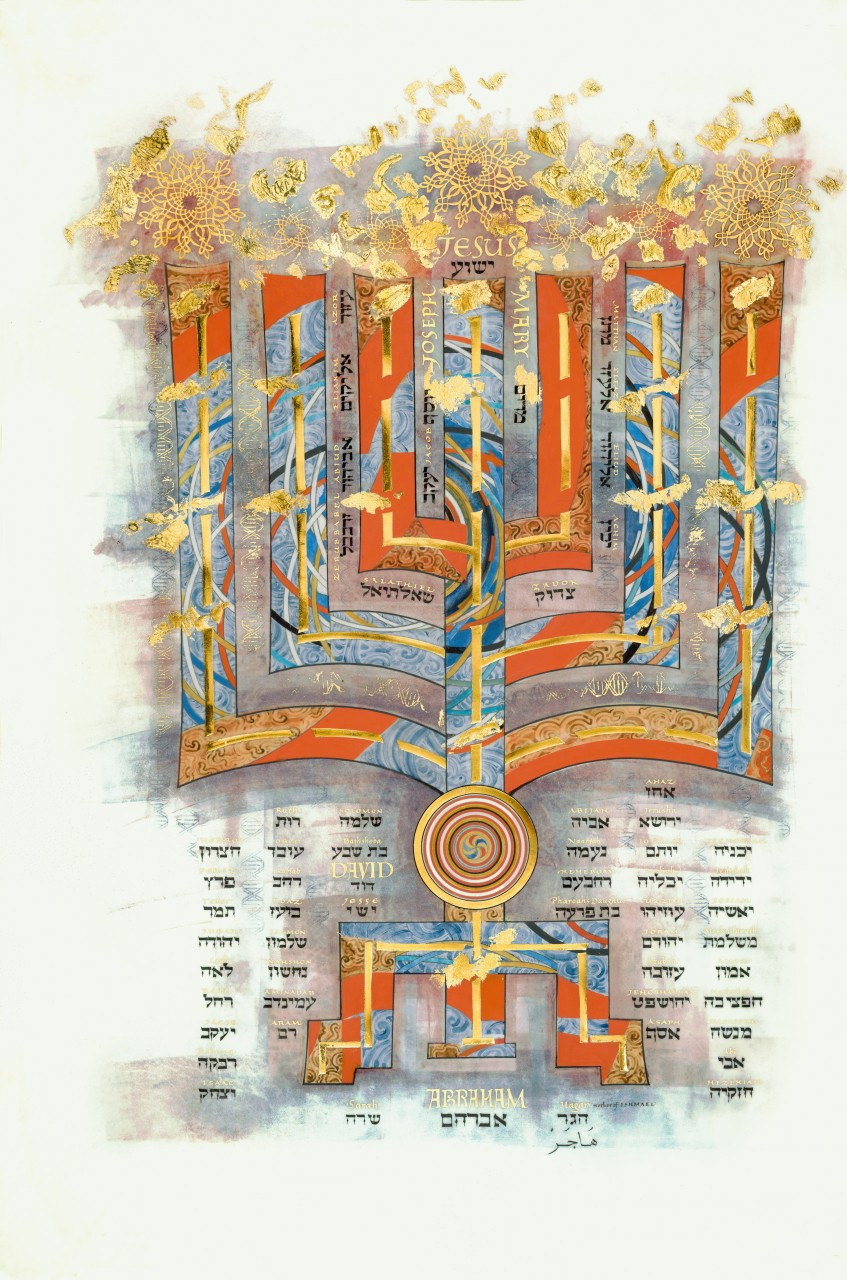
In the beginning of Mathew’s Gospel, the reader is introduced to the genealogy of Christ. One can assume that the author of the Gospel began in this manner to portray the humanity of Jesus while at the same time showing his divinity. The image that appears is a beautiful image of a menorah. Matthew in his time was primarily writing to a Jewish audience, so the image is quite appropriate, not just because of the audience he was addressing his gospel to, but also because Jesus himself was a Jew.

Menorahs are familiar objects to Jews, but this menorah depicts more than the usual object. In fact, Susan Sink writes in The Art of the Saint John’s Bible:

The menorah from Jewish tradition becomes a family tree, from which the names of the genealogy branch out. Matthew wrote for a Jewish audience and set Jesus’ birth within a Jewish context. The line of Jesus through David was important for establishing his divinity. Abraham and Sarah are at the root of this tree, and Hagar is there too, with her name in Arabic as well as Hebrew and English, the branch that leads through Ishmael to Islam. (Vol. 2. pp. 51)

She guides the reader further to notice:

The gilded stamps used in the center of the illustration come from illuminations of the Koran. A mandala is incorporated into the base of the menorah, again a sign of cosmic unity and wholeness found in many religious traditions.

This detail is important to this image because it seeks to show the interconnectedness of not only religions but also creation. Sink invites us to contemplate on “life, on creation, on history and redemption, on identity.” (Ibid.) What a great way to begin the Gospel!

This commentary was contributed by James Gumataotao, a senior Theology major and a member of the Library’s Research Desk team.

Filed Under: Saint John's Bible

Creation, Covenant, Shekinah, Kingdom. Artist: Donald Jackson.

June 20, 2016 By Heidi

Creation, Covenant, Shekinah, Kingdom
Click to enlarge.

In Wisdom of Solomon, chapters 10-11 recount the history of Wisdom from creation through the Israelites’ stay in the desert, making reference to major events in Genesis and Exodus. These events are portrayed in this illumination’s first three panels; viewers familiar with The Saint John’s Bible will recognize various elements. Some elements are changed slightly to tie this illumination to the Wisdom books or to the concept of wisdom.

In The Art of The Saint John’s Bible, Susan Sink describes the panels:

In the first panel the seven pieces from the Creation illumination are put in various widths, emphasizing the cycles of the moon associated with Wisdom, and the creation of humans, along with the coral snake representing the Fall. The raven of the first panel…is complemented by the dove in the second [from the story of the Flood, a second creation story], a symbol of the spirit. […] [In the third panel] The image is of the column of fire by which God led Israel out of Egypt. (Vol. 2, pp. 43-44)

She draws the reader’s attention to the imagery of destruction as well as creation:

The flash of color at the bottom of the second panel is a variation on the Job Frontispiece, imagery that continues into the [3rd] panel. In both cases, as with chaos in the first panel, destruction breaks the boundaries of the image. (Ibid.)

The fourth panel “takes a detail from the vision of Solomon’s temple in Isaiah that focuses on the abundance [that will be] provided to the people in the Promised Land” (Vol. 2, p. 45)

You will notice batons and frames of gold and silver connecting these panels; these represent “wisdom and divinity” according to Sink, and show that “These are not discrete events, but connected.” (Ibid.)

Filed Under: Saint John's Bible

The Word Made Flesh. Artist: Donald Jackson.

December 8, 2015 By Heidi

Word Made Flesh illumination
Click to enlarge.

The Gospel of John begins with the verse, “In the beginning was the Word, and the Word was with God, and the Word was God.” (1:1) The reference to the Beginning hearkens back to Genesis and the Earth’s formation, and artist Donald Jackson incorporates the Genesis story by having the central figure of Christ step from the dark unformed universe toward the bright organized world. In The Art of The Saint John’s Bible, Susan Sink develops this idea:

The image of Christ seems to be stepping from the darkness which recalls the chaos and nothingness of the creation story and moves toward light and order. In fact, the texture behind Christ’s head is inspired by an image taken from the Hubble Space Telescope and reflects the cosmic character of the event.

She draws the reader’s attention to another symbol:

To the left, a keyhole recalls the tradition of locked and hinged manuscripts securing, protecting, and holding the “key” to the Word of God. It might also make you think of standing at the door and knocking, of locked diaries, and of secret prayers of the heart.

Notice also the stenciled crosses which refer to the Transfiguration illumination, and the gold filigree which throughout the Bible refers to the presence of the divine.

The “Word Made Flesh” illumination will be featured in a Visio Divina session on Wednesday, December 9, at 12:45 p.m. in the Chapel of Christ the Teacher. This Advent prayer opportunity is sponsored by Campus Ministry and the Garaventa Center.

Filed Under: Saint John's Bible

Messianic Predictions (Visio Divina image). Artist: Thomas Ingmire.

November 25, 2015 By Heidi

Click to enlarge.
Click to enlarge.

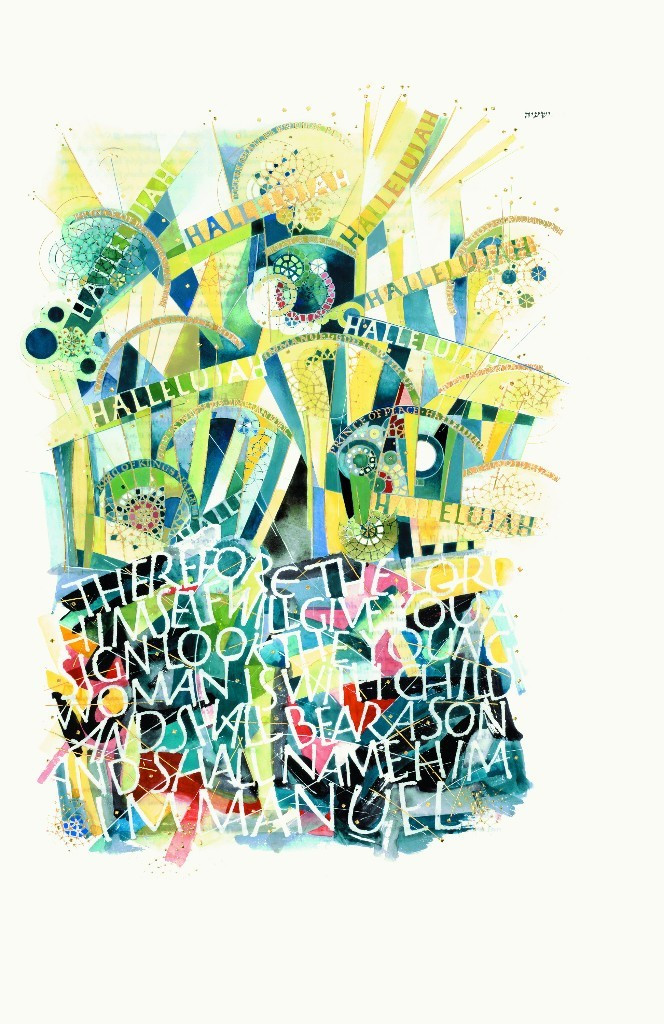
“For a child has been born for us, a son given to us…” (Isaiah 9:6)

According to the publishers of The Saint John’s Bible, “The most important messianic verses are Isaiah 7:14-17, Isaiah 9:1-2, 6-7 and Isaiah 11:1-9. From the earliest of times, Christians have seen these messianic verses as having a direct reference to Christ. Isaiah’s prophecies have had an enduring influence on Western Civilization. The Christmas carol, Lo How a Rose ere Blooming, was inspired by Isaiah 11:1-3. Handel used Isaiah 9:6-7 for one of the great choral sections of the Messiah.

“Artist Thomas Ingmire fills this text treatment with explosive energy, color and radiating gold. Familiar gilded phrases burst out of the foundational text: Prince of Peace, King of Kings, Everlasting Peace, Immanuel God is With Us, For Unto Us a Child is Born, Halleluiah!—all prophesying the coming of our savior. Blues, greens and yellows suggest Marian connections since devotion to the “Blessed Virgin Mother” finds part of its scriptural basis in Isaiah 7.” (Liturgical Press)

Returning to the connection with Handel’s Messiah, Susan Sink says, “This illumination is crowned with Hallelujahs! You can almost see the trumpets raised and blasting with the announcement.” (The Art of The Saint John’s Bible, vol. 2, p. 62) Note also the intricate gold stamp, which we have seen in many recent display illuminations, adding to the celebratory effect.

The “Messianic Predictions” illumination will be featured in a Visio Divina session on Wednesday, December 2, at 12:45 p.m. in the Chapel of Christ the Teacher. This Advent prayer opportunity is sponsored by Campus Ministry and the Garaventa Center. Need more information? See this press release.

The library has a 1995 recording of the University of Portland Singers singing “Lo How a Rose Ere Blooming,” on this CD. Enjoy!

Filed Under: Saint John's Bible

Celebrate Pope Francis’ visit to the U.S.: View The Saint John’s Bible

September 18, 2015 By Heidi

Poster for Clark Library's Saint John's Bible display
Click to enlarge

To celebrate Pope Francis’ visit to the United States, all institutions with The Saint John’s Bible will display the same illumination, and its associated reflection, each day between Monday 9/21 and Sunday 9/27. Saint John’s University describes the event:

The simple acts of displaying the same pages at churches, schools, libraries, hospitals and homes; spending time with the beautiful images and words; and praying a reflection will be rich symbols of unity among Christians. This seven-day program will bring together people from across the country in communion with God during Pope Francis’ visit.

The daily schedule:

Monday 9/21:          Creation
Tuesday 9/22:         Abraham and Sarah
Wednesday 9/23:   Ten Commandments
Thursday 9/24:        Peter’s Confession
Friday 9/25:             Multiplication of the Loaves and Fishes
Saturday 9/26:        Two Cures
Sunday 9/27:           Pentecost

Visit Clark Library each day to see each illumination up close.

Filed Under: Saint John's Bible

Genealogy of Christ. Artist: Donald Jackson.

July 20, 2015 By Heidi

Click to enlarge.
Click to enlarge.

“This is the page which launched the entire project,” says Christopher Calderhead
in Illuminating the Word: The Making of The Saint John’s Bible (2005, p. 169), discussing the Genealogy of Christ illumination in which a family tree takes the shape of a menorah. “It … stands at the beginning of the first volume Donald made. […] [It] was made before many decisions were finalized in the project.”

Artist Donald Jackson had a 5-line description to work with rather than a more detailed analysis, which gave him a feeling of independence:

“I was on my own–I had to work it out. My idea was to suggest a bridge between the Old Testament and the New. So I used the menorah to acknowledge Christianity’s Jewish roots.”

Eventually, the menorah would appear in the Old Testament as well, illustrating the story of Abraham and Sarah, and these names appear here at the base of Jesus’ family tree. Hagar is listed also, with her name in Arabic as well as Hebrew. Another link to Islam, according to Jackson, is the menorah’s candles. Making further associations with faith traditions and suggesting “the connectedness of all seekers of enlightenment” (Susan Sink, Art of The Saint John’s Bible, vol. 1, p. 51), Jackson included “light devices and cosmic mandala fragments from the Buddhist visual tradition.” (Calderhead, p. 171) Viewers will also recognize the double-helix structure of DNA, a reference to Jesus’ incarnation and humanity, and to the Family of Man.

Filed Under: Saint John's Bible

Life in Community. Artists: Donald Jackson in collaboration with Aidan Hart

April 7, 2015 By Heidi

"Life in Community" illumination from Saint John's Bible
Click to enlarge.

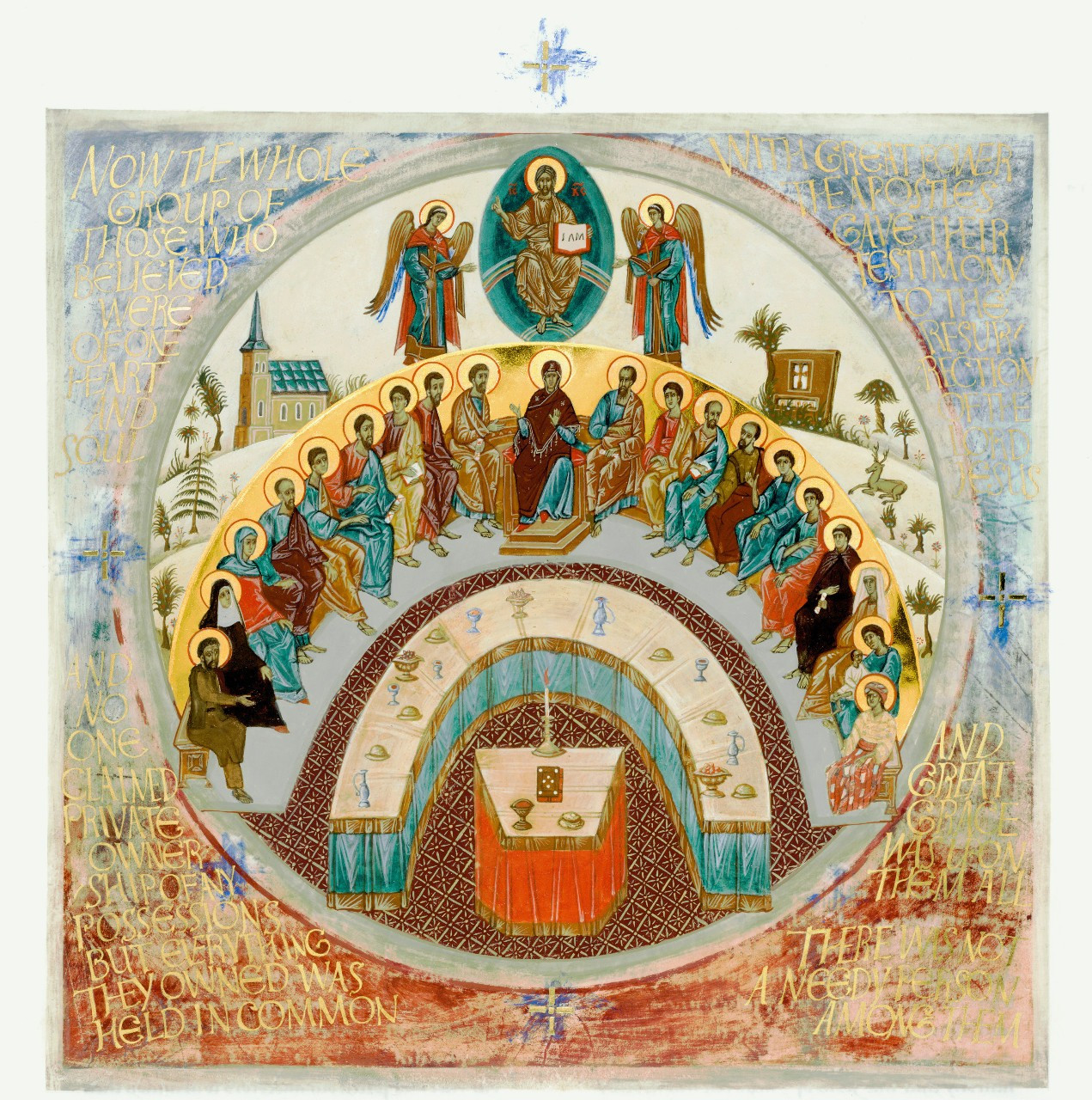
“Community” is a frequently-heard word at UP. When students, faculty and staff are asked what makes UP special, “the sense of community” is often part of their answer. In honor of this sense of community, Clark Library chose the illumination “Life in Community” for the next Saint John’s Bible display.

This detailed illumination appears in the Gospels & Acts volume, illustrating Acts 4:32:35 and its idealized vision of Christ’s followers, e.g. Acts 4:32, “Now the whole group of those who believed were of one heart and soul, and no one claimed private ownership of any possessions.” According to SJB art analyst Susan Sink it borrows from Eastern Orthodox icon traditions, especially icons of the Pentecost:

Pentecostal icons traditionally show the twelve apostles sitting on curved benches as they are here. Additionally, there is usually the figure of an old man in the space below, where the altar is in this image. He is called “Kosmos” and holds a white cloth with twelve scrolls on it, one for each of the twelve apostles. He represents the world that the apostles are being sent out into with the good news. (Sink, The Art of the Saint John’s Bible, vol. 1, p. 104)

In the illumination, several figures hold scrolls; some hold books, and one has a small child.

The Virgin Mary sits at the center of the illumination community, with Peter at her right hand and possibly Paul at her left. Next to them, six apostles sit on each side, and beyond them figures representing saints of the church. The figures at either end of the row are meant to reflect the world church: a man in a Middle Eastern tunic and vest, and a woman wearing a Guatemalan skirt.

Filed Under: Saint John's Bible

The Crucifixion. Artist: Donald Jackson.

March 30, 2015 By Heidi

Crucifixion illumination from Saint John's Bible
Click to enlarge.

The “Crucifixion” illumination from Luke will be featured in Visio Divina sessions on Wednesday, April 1, at 12:45 p.m. (30 minutes) and 7:00 p.m. (60 minutes) in the Chapel of Christ the Teacher. This Lenten prayer opportunity is sponsored by Campus Ministry and the Garaventa Center. Campus Ministry’s Interactive Lenten Calendar provides this commentary:

Rendered in raised and burnished gold, the crucified figure of Christ dominates this composition. The use of gold conveys the idea of God manifesting himself in his divine love for humanity, represented by the crowd below. Luke’s Gospel recounts that darkness covered the earth for three hours, indicated here by the night sky, and that the curtain of the temple, shown as shreds of purple, was torn in two. The contrast of pain with the glory of gold relates this image to current theological discussions concerning the meaning of the Crucifixion in the contemporary world.
The delicate gray border was printed with English lace, contributing to the recurring theme of textiles in The Saint John’s Bible illuminations.

Throughout The Saint John’s Bible, gold leaf represents the divine. This illumination is awash in it, representing Christians’ belief that Jesus is God. The customary outline of the crucified figure is barely visible. Breaking through the dazzling gilt, we see other elements of the story: on either side the two crosses representing the two thieves crucified alongside Jesus; on the left the moon and stars representing the hours of darkness over the land that coincided with the event; on the right a file of people representing the procession with the cross to Golgotha.

Road to Emmaus illumination from Saint John's Bible
Click to enlarge.

On the facing page in the Bible you will see a scene from the story of the road to Emmaus (right), in which Jesus appeared to two of his disciples.

Filed Under: Saint John's Bible

Raising of Lazarus. Artist: Donald Jackson.

March 20, 2015 By Heidi

Click to enlarge.
Click to enlarge.

The “Raising of Lazarus” illumination from John 11 will be featured in Visio Divina sessions on Wednesday, March 25, at 12:45 p.m. (30 minutes) and 7:00 p.m. (60 minutes) in the Chapel of Christ the Teacher. This Lenten prayer opportunity is sponsored by Campus Ministry and the Garaventa Center.

In this illumination the viewer is in the tomb with Lazarus, among the death’s-head moths and golden angels, and the lace of Lazarus’ shroud (created from prints of actual lace). We look out as if through a tunnel of light (perhaps representing descriptions of near-death experiences), where Jesus awaits. Lazarus is upright, appearing to begin to rise and exit. Dominating the illumination are the words, “I am the resurrection and the life” (John 11:25).

In The Art of The Saint John’s Bible, vol. 1, p. 96, Susan Sink says

It is this miracle that will start Jesus on the road to Jerusalem and the crucifixion, the real triumph of light over darkness, life over death. But here we stand with Lazarus poised on the edge of death and life and contemplate our own faith.

Filed Under: Saint John's Bible

Demands of Social Justice. Artist: Suzanne Moore.

March 13, 2015 By Heidi

"Demands of Social Justice" illumination from Saint John's Bible
Click to enlarge.

The “Demands of Social Justice” illumination from Amos 4 will be featured in Visio Divina sessions on Wednesday, March 18, at 12:45 p.m. (30 minutes) and 7:00 p.m. (60 minutes) in the Chapel of Christ the Teacher. This Lenten prayer opportunity is sponsored by Campus Ministry and the Garaventa Center.

Commenting on this illumination, local (Vashon Island, WA) artist Suzanne Moore has said, “it is about choice, the alternatives of light and dark, obedience and disobedience…human responsibility for our own destiny as we respond to God’s promises.” (quoted by Susan Sink in The Art of The Saint John’s Bible, vol. 2, p. 83)

In this passage in Amos, says Sink, God laments that despite all He has done to try to draw Israel back into His blessings, Israel does not return. Those attempts are listed: famine; drought; blight, mildew, and locusts; pestilence, war, and defeat. The refrain is the same each time: “Yet you did not return to me.” This refrain unites the seven pieces of the illumination, seven pieces as in the Creation but fragmented and chaotic, not bountiful and organized. “This is a reminder,” says Sink,

…that God did not just try to turn the people’s hearts with plagues and punishments, but first tried to draw them close with all the beauty, order and fruitfulness of the Garden. It is the people’s choice not to follow God that has made creation this way. (p. 84)

On the right-hand side of the page, a vaguely menacing creature (a locust?) hovers over the text.

Filed Under: Saint John's Bible

  • « Go to Previous Page
  • Go to page 1
  • Interim pages omitted …
  • Go to page 3
  • Go to page 4
  • Go to page 5
  • Go to page 6
  • Go to page 7
  • Interim pages omitted …
  • Go to page 9
  • Go to Next Page »

Primary Sidebar

Contact

Clark Library
503-943-7111
800-841-8261
reference@up.edu

Recent Posts

  • New Image: Luke Anthology
  • New Image: Birth of Christ
  • New Image This Week: Peter’s Confession
  • New Image This Week: The Beatitudes / Sermon on the Mount
  • Image change this week: Multiplication of the Loaves and Fishes

Subscribe by Email

Completely spam free, opt out any time.

Please, insert a valid email.

Thank you, your email will be added to the mailing list once you click on the link in the confirmation email.

Spam protection has stopped this request. Please contact site owner for help.

This form is protected by reCAPTCHA and the Google Privacy Policy and Terms of Service apply.

Archives

  • January 2023
  • December 2022
  • November 2022
  • October 2022
  • May 2022
  • April 2022
  • March 2022
  • December 2021
  • November 2021
  • October 2021
  • September 2021
  • August 2021
  • October 2019
  • April 2017
  • March 2017
  • February 2017
  • December 2016
  • November 2016
  • October 2016
  • September 2016
  • June 2016
  • December 2015
  • November 2015
  • September 2015
  • July 2015
  • April 2015
  • March 2015
  • February 2015
  • January 2015
  • November 2014
  • October 2014
  • July 2014
  • April 2014
  • March 2014
  • February 2014
  • January 2014
  • December 2013
  • November 2013
  • October 2013
  • September 2013
  • August 2013

Categories

  • General
  • Saint John's Bible

Meta

  • Log in
  • Entries feed
  • Comments feed
  • WordPress.org

Copyright © 2025 · News Pro with Full Header On Genesis Framework · WordPress · Log in