• Skip to main content
  • Skip to primary sidebar

Saint John's Bible

Canticle of Mary. Artist: Sally Mae Joseph

February 1, 2017 By Diane

Canticle of Mary
Click to enlarge.

Mary’s Magnificat, also known as Mary’s song, is a beautiful song the young handmaid of the Lord recited when she visited her cousin Elizabeth. Elizabeth herself was pregnant with John the Baptist. As we gaze upon the words in the simple imagery, let us bring to mind who Mary was. Catholics around the world share in one way or another a great devotion to the Mother of God. She is often seen as a queen, gentle, humble, and quiet. While all these qualities are true, I want you to imagine Mary of Nazareth. A young woman who faced trials and joys. Imagine the feelings she first had when the Angel appeared to her revealing that she was chosen to be the Mother of God.

Many scholars would agree that these words that come from Mary’s mouth are the first direct characterization of God in the gospel of Luke. We can look at the words written in gold as a way of understanding Mary’s experience of God. That she was lowly and God raised her up. God is one who fills the hungry with good things. This is how Mary experienced God. The letters written in gold should set a reminder for us, that is through our experiences of our encounter with one another and creation, we come to encounter God who is found in all things. We must also remember that “Mary is truly our sister” as Pope Paul VI would say. She reminds us with her words that God is ever mindful of the mercy promised. At the same she teaches us to be bold and courageous in our life of faith.

This commentary was contributed by James Gumataotao, a senior Theology major and a member of the Library’s Research Desk team.

Filed Under: Saint John's Bible

Birth of Christ. Artist: Donald Jackson.

December 9, 2016 By Heidi

Birth of Christ illumination
Click to enlarge.

One of the most memorable quotes when I think of the birth of Jesus is “Christ was born in an animal trough to be food for the world.” I don’t remember who exactly said this, but it was a part of a sermon I heard at a midnight mass.

Even though we are in this season of preparation, we know looking at this image that Christ is born. Ponder this image of the Birth of Jesus and realize that God became flesh, partaking in our own humanity. Jesus Christ was born into this world, between an ox and a donkey, laid upon the hay on which they fed.

Darkness spreads throughout the page while the middle is a solid gold strip. As we gaze on this gold strip let us remember that even though Christ partakes in our humanity, he still is divine. As Mary, Joseph, the angels, and Shepherds gather around the animal trough where the invisible God lies vulnerable, let us remind ourselves of the love that brings our family together this Christmas and holiday season. If a person has truly entered into this Christmas or Holiday season, they are aware that we do not live in a world of perfect harmony. Our world is dark, broken, and many times unfair, especially to the most vulnerable among us. No matter how dark our lives may become, no matter how hectic the storms in our life can get, or no matter how empty we may feel, it is this love that we can count on, knowing that it is born in the deepest abyss of our hearts. Let the love which we receive and share motivate us to continue to love at all times, making the birth of Jesus visible for others.

This commentary was contributed by James Gumataotao, a senior Theology major and a member of the Library’s Research Desk team.
Filed Under: Saint John's Bible

Baptism of Jesus. Artist: Donald Jackson.

December 6, 2016 By Heidi

Baptism of Jesus illumination from The Saint John's Bible
Click to enlarge.

As we continue to venture into this time of preparation for the coming of the Messiah, we must understand the invitation this season offers. In this image titled the Baptism of Jesus, we see that the focus of this image is not Jesus but John the Baptist. Sink writes “Notice his hands and his feet. He moves, and he gestures in invitation, even as he looks back.” (Sink Vol. 1, pg. 62)

Here the figure of John the Baptist invites us into this season of hope. John preached the coming of the Kingdom of God; this is the message he was given to proclaim. The image reminds us of the message we are also called to proclaim: The message of hope! Hope for all people in our world. How do we proclaim this message? To proclaim this message of hope, we must be hope for others, through our words and actions standing by the side of those who are alone in their suffering.

As this season of preparation continues and we ready our hearts and homes to be in the spirt of the season, we must also remember that the hope we celebrate is not meant just for us to keep. This hope is meant for us to give, just like the message which John proclaimed. Yet, this image is also a reminder for us that in this time of preparation, we must remind ourselves of the hope that lies within us.

The “Baptism of Jesus” illumination will be featured in a Visio Divina session on Wednesday, December 7, at 12:45 p.m. in the Chapel of Christ the Teacher. This Advent prayer opportunity is sponsored by Campus Ministry and the Garaventa Center.

This commentary was contributed by James Gumataotao, a senior Theology major and a member of the Library’s Research Desk team.
Filed Under: Saint John's Bible

Messianic Predictions. Artist: Thomas Ingmire.

November 29, 2016 By Heidi

"Messianic Predictions" illumination from Saint John's Bible
Click to enlarge.

(Isaiah 7:14-17; Isaiah 9:1-2, 6-7; Isaiah 11:1-9)

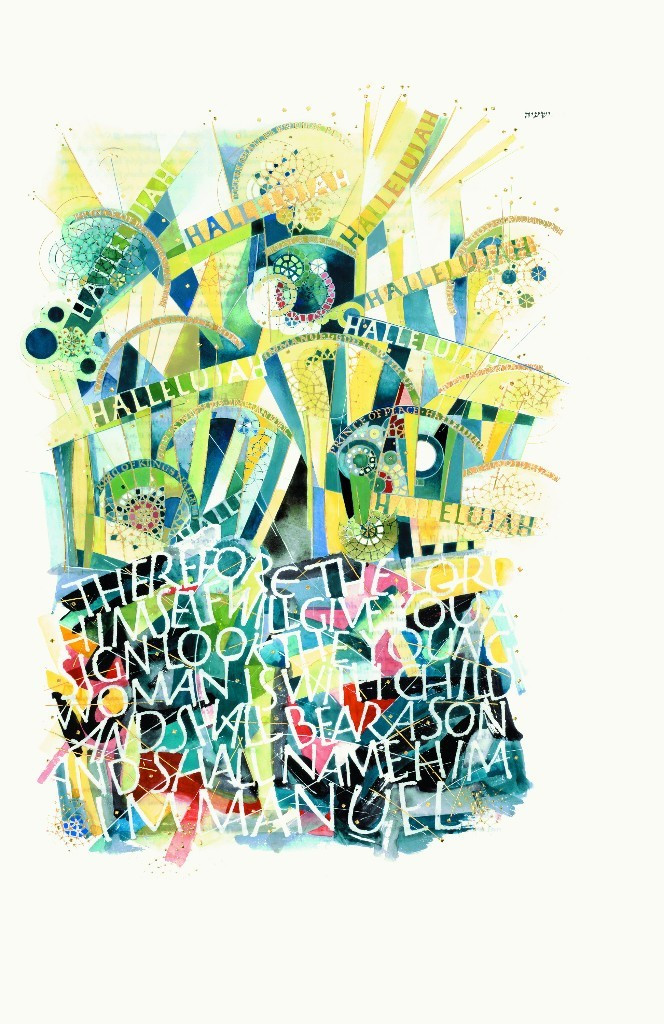
This picture along with the title Messianic Predictions gives the observer the popular view of the Messiah prior to and during the time of Jesus. The Messiah was predicted to be a great king and mighty warrior who would restore God’s people to their righteous place. As we look at this image let us focus on the different movements and pay attention to the way it moves from dark colors to bright and vibrant colors, expressing the Messiah’s predicted powers.

As some of us enter into this season of advent or preparation towards Christmas, this image reminds us that the Messiah comes into a busy and constantly moving world, a world made of different people coming from all different walks of life, people with different stories to tell. The busyness of this image could also represent our lives, especially during this season where our schedules may not allow us time to enter and be present in the moment. The colors moving from dark to light remind us of the hope which the Messiah brings. The Messiah comes to restore life to the darkness in world and in our lives.

At the bottom of this image is written Immanuel, or “God with us.” As we prepare ourselves to welcome the Messiah, let us be living predictions of the Messiah for others. Let us be more present and aware to others, especially those who seem to be forgotten or unwanted. It is through our being present with others in their darkness, that they can recognize the life to which they are called. It is through actions like this that one can recognize Immanuel. Once we can recognize that God is truly with us, we in turn can go forth bringing that same hope, that same love, and that same peace to those who cry out each night “Maranatha,” frequently translated as “Come, Lord!”

The “Messianic Predictions” illumination will be featured in a Visio Divina session on Wednesday, November 30, at 12:45 p.m. in the Chapel of Christ the Teacher. This Advent prayer opportunity is sponsored by Campus Ministry and the Garaventa Center.

This commentary was contributed by James Gumataotao, a senior Theology major and a member of the Library’s Research Desk team.
Filed Under: Saint John's Bible

Parable of the Sower and the Seed. Artists: Aidan Hart with contributions from Donald Jackson and Sally Mae Joseph.

November 16, 2016 By Heidi

Illumination of Sower and the Seed
Click to enlarge.

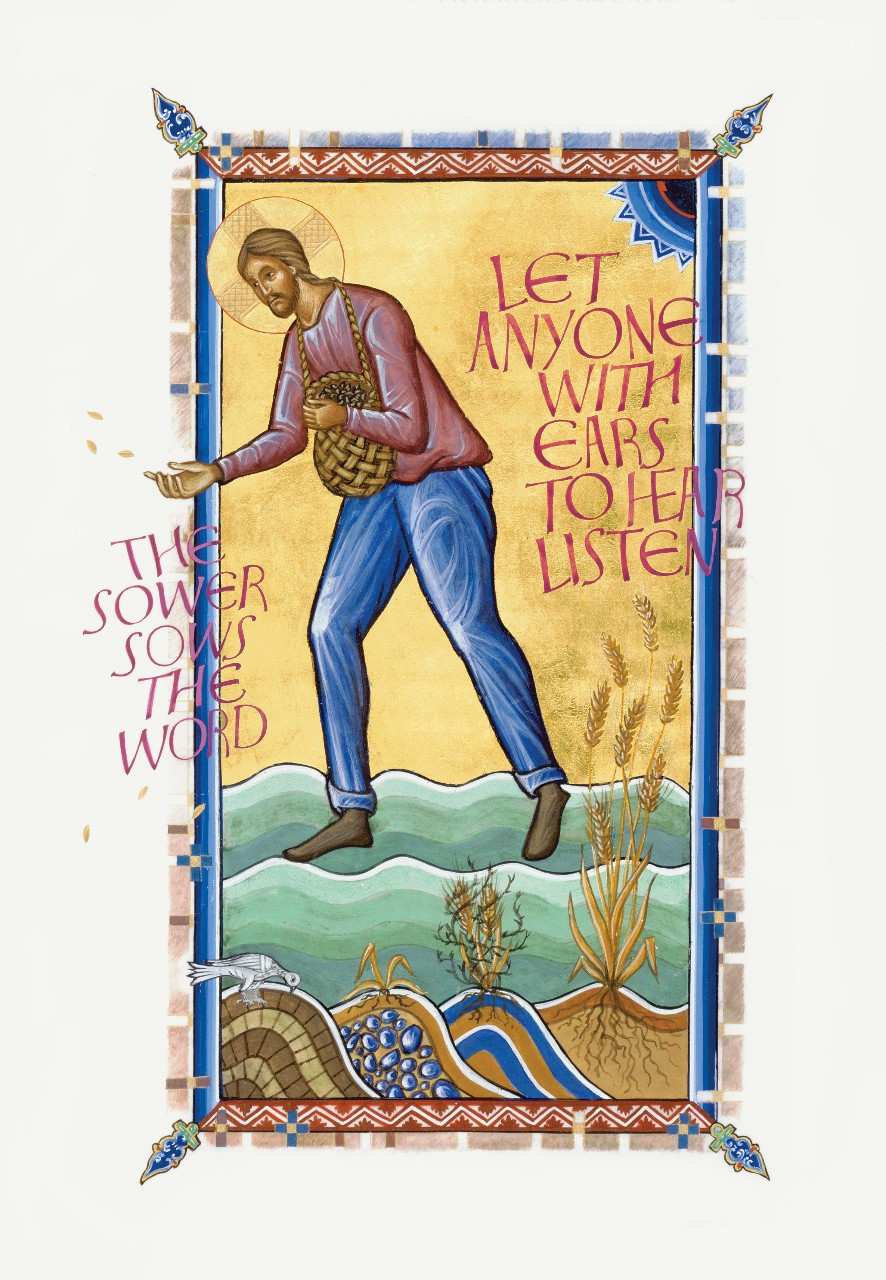
The typical images associated with this parable are the dry and rocky soil, the soil with weeds, and the good soil; in this illumination artist Aidan Hart draws our attention to the head of the sower and clothes which he wears. The clothes worn by the sower are not the clothes of a middle aged male Jew living in Nazareth, nor are they the typical contemporary outfit for a person scattering seed. The clothes are ones we can identify, maybe even wear.

Because we can identify with the sower, it is safe to assume that this illumination is calling us to take on this role. Believers have received the Word of God, and many have also partaken in the banquet of Christ’s body and blood. Christ has sown his word and nourished his flock, and like the good soil they must become a place for these seeds to grow. How to help the seeds grow? By going forth to become God’s word in the dark and broken world. Going forward and being nourishment for others by becoming the hands and feet of Christ through our words and actions. All of us, believers and non-believers, can be like Christ and walk and stand on the same soil to sow the seed, standing with those for whom the soil or hard concrete has become their bed or the only source of income they receive. Christ must be our inspiration and model. Instead of thinking that helping others is stooping to their level, we can take inspiration from Christ who lived with, served, and listened to the cry of the marginalized in his society. Christ’s mindset leads us to truly encounter and interact with the lives we so often neglect. The image displayed today echoes a unique call to believers in any tradition.

This commentary was contributed by James Gumataotao, a senior Theology major and a member of the Library’s Research Desk team.

Filed Under: Saint John's Bible

Life in Community. Artists: Donald Jackson in collaboration with Aidan Hart.

November 4, 2016 By Heidi

Life in Community Illumination
Click to enlarge

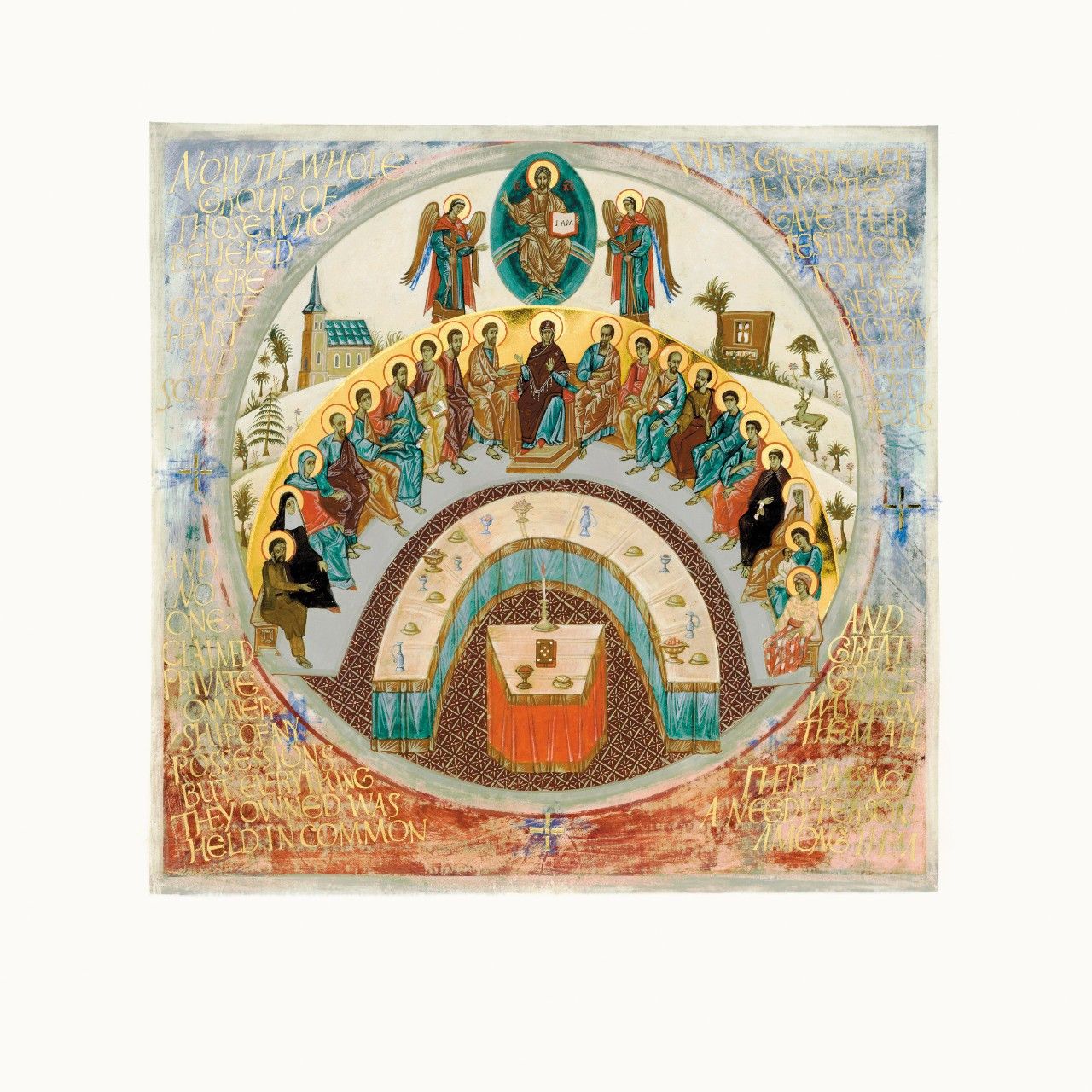
Essential to everyone — any Christian, any believer, any non-believer — is community. In a community one finds support and strength through participation in a group. The Saint John’s Bible provides this rich depiction of Life in Community. Let’s focus on two main aspects; Mary, mother of Jesus, who is seen in the center; and a table that is set. One can assume that the main message of this picture is that the church is made of all types of people. While this statement is true, there is more to the message. We see the people seated at one table, this is a call for us to invite everyone, including those who are on the margins of our society, to one community.

Let us sit and break bread with those who Jesus served. This cannot be accomplished if people are left outside the banquet hall begging for their next meal. This image invokes the call to work towards a society in which the poor and marginalized become our sisters and brothers. A call to build community where all life is supported and accepted, in a space where all of creation can live in solidarity with one another. Mary seated in the center reminds us of the call and our duty to answer it. Through her fiat at the annunciation, she invites us to also to lay our life down so that others may have life. Her example is a reminder that believers need humility and openness to God’s will. The first step to building this community is in complete acceptance and openness to Providence. Let us accept that call to break down the walls of inequality and inequity, inviting and allowing everyone to share in this feast.

This commentary was contributed by James Gumataotao, a senior Theology major and a member of the Library’s Research Desk team.

Filed Under: Saint John's Bible

Fulfillment of Creation. Artist: Thomas Ingmire.

October 25, 2016 By Heidi

Fulfillment of Creation illumination from Saint John's Bible
Click to enlarge.

In continuance of our theme from before Fall Break, this image of the Fulfillment of Creation brings to light the importance of reorientation. In this image, let us focus on two components; the star and the half drawn images of creation. The star on this page could be perceived as a cross, which for believers represents the death and resurrection of Jesus. At the bottom of the page one can find half drawn depictions of creation. Why are they half drawn? One answer that can satisfy this question is sin.

In sin a person loses their sense of purpose, moving further away from what they were created for. Humanity’s sins to the earth prevent our natural resources from accomplishing their purpose to their full capacity and deprive the rest of creation from the opportunity of living to their full potential. In this image, we find that when sin is introduced the vibrant colors become dark. The entire cosmos in this depiction becomes nothingness or as St. John of the Cross would call it, the “dark night.” Thus purpose, meaning, and order are lost.

Amidst darkness, there is hope. The cross in the form of a star returns vibrant colors and life to the image. It is the cross upon which Christ has died that brings us to fulfillment. God giving of God’s self as love upon the cross restores purpose, meaning, and order. As St. Paul would preach, nothing can separate us from this love. This love reminds us that the more one strives to genuinely be one’s self, the more one becomes like Christ, who is the fullness of our creation. In order to be Christ-like, one must ultimately be one’s self, who was perfectly created from the beginning.

Filed Under: Saint John's Bible

Call of the Disciples. Artist: Donald Jackson.

October 7, 2016 By Heidi

Call of the Disciples illumination from The Saint John's Bible
Click to enlarge.

The busyness and worries of life can overwhelm people, even when they are simply trying to accomplish day to day tasks. For its size, the illumination called The Call of the Disciples can be quite overwhelming. The moving crowds, flying angels, Jesus somewhere in there, and almost an unnoticeable lamb on the bottom right corner of the page. With all this going on, one must step back and ask what is the message this image is trying to convey? As any believer and non-believer would know, following a certain practice or belief is no easy task.

Being a disciple comes with its challenges and blessings, but that is not the message this image invokes. Looking at it one might ask the question “Where is God calling me to serve him?” or “How is God calling me to live out my call?” With Christ barely noticeable in the middle of the page and displaying similar colors to both the people and angels, one can consider that message is about solidarity and about Christ’s presence here and now, among us. One can receive the message that the call to follow Christ is to serve one another, to live in solidarity.

Another message this image invokes is the joy of being a disciple. The image calls one to a reorientation to have Christ at the center of life. By reorienting back to the core of one’s beliefs, and focusing on the representation of those beliefs, one can find joy in true discipleship. As Thomas Merton states “we do not exist for ourselves alone, and it is only when we are fully convinced of this fact that we begin to love ourselves properly and thus also love others.”

This commentary was contributed by James Gumataotao, a senior Theology major and a member of the Library’s Research Desk team.

Filed Under: Saint John's Bible

Psalms Frontispiece. Artist: Donald Jackson.

September 22, 2016 By Heidi

Psalms Frontispiece illumination
Click to enlarge.

This image of the beginning of the Book of Psalms might not invoke love, lament, hope, and remorse, although these are the feelings that come to mind when one reflects on the life of King David, the author of these 150 compositions. Was David truly a man after God’s heart? The Psalms describe the desire of the human soul, longing for God. Simultaneously, they are a desperate cry of hope or lamentation. Looking at this image, one might have a sense of peace and calm rather than of desperation.

The gold ornamentation symbolizes the Israelites’ creating a deeper relationship with the Creator via the Psalms, and to show that it was through the line of David that Jesus came. The shades of reds and pink remind us of the of the love and mercy of God which is believers’ constant. The dark purple and violet bring to mind the times believers have fallen short, but also royalty. Just as Jesus was clothed in a purple cloak, mocked, and crucified, it was through this ordeal that he became able to clothe sinners in royalty, love and mercy.

As we reflect on this image Susan Sink reminds us

“The Psalms do not simply collect stories of God’s faithfulness in the past. Just as they did for the people gathered to sing them at the temple, they remind us of our history with God, the covenant and a call to follow God’s command today.” (The Art of The Saint John’s Bible, Vol 1. p. 38)

The Psalms were meant to be sung from the lips of a believer, to let one echo the Biblical voice through actions of mercy and compassion to those who desperately pray and cry out to God, who is always listening.

This commentary was contributed by James Gumataotao, a senior Theology major and a member of the Library’s Research Desk team.

Filed Under: Saint John's Bible

Pentecost. Artist: Donald Jackson.

September 14, 2016 By Heidi

Pentecost illumination from The Saint John's Bible
Click to enlarge.

For believers, Pentecost is the time in which the Holy Spirit descended upon the Apostles and Mary fifty days after the resurrection. Others will add that Pentecost is also the birthday of the Church. Pentecost or Shavu’ot is also a traditional Jewish feast which remembers the day when Moses received the law from God.

The image that is displayed is based on the event described in the Acts of the Apostles. This image is quite different from traditional images we see of Pentecost; this seems to be a darker image that does not depict the Apostles and Mary in a room looking towards heaven with tongues of fire above their heads.

Susan Sink explains the darker imagery in The Art of the Saint John’s Bible:

Much of the imagery comes from the prophecy of Joel describing the day of the Lord with all its traditional imagery: blood, fire, smoky mists, and heavenly portents, to which Peter refers in his speech. However, in this scene the Lukan author shows the Day of the Lord as hopeful, a fulfillment and building up, not as one of destruction.” (Vol. 1., p. 101)

Sink also reminds the reader of the image’s connections, which are alluded to in the lower half of the illumination:

This illumination joins the past and the present, Jerusalem and the Abbey Church in Collegeville, to show the scope of the ministry of the Church.

From this event the Apostles went forth to evangelize all peoples and nations. Through this event the ministry of the Church began, not with people of status and fame but with ordinary people. As you look at this image, reflect on Sink’s words: “The hope of the passage, and of the illumination, is life in the Holy Spirit in history and eternity.” (Ibid.) So the ministry of the Church continues.

This commentary was contributed by James Gumataotao, a senior Theology major and a member of the Library’s Research Desk team.

Filed Under: Saint John's Bible

  • « Go to Previous Page
  • Go to page 1
  • Go to page 2
  • Go to page 3
  • Go to page 4
  • Go to page 5
  • Go to page 6
  • Interim pages omitted …
  • Go to page 9
  • Go to Next Page »

Primary Sidebar

Contact

Clark Library
503-943-7111
800-841-8261
reference@up.edu

Recent Posts

  • New Image: Luke Anthology
  • New Image: Birth of Christ
  • New Image This Week: Peter’s Confession
  • New Image This Week: The Beatitudes / Sermon on the Mount
  • Image change this week: Multiplication of the Loaves and Fishes

Subscribe by Email

Completely spam free, opt out any time.

Please, insert a valid email.

Thank you, your email will be added to the mailing list once you click on the link in the confirmation email.

Spam protection has stopped this request. Please contact site owner for help.

This form is protected by reCAPTCHA and the Google Privacy Policy and Terms of Service apply.

Archives

  • January 2023
  • December 2022
  • November 2022
  • October 2022
  • May 2022
  • April 2022
  • March 2022
  • December 2021
  • November 2021
  • October 2021
  • September 2021
  • August 2021
  • October 2019
  • April 2017
  • March 2017
  • February 2017
  • December 2016
  • November 2016
  • October 2016
  • September 2016
  • June 2016
  • December 2015
  • November 2015
  • September 2015
  • July 2015
  • April 2015
  • March 2015
  • February 2015
  • January 2015
  • November 2014
  • October 2014
  • July 2014
  • April 2014
  • March 2014
  • February 2014
  • January 2014
  • December 2013
  • November 2013
  • October 2013
  • September 2013
  • August 2013

Categories

  • General
  • Saint John's Bible

Meta

  • Log in
  • Entries feed
  • Comments feed
  • WordPress.org

Copyright © 2025 · News Pro with Full Header On Genesis Framework · WordPress · Log in