• Skip to main content
  • Skip to primary sidebar

Saint John's Bible

Saint John's Bible

Ruth and Naomi. Artist: Suzanne Moore.

October 2, 2014 By Heidi

Ruth and Naomi
Click to enlarge.

A woman and her mother-in-law embrace and gaze at a landscape of rolling green and yellow hills and colorful dwellings. “Their future” says Susan Sink (Art of The Saint John’s Bible, vol. 3, p. 31), as their current situation is bleak. They are two widows, Ruth and Naomi, and one of them is an outsider. But thanks to their love for each other, and God’s favor toward them, they will thrive. Ruth’s attentions to her mother-in-law will attract her second husband and she will produce a son, the father of King David.

But for the moment they survive through Ruth’s gleaning. She follows harvesters to steal a grain and perhaps a stray stalk here and there, an occupation that lasts only during the gathering time and that places Ruth at risk of being harassed by the men in the fields. On the facing page we see Ruth standing proudly with her basket.

Sink draws our attention to several motifs on the page, such as the stamped motif sparkling around Ruth and Naomi’s heads in both images, representing cosmic order to the universe and especially God’s miraculous provision for the two widows. And the basket of plenty, which Sink describes as

…more than a basket of grain. It seems to speak to the abundance and fertility at the center of her being, an extension of her swirling skirts. Barrenness and God’s promises will play a role in [several stories in the Bible]. The parallels are rich.

The image of Ruth and Naomi has parallels also in other Saint John’s Bible images, such as (says Sink) the portrait of Mary and Martha in the Luke Anthology. Come to the UP Authors event next Thursday 10/9 from 3:00 to 4:30 to examine this and other images up close.

Filed Under: Saint John's Bible

Out of the Whirlwind, 3: He Will Wipe Every Tear. Artist: Thomas Ingmire.

July 3, 2014 By Heidi

Out of the Whirlwind 3, from Job
Click to enlarge.

Interested in a puzzle? Clark Library has learned that recently an 8-year-old girl found a mistake in this illumination, which appears on the last page of Job. Library staff have not yet found it. If you find it, please point it out!

This illumination has three layers and according to Susan Sink is structured similarly to the Messianic Predictions illumination in Prophets, also by Thomas Ingmire, “with strings of words like trumpet blasts.” (The Art of The Saint John’s Bible, vol. 2, p. 20) First, sentences seemingly clipped from newspaper articles report on all that Job has lost. In reply, Job states, “I know that you can do all things, and that no purpose of yours can be thwarted.” And finally, the illumination’s foundation offers comfort:

He will wipe every tear from their eyes
Death will be no more;
mourning and crying and pain will be no more;
for the first things have passed away.

Filed Under: Saint John's Bible

Joshua Anthology. Artist: Donald Jackson, with contributions by Thomas Ingmire.

April 27, 2014 By Heidi

Click to enlarge.

This illumination appears at the beginning of the book of Joshua, which reminds the reader that Moses did not reach the Promised Land and that Joshua took up the task of leading the Israelites out of the wilderness across the Jordan River. Their progress toward the distant green valley is symbolized by a parade of fragments from the Ten Commandments illumination, and by a gold arched stamp representing the Ark of the Covenant. Hazards encumber their journey: the river is filled with drowned bodies; lions watch from the cliff tops; a scarab beetle seems to want to lead them in the wrong direction. Spiritual temptations threaten: you will recognize the golden calf and an Egyptian eye signifying the false gods of Egypt.

Donald Jackson also represented Egypt in the illumination’s border, taking the design “from a frieze on an Egyptian burial tomb.” (Susan Sink, The Art of The Saint John’s Bible, vol. 3, p. 14)

For this final blog post of the 2013-2014 academic year, as we send best wishes to UP graduates, the library is pleased to provide a reflection on this illumination from Theology professor Michael Cameron:

Each of us over the course of a lifetime hears, speaks, reads, and writes millions of words. From somewhere deep within they well up to help us in ways both ordinary and extraordinary, from making a grocery list to comforting a dying parent. From that same deep reservoir of human words God’s covenant drew a special few to express divine love, to teach truth, and to blaze a trail of wisdom. In order to learn and obey God’s will, while Israel was forbidden to fashion images of God they were commanded to know words of God. No wonder that Jewish tradition through the ages has seen the Ten Commandments (literally in Hebrew, “the Ten Words”) as little glowing lanterns of God’s presence (see Psalm 119). But becoming “doers of the word, and not hearers only” (James 1:22) was and is an enormous challenge. Entering the Promised Land under Joshua, the people formed by God’s wisdom were tossed by huge waves of temptation that threatened to drown the words of the covenant, especially the words forbidding love for other gods. In our world of endless texts and tweets and wooing words of enticement, what waves still batter the covenant commands about faithful love?

Filed Under: Saint John's Bible

Garden of Desire. Artist: Donald Jackson.

April 21, 2014 By Heidi

Click to enlarge.
Click to enlarge.

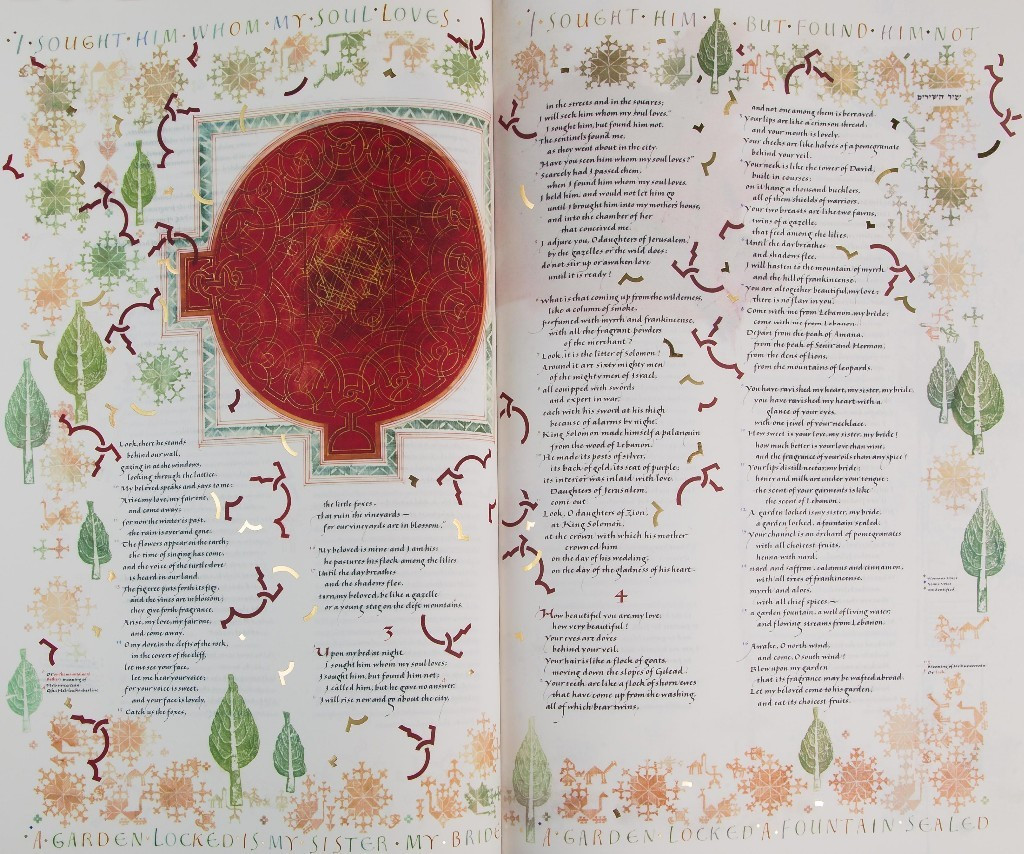
The Garden of Desire illumination is rich with details intended to evoke the many images and layers of meaning in the Song of Solomon. The eye is drawn first to the garden of the title and its wall, and on closer inspection you’ll discover that the garden houses an intricate labyrinth outlined in delicate gold. Expanding your view outward, notice the line segments, some bright gold and others warm red, that have escaped the garden. If captured and reassembled, these segments would cover a portion of the labyrinth; they are puzzle pieces. Their travels around the page lead your eye to the border where you might notice first the trees, then the flowers, houses, camels, birds, and people.

The labyrinth, puzzle pieces, and border reference the Song’s imagery and meaning layers. One can read the Song as a love poem between humans and also as an expression of God’s love for Israel. Similarly the labyrinth can be a symbol of the path one travels to reach Wisdom however defined: knowledge, peace with the world and oneself, God, etc. The puzzle pieces have escaped and become disordered, but perhaps they long for order and desire to be reunited. They might represent humans’ desire for social connection, and for some people connection to God.

In The Art of The Saint John’s Bible, Susan Sink writes that artist Donald Jackson enthusiastically embraced the “opportunity to find a visual language for this poetry” and states that the Bible’s highest ratio of illumination to text is found in the Song of Solomon book: “two back-to-back spreads and a text treatment adorn the eight chapters.” (Vol. 2, p. 32) You can see the shadow of the second back-to-back spread on the right-hand page of this illumination. The shadow is specially printed on the Heritage Edition to mimic the ink bleed-through that occurred in the original.

Filed Under: Saint John's Bible

The Crucifixion. Artist: Donald Jackson.

April 14, 2014 By Heidi

Click to enlarge.

The “Crucifixion” illumination from Luke will be featured in Visio Divina sessions on Wednesday, April 16, at 12:45 p.m. (30 minutes) and 7:15 p.m. (40 minutes) in the Chapel of Christ the Teacher. This Lenten prayer opportunity is sponsored by Campus Ministry and the Garaventa Center. Campus Ministry’s Interactive Lenten Calendar provides this commentary:

This is the beginning of Holy Week. Lent is almost over. How far have you come on this Journey to Jerusalem we began on Ash Wednesday? Are you standing with Jesus as he enters Jerusalem? Will you be with him on Friday? Spend some time asking for the grace of fidelity, for love. May we be true to our call to follow Christ. May we be true to our invitation to love. Jesus did the difficult work. We have only to respond to his gift.

Throughout The Saint John’s Bible, gold leaf represents the divine. This illumination is awash in it, representing Christians’ belief that Jesus is God. The customary outline of the crucified figure is barely visible. Breaking through the dazzling gilt, we see other elements of the story: on either side the two crosses representing the two thieves crucified alongside Jesus; on the left the moon and stars representing the hours of darkness over the land that coincided with the event; on the right a file of people representing the procession with the cross to Golgotha.

Click to enlarge.

On the facing page in the Bible you will see a scene from the story of the road to Emmaus (right),  in which Jesus appeared to two of his disciples.

Filed Under: Saint John's Bible

Valley of Dry Bones. Artist: Donald Jackson.

March 30, 2014 By Heidi

Click to enlarge.
Click to enlarge.

The “Valley of Dry Bones” illumination from Ezekiel will be featured in Visio Divina sessions on Wednesday, April 2, at 12:45 p.m. (30 minutes) and 7:15 p.m. (40 minutes) in the Chapel of Christ the Teacher. This Lenten prayer opportunity is sponsored by Campus Ministry and the Garaventa Center. Campus Ministry’s Interactive Lenten Calendar provides a prompt:

God makes all things new. He raises the dead. He gives the dry bones new flesh. So, too, in our own lives. God can transform all things. Where do you need God’s work in your life? Ask God for this grace.

This illumination illustrates Ezekiel 37: 1-14, in which God sets Ezekiel in the middle of a valley filled with dry bones, representing a destroyed society cut off from faith. Ezekiel preaches the word of God to the bones, and God promises the bones that He will “put my Spirit in you and you will live, and I will settle you in your own land.” You will find many human bones in this illumination, as well as the figurative bones of civilization.

In The Art of the Saint John’s Bible, Susan Sink relates how Donald Jackson began work on this illumination with an Internet search, looking for documentary photos of human suffering.

“The skulls are based on photos taken of genocide and war in Armenia, Rwanda, Iraq, and Bosnia. The piles of broken glass suggest the broken windows caused by car bombs…. At the center is a pile of eyeglasses, a well-known image from the Holocaust. […] For Donald Jackson the waste of ecological disaster is part of the larger image…. The three automobile hulls are one sign of the spiritual death of society.” (Sink, vol. 2, p. 82)

Yet throughout the image we find glimmers of hope. Note the splash of oil on the right-hand page, with a rainbow sheen connecting the dry bones to the exultant rainbow at the top. Remember the gold squares from the Creation image? They are present here, indicating divine watchfulness.

Finally, note the seven menorahs, a sign throughout the Saint John’s Bible of creation and covenant. Sink notes: “Here the seven gold and black bars are intersected by arcs that end in points of light. Seven menorahs with seven points of light rise out of and transcend the wreckage and wrongdoings of humankind….” (Sink, vol. 2, p. 83)

A post about the Valley of Dry Bones illumination originally appeared in the Clark Library Blog on October 29, 2013.

Filed Under: Saint John's Bible

The Ten Commandments. Artist: Thomas Ingmire.

March 23, 2014 By Heidi

The “Ten Commandments” illumination from Exodus will be featured in Visio Divina sessions on Wednesday, March 26, at 12:45 p.m. (30 minutes) and 7:15 p.m. (40 minutes) in the Chapel of Christ the Teacher. This Lenten prayer opportunity is sponsored by Campus Ministry and the Garaventa Center. Campus Ministry’s Interactive Lenten Calendar provides a prompt:

God’s giving of the Ten Commandments atop of Mount Sinai ranks was one of the greatest religious events of all time. Moses acts as the intermediary for the people who are too frightened to approach the mountain or who have been prohibited from doing so. Not only do the Ten Commandments have significance in religious history, but they have also had a tremendous effect on civil law the world over. Just as the creation in Genesis brought order from the chaos, the Law, according to Jewish interpretation, brings order from the chaos of lawless society. In this sense, the giving of the Law is a new creation. The law forms the foundation of the covenant that God is establishing with His people.

A Saint John’s Bible press release about this illumination says “Just as the creation in Genesis brought order from the chaos, the Law, according to Jewish interpretation, brings order from the chaos of lawless society. In this sense, the giving of the Law is a new creation.” In this illumination we find several references to the Creation image, e.g. the multiple panels across the top, the inclusion of birds (look for eyes and wings). The panels represent four stories: the burning bush, the first Passover, the Red Sea crossing, and the twelve pillars erected at the foot of Mount Sinai.

The architectural features and religious symbols you see here will appear in other SJB illuminations, such as the faint menorah in the burning bush, the pillars/skyline, and the Cubist elements in the middle panels.

Artist Thomas Ingmire draws our attention to the typography on the page, saying “the most fascinating part for me in the Ten Commandments is their relationship to the history of writing. The Commandments were given in alphabetical form, rather than pictograms. As I see it, the Commandments could only be taken in as a mysterious code by the Hebrews (themselves slaves and not necessarily literate). The Lord, by the second Commandment which forbade the creation of engraved images, reinforced the mystery. His words, in alphabetical form, were the strongest evidence of his existence: I am who I am – no pictures, statues…..Words = God. This is clearly an abstract concept – just as the alphabet, when one really thinks about it, is a completely abstract concept.  I am interested in the idea that God presented himself as an abstraction and the abstraction was the Word.”

Susan Sink adds, “the familiar words of the commandments [are] stenciled in Stone Sans typeface as though engraved on tablets.” (The Art of the Saint John’s Bible, vol. 1, p. 27)

A post about the Ten Commandments illumination originally appeared in the Clark Library Blog on September 13, 2013.

Filed Under: Saint John's Bible

Wisdom Woman. Artist: Donald Jackson.

February 18, 2014 By Heidi

In this illumination, Wisdom appears as a woman, reflected in a hand mirror with moon-inscribed frame and cosmic elements in the corners. The reference is to chapter 7 of Wisdom of Solomon: “For she is a reflection of eternal light, a spotless mirror of the working of God.” Solomon prayed to God to send Wisdom to help him, and eternal Wisdom will attend Solomon and help him with his work.

Click to enlarge.
Click to enlarge.

Wisdom’s image is based on a photograph of a Palestinian woman, and is according to Susan Sink the only image inspired by an actual human face other than Adam and Eve. (The Art of The Saint John’s Bible, vol. 2, p. 37). The image was silk-screened onto the original vellum multiple times — at least four — in an “unforgiving” process (Sink, p. 37) that gives the artist a single chance to get things right. The two-page nature of the image made the arrangement much more difficult.

Sink describes Wisdom Woman’s face as “perfect:”

The crow’s feet around her eyes and the sparkle in those eyes emit more joy than her slight smile suggests. Like Wisdom, she is full of light. She has squinted into the sun, and she has looked hard at life, and she has laughed. The lines on her forehead show she has worried and given her full attention to the task at hand. Her smile is knowing, somewhat secretive, but also intimate — she will tell us her secret if we ask. (p. 38)

Take a closer look at the mirror’s round frame and you will notice another reference to the feminine, in the depiction of the moon’s 28-day cycle. The paintings in the mirror’s four corners are based on images from the Hubble telescope. The “wisdom tree” stamp in the margins, based on a piece of cloth from India that was embroidered and appliquéd with mirrors, appears throughout the Wisdom books and has been seen in previous displays such as Seven Pillars of Wisdom and Revelation Frontispiece.

Filed Under: Saint John's Bible

Esther. Artist: Donald Jackson.

January 13, 2014 By Heidi

In the Bible, Esther is an Israelite orphan who becomes queen at a young age and then collaborates with her uncle and a foreign king to foil the plans of a man who would destroy her people. This beautiful design expresses many aspects of the story of Esther in a small space. We see Esther’s dual identity in the “split screen” depiction of her face and environment. On the right is the beautiful Israelite and the menorah representing her heritage. On the left she wears her queenly headdress and other regalia, and sumptuous tapestries surround her. In The Art of The Saint John’s Bible Susan Sink reports

Although [these images] are not based on the period in the story, they are taken from pieces in the region that are marks of royalty and weddings. Esther’s queenship is marked by finery and “cosmetic” treatments, crowned by a gold figure of the lion of Babylon and by rich Persian rugs. The images on the left side of the illumination are inspired by Turkmen (Afghan) traditional bridal gifts and ancient Persian gold artifacts such as coins, jewelry, and textiles.(Vol. 3, p. 68)

Sink further notes, “The face of Queen Esther…is based on a portrait of Adele Bloch-Bauer by Gustav Klimt.” Bloch-Bauer was Klimt’s patroness, married at age 18 to a man 17 years older. By using Adele as his model, artist Donald Jackson alludes to the existence of such “May-December” marriages throughout history (Sink, vol. 3, p. 67).
Hanging at the lower left we see what happened to the treacherous official, named Haman; the image is apparently based on images of public executions in Saudi Arabia and is intended to cause viewers to reflect on the presence of violence and war in current events (Sink, vol. 3, p. 68).

Filed Under: Saint John's Bible

Messianic Predictions. Artist: Thomas Ingmire.

December 9, 2013 By Heidi

Click to enlarge.
Click to enlarge.

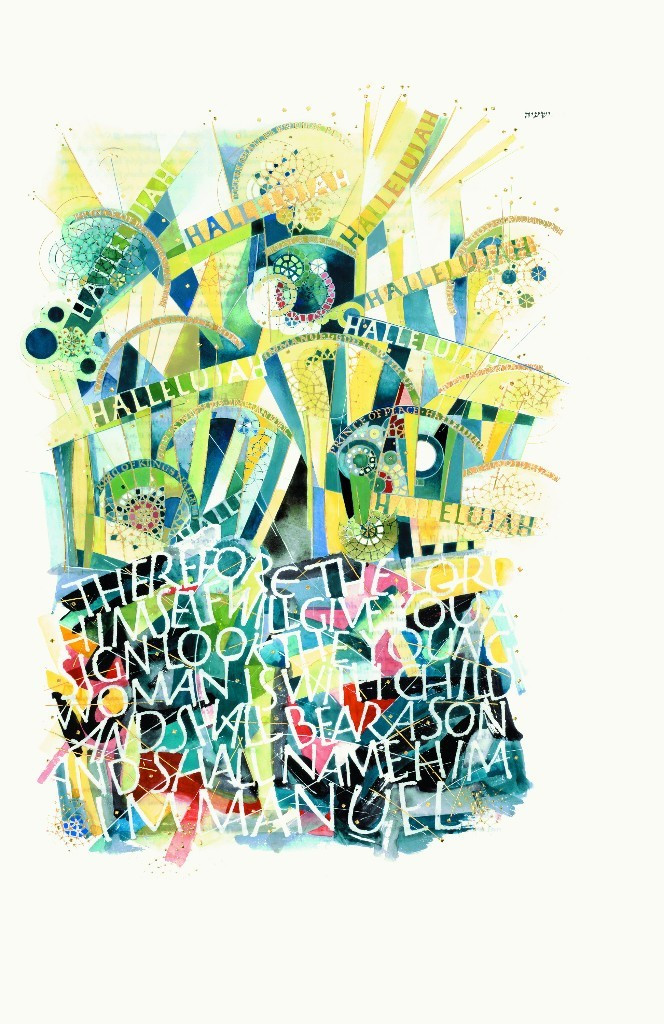
“For a child has been born for us, a son given to us…” (Isaiah 9:6)

According to the publishers of The Saint John’s Bible, “The most important messianic verses are Isaiah 7:14-17, Isaiah 9:1-2, 6-7 and Isaiah 11:1-9. From the earliest of times, Christians have seen these messianic verses as having a direct reference to Christ. Isaiah’s prophecies have had an enduring influence on Western Civilization. The Christmas carol, Lo How a Rose ere Blooming, was inspired by Isaiah 11:1-3. Handel used Isaiah 9:6-7 for one of the great choral sections of the Messiah.

“Artist Thomas Ingmire fills this text treatment with explosive energy, color and radiating gold. Familiar gilded phrases burst out of the foundational text: Prince of Peace, King of Kings, Everlasting Peace, Immanuel God is With Us, For Unto Us a Child is Born, Halleluiah!—all prophesying the coming of our savior. Blues, greens and yellows suggest Marian connections since devotion to the “Blessed Virgin Mother” finds part of its scriptural basis in Isaiah 7.”

Returning to the connection with Handel’s Messiah, Susan Sink says, “This illumination is crowned with Hallelujahs! You can almost see the trumpets raised and blasting with the announcement.” (The Art of The Saint John’s Bible, vol. 2, p. 62) Note also the intricate gold stamp, which we have seen in many recent display illuminations, adding to the celebratory effect.

Filed Under: Saint John's Bible

  • « Go to Previous Page
  • Go to page 1
  • Interim pages omitted …
  • Go to page 3
  • Go to page 4
  • Go to page 5
  • Go to page 6
  • Go to page 7
  • Go to Next Page »

Primary Sidebar

Contact

Clark Library
503-943-7111
800-841-8261
reference@up.edu

Recent Posts

  • New Image: Luke Anthology
  • New Image: Birth of Christ
  • New Image This Week: Peter’s Confession
  • New Image This Week: The Beatitudes / Sermon on the Mount
  • Image change this week: Multiplication of the Loaves and Fishes

Subscribe by Email

Completely spam free, opt out any time.

Please, insert a valid email.

Thank you, your email will be added to the mailing list once you click on the link in the confirmation email.

Spam protection has stopped this request. Please contact site owner for help.

This form is protected by reCAPTCHA and the Google Privacy Policy and Terms of Service apply.

Archives

  • January 2023
  • December 2022
  • November 2022
  • October 2022
  • May 2022
  • April 2022
  • March 2022
  • December 2021
  • November 2021
  • October 2021
  • September 2021
  • August 2021
  • October 2019
  • April 2017
  • March 2017
  • February 2017
  • December 2016
  • November 2016
  • October 2016
  • September 2016
  • June 2016
  • December 2015
  • November 2015
  • September 2015
  • July 2015
  • April 2015
  • March 2015
  • February 2015
  • January 2015
  • November 2014
  • October 2014
  • July 2014
  • April 2014
  • March 2014
  • February 2014
  • January 2014
  • December 2013
  • November 2013
  • October 2013
  • September 2013
  • August 2013

Categories

  • General
  • Saint John's Bible

Meta

  • Log in
  • Entries feed
  • Comments feed
  • WordPress.org

Copyright © 2025 · News Pro with Full Header On Genesis Framework · WordPress · Log in