• Skip to main content
  • Skip to primary sidebar

Saint John's Bible

Saint John's Bible

Life in Community. Artists: Donald Jackson in collaboration with Aidan Hart.

November 4, 2016 By Heidi

Life in Community Illumination
Click to enlarge

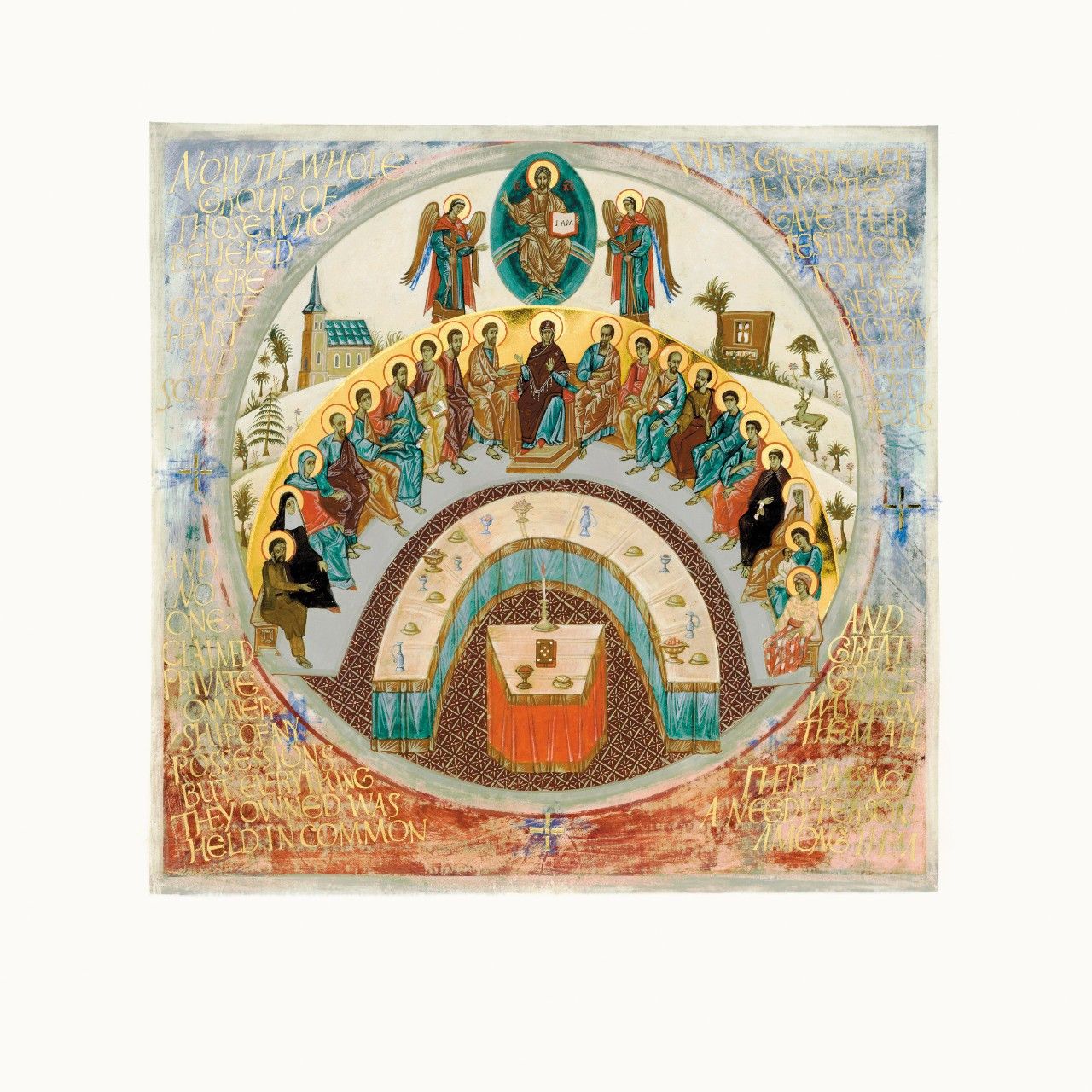
Essential to everyone — any Christian, any believer, any non-believer — is community. In a community one finds support and strength through participation in a group. The Saint John’s Bible provides this rich depiction of Life in Community. Let’s focus on two main aspects; Mary, mother of Jesus, who is seen in the center; and a table that is set. One can assume that the main message of this picture is that the church is made of all types of people. While this statement is true, there is more to the message. We see the people seated at one table, this is a call for us to invite everyone, including those who are on the margins of our society, to one community.

Let us sit and break bread with those who Jesus served. This cannot be accomplished if people are left outside the banquet hall begging for their next meal. This image invokes the call to work towards a society in which the poor and marginalized become our sisters and brothers. A call to build community where all life is supported and accepted, in a space where all of creation can live in solidarity with one another. Mary seated in the center reminds us of the call and our duty to answer it. Through her fiat at the annunciation, she invites us to also to lay our life down so that others may have life. Her example is a reminder that believers need humility and openness to God’s will. The first step to building this community is in complete acceptance and openness to Providence. Let us accept that call to break down the walls of inequality and inequity, inviting and allowing everyone to share in this feast.

This commentary was contributed by James Gumataotao, a senior Theology major and a member of the Library’s Research Desk team.

Filed Under: Saint John's Bible

Fulfillment of Creation. Artist: Thomas Ingmire.

October 25, 2016 By Heidi

Fulfillment of Creation illumination from Saint John's Bible
Click to enlarge.

In continuance of our theme from before Fall Break, this image of the Fulfillment of Creation brings to light the importance of reorientation. In this image, let us focus on two components; the star and the half drawn images of creation. The star on this page could be perceived as a cross, which for believers represents the death and resurrection of Jesus. At the bottom of the page one can find half drawn depictions of creation. Why are they half drawn? One answer that can satisfy this question is sin.

In sin a person loses their sense of purpose, moving further away from what they were created for. Humanity’s sins to the earth prevent our natural resources from accomplishing their purpose to their full capacity and deprive the rest of creation from the opportunity of living to their full potential. In this image, we find that when sin is introduced the vibrant colors become dark. The entire cosmos in this depiction becomes nothingness or as St. John of the Cross would call it, the “dark night.” Thus purpose, meaning, and order are lost.

Amidst darkness, there is hope. The cross in the form of a star returns vibrant colors and life to the image. It is the cross upon which Christ has died that brings us to fulfillment. God giving of God’s self as love upon the cross restores purpose, meaning, and order. As St. Paul would preach, nothing can separate us from this love. This love reminds us that the more one strives to genuinely be one’s self, the more one becomes like Christ, who is the fullness of our creation. In order to be Christ-like, one must ultimately be one’s self, who was perfectly created from the beginning.

Filed Under: Saint John's Bible

Call of the Disciples. Artist: Donald Jackson.

October 7, 2016 By Heidi

Call of the Disciples illumination from The Saint John's Bible
Click to enlarge.

The busyness and worries of life can overwhelm people, even when they are simply trying to accomplish day to day tasks. For its size, the illumination called The Call of the Disciples can be quite overwhelming. The moving crowds, flying angels, Jesus somewhere in there, and almost an unnoticeable lamb on the bottom right corner of the page. With all this going on, one must step back and ask what is the message this image is trying to convey? As any believer and non-believer would know, following a certain practice or belief is no easy task.

Being a disciple comes with its challenges and blessings, but that is not the message this image invokes. Looking at it one might ask the question “Where is God calling me to serve him?” or “How is God calling me to live out my call?” With Christ barely noticeable in the middle of the page and displaying similar colors to both the people and angels, one can consider that message is about solidarity and about Christ’s presence here and now, among us. One can receive the message that the call to follow Christ is to serve one another, to live in solidarity.

Another message this image invokes is the joy of being a disciple. The image calls one to a reorientation to have Christ at the center of life. By reorienting back to the core of one’s beliefs, and focusing on the representation of those beliefs, one can find joy in true discipleship. As Thomas Merton states “we do not exist for ourselves alone, and it is only when we are fully convinced of this fact that we begin to love ourselves properly and thus also love others.”

This commentary was contributed by James Gumataotao, a senior Theology major and a member of the Library’s Research Desk team.

Filed Under: Saint John's Bible

Psalms Frontispiece. Artist: Donald Jackson.

September 22, 2016 By Heidi

Psalms Frontispiece illumination
Click to enlarge.

This image of the beginning of the Book of Psalms might not invoke love, lament, hope, and remorse, although these are the feelings that come to mind when one reflects on the life of King David, the author of these 150 compositions. Was David truly a man after God’s heart? The Psalms describe the desire of the human soul, longing for God. Simultaneously, they are a desperate cry of hope or lamentation. Looking at this image, one might have a sense of peace and calm rather than of desperation.

The gold ornamentation symbolizes the Israelites’ creating a deeper relationship with the Creator via the Psalms, and to show that it was through the line of David that Jesus came. The shades of reds and pink remind us of the of the love and mercy of God which is believers’ constant. The dark purple and violet bring to mind the times believers have fallen short, but also royalty. Just as Jesus was clothed in a purple cloak, mocked, and crucified, it was through this ordeal that he became able to clothe sinners in royalty, love and mercy.

As we reflect on this image Susan Sink reminds us

“The Psalms do not simply collect stories of God’s faithfulness in the past. Just as they did for the people gathered to sing them at the temple, they remind us of our history with God, the covenant and a call to follow God’s command today.” (The Art of The Saint John’s Bible, Vol 1. p. 38)

The Psalms were meant to be sung from the lips of a believer, to let one echo the Biblical voice through actions of mercy and compassion to those who desperately pray and cry out to God, who is always listening.

This commentary was contributed by James Gumataotao, a senior Theology major and a member of the Library’s Research Desk team.

Filed Under: Saint John's Bible

Pentecost. Artist: Donald Jackson.

September 14, 2016 By Heidi

Pentecost illumination from The Saint John's Bible
Click to enlarge.

For believers, Pentecost is the time in which the Holy Spirit descended upon the Apostles and Mary fifty days after the resurrection. Others will add that Pentecost is also the birthday of the Church. Pentecost or Shavu’ot is also a traditional Jewish feast which remembers the day when Moses received the law from God.

The image that is displayed is based on the event described in the Acts of the Apostles. This image is quite different from traditional images we see of Pentecost; this seems to be a darker image that does not depict the Apostles and Mary in a room looking towards heaven with tongues of fire above their heads.

Susan Sink explains the darker imagery in The Art of the Saint John’s Bible:

Much of the imagery comes from the prophecy of Joel describing the day of the Lord with all its traditional imagery: blood, fire, smoky mists, and heavenly portents, to which Peter refers in his speech. However, in this scene the Lukan author shows the Day of the Lord as hopeful, a fulfillment and building up, not as one of destruction.” (Vol. 1., p. 101)

Sink also reminds the reader of the image’s connections, which are alluded to in the lower half of the illumination:

This illumination joins the past and the present, Jerusalem and the Abbey Church in Collegeville, to show the scope of the ministry of the Church.

From this event the Apostles went forth to evangelize all peoples and nations. Through this event the ministry of the Church began, not with people of status and fame but with ordinary people. As you look at this image, reflect on Sink’s words: “The hope of the passage, and of the illumination, is life in the Holy Spirit in history and eternity.” (Ibid.) So the ministry of the Church continues.

This commentary was contributed by James Gumataotao, a senior Theology major and a member of the Library’s Research Desk team.
Filed Under: Saint John's Bible

Genealogy of Christ (2016 entry). Artist: Donald Jackson

September 8, 2016 By Heidi

Genealogy of Jesus illumination
Click to enlarge.

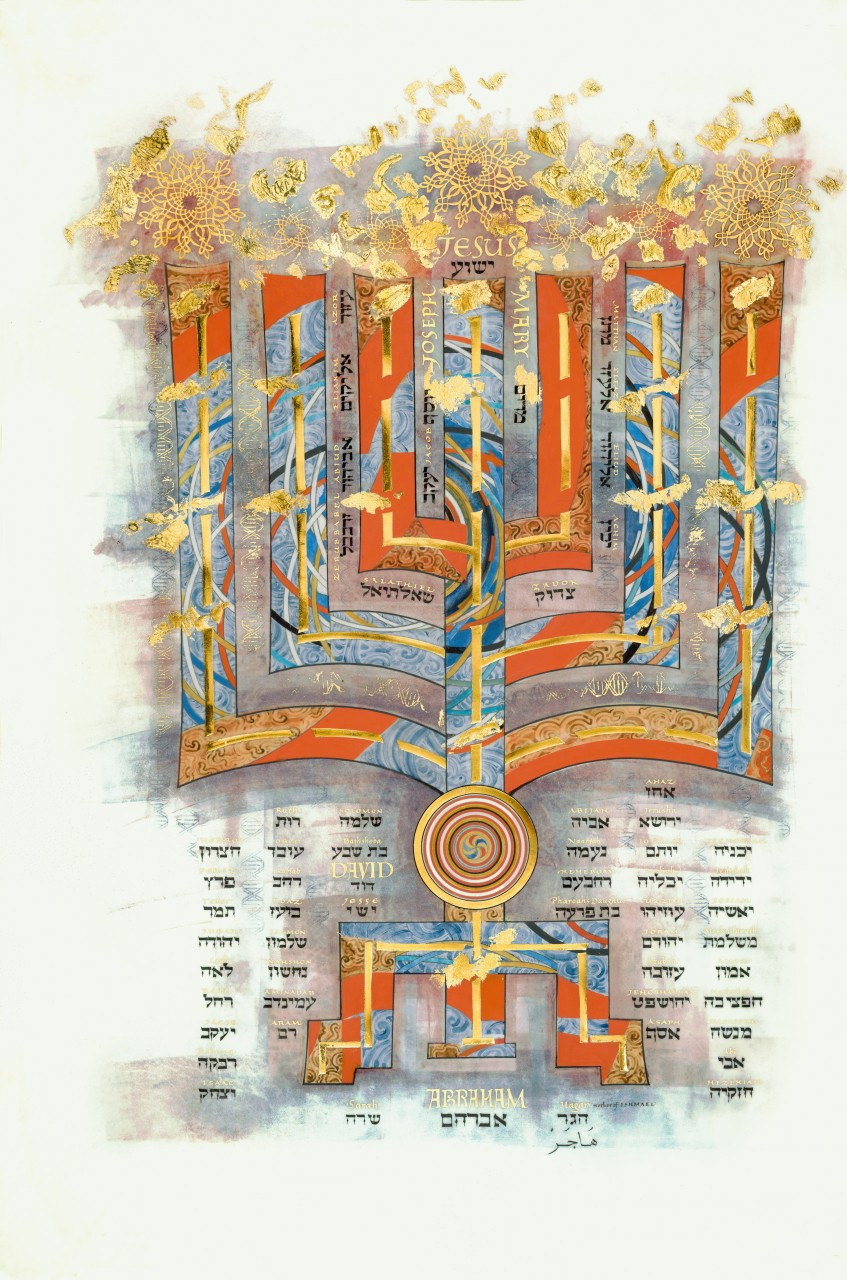
In the beginning of Mathew’s Gospel, the reader is introduced to the genealogy of Christ. One can assume that the author of the Gospel began in this manner to portray the humanity of Jesus while at the same time showing his divinity. The image that appears is a beautiful image of a menorah. Matthew in his time was primarily writing to a Jewish audience, so the image is quite appropriate, not just because of the audience he was addressing his gospel to, but also because Jesus himself was a Jew.

Menorahs are familiar objects to Jews, but this menorah depicts more than the usual object. In fact, Susan Sink writes in The Art of the Saint John’s Bible:

The menorah from Jewish tradition becomes a family tree, from which the names of the genealogy branch out. Matthew wrote for a Jewish audience and set Jesus’ birth within a Jewish context. The line of Jesus through David was important for establishing his divinity. Abraham and Sarah are at the root of this tree, and Hagar is there too, with her name in Arabic as well as Hebrew and English, the branch that leads through Ishmael to Islam. (Vol. 2. pp. 51)

She guides the reader further to notice:

The gilded stamps used in the center of the illustration come from illuminations of the Koran. A mandala is incorporated into the base of the menorah, again a sign of cosmic unity and wholeness found in many religious traditions.

This detail is important to this image because it seeks to show the interconnectedness of not only religions but also creation. Sink invites us to contemplate on “life, on creation, on history and redemption, on identity.” (Ibid.) What a great way to begin the Gospel!

This commentary was contributed by James Gumataotao, a senior Theology major and a member of the Library’s Research Desk team.

Filed Under: Saint John's Bible

Creation, Covenant, Shekinah, Kingdom. Artist: Donald Jackson.

June 20, 2016 By Heidi

Creation, Covenant, Shekinah, Kingdom
Click to enlarge.

In Wisdom of Solomon, chapters 10-11 recount the history of Wisdom from creation through the Israelites’ stay in the desert, making reference to major events in Genesis and Exodus. These events are portrayed in this illumination’s first three panels; viewers familiar with The Saint John’s Bible will recognize various elements. Some elements are changed slightly to tie this illumination to the Wisdom books or to the concept of wisdom.

In The Art of The Saint John’s Bible, Susan Sink describes the panels:

In the first panel the seven pieces from the Creation illumination are put in various widths, emphasizing the cycles of the moon associated with Wisdom, and the creation of humans, along with the coral snake representing the Fall. The raven of the first panel…is complemented by the dove in the second [from the story of the Flood, a second creation story], a symbol of the spirit. […] [In the third panel] The image is of the column of fire by which God led Israel out of Egypt. (Vol. 2, pp. 43-44)

She draws the reader’s attention to the imagery of destruction as well as creation:

The flash of color at the bottom of the second panel is a variation on the Job Frontispiece, imagery that continues into the [3rd] panel. In both cases, as with chaos in the first panel, destruction breaks the boundaries of the image. (Ibid.)

The fourth panel “takes a detail from the vision of Solomon’s temple in Isaiah that focuses on the abundance [that will be] provided to the people in the Promised Land” (Vol. 2, p. 45)

You will notice batons and frames of gold and silver connecting these panels; these represent “wisdom and divinity” according to Sink, and show that “These are not discrete events, but connected.” (Ibid.)

Filed Under: Saint John's Bible

The Word Made Flesh. Artist: Donald Jackson.

December 8, 2015 By Heidi

Word Made Flesh illumination
Click to enlarge.

The Gospel of John begins with the verse, “In the beginning was the Word, and the Word was with God, and the Word was God.” (1:1) The reference to the Beginning hearkens back to Genesis and the Earth’s formation, and artist Donald Jackson incorporates the Genesis story by having the central figure of Christ step from the dark unformed universe toward the bright organized world. In The Art of The Saint John’s Bible, Susan Sink develops this idea:

The image of Christ seems to be stepping from the darkness which recalls the chaos and nothingness of the creation story and moves toward light and order. In fact, the texture behind Christ’s head is inspired by an image taken from the Hubble Space Telescope and reflects the cosmic character of the event.

She draws the reader’s attention to another symbol:

To the left, a keyhole recalls the tradition of locked and hinged manuscripts securing, protecting, and holding the “key” to the Word of God. It might also make you think of standing at the door and knocking, of locked diaries, and of secret prayers of the heart.

Notice also the stenciled crosses which refer to the Transfiguration illumination, and the gold filigree which throughout the Bible refers to the presence of the divine.

The “Word Made Flesh” illumination will be featured in a Visio Divina session on Wednesday, December 9, at 12:45 p.m. in the Chapel of Christ the Teacher. This Advent prayer opportunity is sponsored by Campus Ministry and the Garaventa Center.

Filed Under: Saint John's Bible

Messianic Predictions (Visio Divina image). Artist: Thomas Ingmire.

November 25, 2015 By Heidi

Click to enlarge.
Click to enlarge.

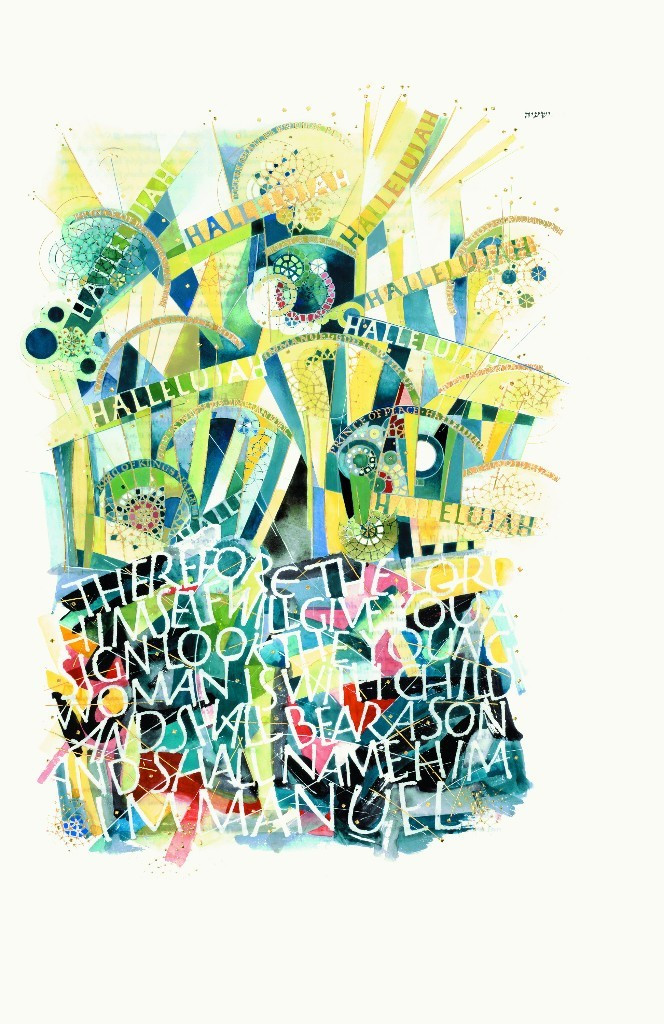
“For a child has been born for us, a son given to us…” (Isaiah 9:6)

According to the publishers of The Saint John’s Bible, “The most important messianic verses are Isaiah 7:14-17, Isaiah 9:1-2, 6-7 and Isaiah 11:1-9. From the earliest of times, Christians have seen these messianic verses as having a direct reference to Christ. Isaiah’s prophecies have had an enduring influence on Western Civilization. The Christmas carol, Lo How a Rose ere Blooming, was inspired by Isaiah 11:1-3. Handel used Isaiah 9:6-7 for one of the great choral sections of the Messiah.

“Artist Thomas Ingmire fills this text treatment with explosive energy, color and radiating gold. Familiar gilded phrases burst out of the foundational text: Prince of Peace, King of Kings, Everlasting Peace, Immanuel God is With Us, For Unto Us a Child is Born, Halleluiah!—all prophesying the coming of our savior. Blues, greens and yellows suggest Marian connections since devotion to the “Blessed Virgin Mother” finds part of its scriptural basis in Isaiah 7.” (Liturgical Press)

Returning to the connection with Handel’s Messiah, Susan Sink says, “This illumination is crowned with Hallelujahs! You can almost see the trumpets raised and blasting with the announcement.” (The Art of The Saint John’s Bible, vol. 2, p. 62) Note also the intricate gold stamp, which we have seen in many recent display illuminations, adding to the celebratory effect.

The “Messianic Predictions” illumination will be featured in a Visio Divina session on Wednesday, December 2, at 12:45 p.m. in the Chapel of Christ the Teacher. This Advent prayer opportunity is sponsored by Campus Ministry and the Garaventa Center. Need more information? See this press release.

The library has a 1995 recording of the University of Portland Singers singing “Lo How a Rose Ere Blooming,” on this CD. Enjoy!

Filed Under: Saint John's Bible

Celebrate Pope Francis’ visit to the U.S.: View The Saint John’s Bible

September 18, 2015 By Heidi

Poster for Clark Library's Saint John's Bible display
Click to enlarge

To celebrate Pope Francis’ visit to the United States, all institutions with The Saint John’s Bible will display the same illumination, and its associated reflection, each day between Monday 9/21 and Sunday 9/27. Saint John’s University describes the event:

The simple acts of displaying the same pages at churches, schools, libraries, hospitals and homes; spending time with the beautiful images and words; and praying a reflection will be rich symbols of unity among Christians. This seven-day program will bring together people from across the country in communion with God during Pope Francis’ visit.

The daily schedule:

Monday 9/21:          Creation
Tuesday 9/22:         Abraham and Sarah
Wednesday 9/23:   Ten Commandments
Thursday 9/24:        Peter’s Confession
Friday 9/25:             Multiplication of the Loaves and Fishes
Saturday 9/26:        Two Cures
Sunday 9/27:           Pentecost

Visit Clark Library each day to see each illumination up close.

Filed Under: Saint John's Bible

  • « Go to Previous Page
  • Go to page 1
  • Go to page 2
  • Go to page 3
  • Go to page 4
  • Go to page 5
  • Interim pages omitted …
  • Go to page 7
  • Go to Next Page »

Primary Sidebar

Contact

Clark Library
503-943-7111
800-841-8261
reference@up.edu

Recent Posts

  • New Image: Luke Anthology
  • New Image: Birth of Christ
  • New Image This Week: Peter’s Confession
  • New Image This Week: The Beatitudes / Sermon on the Mount
  • Image change this week: Multiplication of the Loaves and Fishes

Subscribe by Email

Completely spam free, opt out any time.

Please, insert a valid email.

Thank you, your email will be added to the mailing list once you click on the link in the confirmation email.

Spam protection has stopped this request. Please contact site owner for help.

This form is protected by reCAPTCHA and the Google Privacy Policy and Terms of Service apply.

Archives

  • January 2023
  • December 2022
  • November 2022
  • October 2022
  • May 2022
  • April 2022
  • March 2022
  • December 2021
  • November 2021
  • October 2021
  • September 2021
  • August 2021
  • October 2019
  • April 2017
  • March 2017
  • February 2017
  • December 2016
  • November 2016
  • October 2016
  • September 2016
  • June 2016
  • December 2015
  • November 2015
  • September 2015
  • July 2015
  • April 2015
  • March 2015
  • February 2015
  • January 2015
  • November 2014
  • October 2014
  • July 2014
  • April 2014
  • March 2014
  • February 2014
  • January 2014
  • December 2013
  • November 2013
  • October 2013
  • September 2013
  • August 2013

Categories

  • General
  • Saint John's Bible

Meta

  • Log in
  • Entries feed
  • Comments feed
  • WordPress.org

Copyright © 2025 · News Pro with Full Header On Genesis Framework · WordPress · Log in