• Skip to main content
  • Skip to primary sidebar

Saint John's Bible

Diane

The Resurrection. Artist: Donald Jackson.

April 26, 2017 By Diane

(John 20: 1-23)

Death has lost the battle because Christ has risen victoriously. In this image of Jesus’ resurrection we find that Jesus is not the main focal point. Mary Magdalene, who was the first to receive the message of the resurrection, is highlighted. Another important detail to discover is that instead of seeing the face of Christ, his back is turned towards us. These two details bring up important messages of the resurrection. Just as Mary is highlighted in the image, we can come to know that the resurrection is not only proclaimed in Jesus Christ, but also in us. As believers we behold the glory of the resurrection in our words and actions. Going back to the words of John Paull II, “Do not abandon yourselves to despair. We are the Easter people and hallelujah is our song.” We are called to bring this message of hope, love, and forgiveness to all people.

As graduation approaches, how can this message of Easter speak to us? We can be reminded of the hope we are given because of the resurrection. So often we succumb to the tomb of our sins, or our heart has become so hardened and sealed with complacency. Christ comes to give new life; a life of joy. Even though many uncertainties lie ahead of us, we are assured that we are called to more. We are also reminded to continue to be a people of hope. Bringing hope of new life to those who feel dead, to those who have lost their way, and to those who find themselves on the margins in our society.

This commentary was contributed by James Gumataotao, a senior Theology major and a member of the Library’s Research Desk team.

Filed Under: Saint John's Bible

Valley of the Dry Bones. Artist: Donald Jackson

April 6, 2017 By Diane

Valley of the Dry Bones
Click to enlarge.

(Ezekiel 37:1-14)

The Valley of the Dry Bones offers perspective as we continue to delve deeper into our season of Lent. For Catholics, and other Christians who celebrate this solemn season, fasting, prayer, and service are three major pillars. For many, living out these pillars is not an easy task. There are many temptations and struggles, but these practices are not made to make us suffer. They help us every day to learn more about who we are, and what has become “gods” in our lives.

This image comes at a perfect time, a time when in our journey we can feel dry and empty, like all our sacrifices are useless or the struggle has become too hard. One can also realize how dead we have become, falling into ways where we are not necessarily living our true authentic self. The bright colors that run across the top represent hope. Hope in the struggles and trials of our own realities, a hope that goes beyond death. Along with the golden squares throughout the image, these represent the presence of our creator God. One can also see that even among the dry bones we find these squares; not only does God have power over death but, even in death God is present. Let this image remind us of the call that echoes not only through these days of Lent, but every day. A call to be a people of hope, bringing this hope to everyone we meet, especially the poor and marginalized in our society. A call to be present to one another, even in the midst of death.

This commentary was contributed by James Gumataotao, a senior Theology major and a member of the Library’s Research Desk team.

Filed Under: Saint John's Bible

Dinner at the Pharisees House. Artist: Donald Jackson

March 17, 2017 By Diane

Dinner At The Pharisees House
Click to enlarge.

(Luke 7: 36-50)

Jesus’ encounter with the sinner in the Gospel of Luke calls us to look beyond the words we read and hear. As one gazes upon this image it is easy to get lost, forgetting facts that give this story its richness. Biblical scholar Joseph Fitzmyer points out that:

“This scene is one of great episodes in the Lucan Gospel, for it depicts Jesus not merely defending a sinful woman against the criticism of a Pharisee, but drives home in a special way the relationship between the forgiveness of sins (by God) and the place of human love and the giving of oneself in that whole process.”[1]

When we look upon this image it is easy to see that the image is divided into two. On one side, we have the woman as the “sinner.” This side is chaotic, unorganized, and unfocused. On the other, we see tidiness and clearly rendered objects. Some argue that this image is a depiction of an encounter with the unholy and the holy. The words of Christ appear in the middle and mediates between the two sides. One could argue that Christ in this event radically changes the status of women in this society. Instead of preaching forgiveness, some scholars argue Christ comes to preach restoration. Rather than rejection of sinners, Jesus shows inclusive hospitality. He restores the woman back to community, as he releases her from rejection and oppression. As Jennifer English writes:

“Once again our failure to understand Jesus’ words results in our inability to see. Jesus does not call his disciples only to an attitude of service or the ideal of humility; he calls them to service that actually stoops down to help another and humility that is embodied and expressed relationally.”[2]

[1] Joseph Fitzmyer, The Gospel According to Luke: Introduction, Translation, and Notes (Garden City, NY: Doubleday, 1981), 686.

[2] Jennifer A. English, “Which Woman? Reimagining the Woman Who Anoints Jesus in Luke 7:36-50,” Currents in Theology and Mission 39, no. 6 (2012): 435-441.

This commentary was contributed by James Gumataotao, a senior Theology major and a member of the Library’s Research Desk team.


Filed Under: Saint John's Bible

Canticle of Mary. Artist: Sally Mae Joseph

February 1, 2017 By Diane

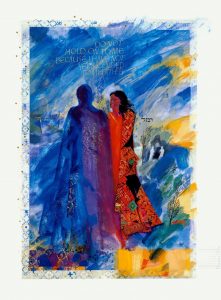
Canticle of Mary
Click to enlarge.

Mary’s Magnificat, also known as Mary’s song, is a beautiful song the young handmaid of the Lord recited when she visited her cousin Elizabeth. Elizabeth herself was pregnant with John the Baptist. As we gaze upon the words in the simple imagery, let us bring to mind who Mary was. Catholics around the world share in one way or another a great devotion to the Mother of God. She is often seen as a queen, gentle, humble, and quiet. While all these qualities are true, I want you to imagine Mary of Nazareth. A young woman who faced trials and joys. Imagine the feelings she first had when the Angel appeared to her revealing that she was chosen to be the Mother of God.

Many scholars would agree that these words that come from Mary’s mouth are the first direct characterization of God in the gospel of Luke. We can look at the words written in gold as a way of understanding Mary’s experience of God. That she was lowly and God raised her up. God is one who fills the hungry with good things. This is how Mary experienced God. The letters written in gold should set a reminder for us, that is through our experiences of our encounter with one another and creation, we come to encounter God who is found in all things. We must also remember that “Mary is truly our sister” as Pope Paul VI would say. She reminds us with her words that God is ever mindful of the mercy promised. At the same she teaches us to be bold and courageous in our life of faith.

This commentary was contributed by James Gumataotao, a senior Theology major and a member of the Library’s Research Desk team.

Filed Under: Saint John's Bible

Primary Sidebar

Contact

Clark Library
503-943-7111
800-841-8261
reference@up.edu

Recent Posts

  • New Image: Luke Anthology
  • New Image: Birth of Christ
  • New Image This Week: Peter’s Confession
  • New Image This Week: The Beatitudes / Sermon on the Mount
  • Image change this week: Multiplication of the Loaves and Fishes

Subscribe by Email

Completely spam free, opt out any time.

Please, insert a valid email.

Thank you, your email will be added to the mailing list once you click on the link in the confirmation email.

Spam protection has stopped this request. Please contact site owner for help.

This form is protected by reCAPTCHA and the Google Privacy Policy and Terms of Service apply.

Archives

  • January 2023
  • December 2022
  • November 2022
  • October 2022
  • May 2022
  • April 2022
  • March 2022
  • December 2021
  • November 2021
  • October 2021
  • September 2021
  • August 2021
  • October 2019
  • April 2017
  • March 2017
  • February 2017
  • December 2016
  • November 2016
  • October 2016
  • September 2016
  • June 2016
  • December 2015
  • November 2015
  • September 2015
  • July 2015
  • April 2015
  • March 2015
  • February 2015
  • January 2015
  • November 2014
  • October 2014
  • July 2014
  • April 2014
  • March 2014
  • February 2014
  • January 2014
  • December 2013
  • November 2013
  • October 2013
  • September 2013
  • August 2013

Categories

  • General
  • Saint John's Bible

Meta

  • Log in
  • Entries feed
  • Comments feed
  • WordPress.org

Copyright © 2025 · News Pro with Full Header On Genesis Framework · WordPress · Log in