• Skip to main content
  • Skip to primary sidebar

Saint John's Bible

Archives for November 2013

Chameleon. Artist: Chris Tomlin.

November 22, 2013 By Heidi

Chameleon at end of Historical Books volume
Click the image to view a larger version.

Happy Thanksgiving! As this chameleon appears to be giving thanks for the existence of flies, so we now enter into the season of giving thanks for all of our blessings, and of enjoying the fruits of the harvest.

The Saint John’s Bible contains many images of animal life: the butterfly wings in the Jacob’s Ladder illumination and Ecclesiastes frontispiece, and the coral snake and harlequin shrimp in the Garden of Eden illumination, are just a few examples from the art that has been on display in the library so far.

This chameleon enlivens the last page in the Historical Books volume, at the end of 2 Maccabees. A few words for the benefit of people not familiar with the Bible: 1 and 2 Maccabees relate the history of Israel, as do the other historical books, but they are available in Greek manuscripts only and are therefore part of the “deuterocanon,” i.e. “second canon,” not traditionally part of the Jewish or Protestant collections of Old Testament literature. They do appear in Orthodox or Catholic collections, however, and thus are included in The Saint John’s Bible. While some Bibles place the 7 deuterocanonical books between the Old and New Testaments, The Saint John’s Bible arranges them according to their placement in the Catholic version of the Old Testament.

The chameleon’s presence has a fanciful origin, according to Susan Sink in The Art of The Saint John’s Bible. Like many writers, the author of 2 Maccabees had difficulty writing a conclusion to his story. Note that in his final verses he announces the story’s end twice:

[37] This, then, is how matters turned out with Nicanor. And from that time the city has been in the possession of the Hebrews. So I too will here end my story.
[38] If it is well told and to the point, that is what I myself desired; if it is poorly done and mediocre, that was the best I could do.
[39] For just as it is harmful to drink wine alone, or, again, to drink water alone, while wine mixed with water is sweet and delicious and enhances one’s enjoyment, so also the style of the story delights the ears of those who read the work. And here will be the end.

“Given such a playful and colorful ending,” says Sink, “Donald Jackson could not resist including one more image.” (vol. 3, p.71) Enjoy, and best wishes for a restful Thanksgiving vacation.

Filed Under: Saint John's Bible

Jacob’s Ladder. Donald Jackson, with contributions by Chris Tomlin.

November 13, 2013 By Heidi

Jacob's LadderAngels ascend and descend a golden ladder, dwarfing a blue human figure. God is making contact with the figure, Jacob, and through him continuing the covenant that began with Abraham and Isaac, renaming him Israel and promising that Jacob’s sons will lead the 12 tribes of Israel.

In Illuminating the Word: The Making of the Saint John’s Bible, Christopher Calderhead quotes Donald Jackson: “I wanted [this vision] to be surreal, shining things and light, with dawn about to break.” (p. 165). Calderhead further reports that this illumination represents artistic integrity. The Committee on Illumination and Text, which provided Jackson with theological and historical background for each illumination, had

mentioned in passing a common monastic image from the Middle Ages — the Ladder of Perfection, depicting monks mounting upwards toward their heavenly goal as some fall to their doom. They compared this admonitory image to the Jacob story. (p. 165)

According to this view of the story, some angels would fall while others rose to heaven, but Jackson “stuck to his guns” and decided that the story was not about separating the good from the bad, but rather a moment when heaven and earth were momentarily joined.

The butterflies are an apt analogy for angels, Jackson felt, because of their “enormous rarity! They are beautiful, full of grace, and very mysterious…You bat your eyelid and the butterfly is gone” — a fleeting vision, just as Jacob’s vision was momentary. Moreover, “[Butterflies] have such life-will…their incredible fragility contrasts with the thousands of miles they travel on their yearly migrations.” (p. 166)

The lacy pattern of gold against which the butterflies appear is a textile print, acrylic medium applied to a crocheted material.

Filed Under: Saint John's Bible

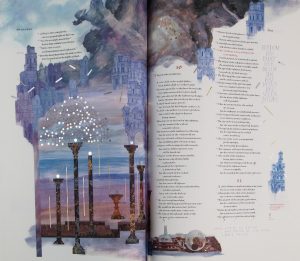
Seven Pillars of Wisdom. Artist: Donald Jackson.

November 6, 2013 By Heidi

Proverbs 9 begins, “Wisdom has built her house,  she has hewn her seven pillars.” That verse is unfortunately not visible on this page, but we do see Wisdom’s pillars, of varying heights and widths. Fabric and lace render marble veins, and each pillar is topped with a pearl (of wisdom?), “a precious thing of beauty created by mysterious processes,” suggests Susan Sink in The Art of the Saint John’s Bible, vol. 2, p. 24. The pearls appear to have descended from the stamp just about them, with an echo in the swirling clouds — the same stamp we saw in the Revelation Frontispiece, based on a piece of cloth from India that was embroidered and appliquéd with mirrors.

The chapter continues, “She has slaughtered her animals, she has mixed her wine,  she has also set her table.” Note that the artist has provided a set table, spread with wine but bread substitutes for meat. This and verse 5 of the chapter, “Come, eat of my bread and drink of the wine I have mixed,” could be seen as a connection between Wisdom and Christ, in making the viewer think of Christ’s invitation to “take this bread” and “drink this wine, and the fellowship of the Eucharistic prayer (Sink, vol. 3, p. 25).

A whole village of buildings appears to sprout from one of the pillars, including apparently a “monochromatic green drawing of the dome of the church at Saint Benedict’s Monastery (Sink, vol. 3, p. 24),” a sister site to Saint John’s Monastery. This also is echoed in the passage’s next verse: “She has sent out her servant-girls, she calls from the highest places in the town.” Faint architectural images vanish into the clouds above; wisdom remains while man’s creations subside.

For all engaged in life-long learning and dedicated to a mindful life, Proverbs 9:6 is especially apt: “Lay aside immaturity, and live, and walk in the way of insight.”

Filed Under: Saint John's Bible

Primary Sidebar

Contact

Clark Library
503-943-7111
800-841-8261
reference@up.edu

Recent Posts

  • New Image: Luke Anthology
  • New Image: Birth of Christ
  • New Image This Week: Peter’s Confession
  • New Image This Week: The Beatitudes / Sermon on the Mount
  • Image change this week: Multiplication of the Loaves and Fishes

Subscribe by Email

Completely spam free, opt out any time.

Please, insert a valid email.

Thank you, your email will be added to the mailing list once you click on the link in the confirmation email.

Spam protection has stopped this request. Please contact site owner for help.

This form is protected by reCAPTCHA and the Google Privacy Policy and Terms of Service apply.

Archives

  • January 2023
  • December 2022
  • November 2022
  • October 2022
  • May 2022
  • April 2022
  • March 2022
  • December 2021
  • November 2021
  • October 2021
  • September 2021
  • August 2021
  • October 2019
  • April 2017
  • March 2017
  • February 2017
  • December 2016
  • November 2016
  • October 2016
  • September 2016
  • June 2016
  • December 2015
  • November 2015
  • September 2015
  • July 2015
  • April 2015
  • March 2015
  • February 2015
  • January 2015
  • November 2014
  • October 2014
  • July 2014
  • April 2014
  • March 2014
  • February 2014
  • January 2014
  • December 2013
  • November 2013
  • October 2013
  • September 2013
  • August 2013

Categories

  • General
  • Saint John's Bible

Meta

  • Log in
  • Entries feed
  • Comments feed
  • WordPress.org

Copyright © 2026 · News Pro with Full Header On Genesis Framework · WordPress · Log in